Televisor Kit Build · Volume 1
The Kit, and What It Actually Is
A box roughly the size of a large hardback — 260 by 195 by 70 millimetres — arrives containing a plastic chassis, a printed circuit board, a small direct-current motor, a disc, and a compact disc with about twenty-five minutes of video on it. Assembled, it is a working television receiver of the kind that went out of broadcast service in 1935. It runs on four AA cells. It has no HDMI socket, no tuner, no screen in any sense a modern reader would recognise, and the picture it produces is about the size of a postage stamp. It is also, on the manufacturer’s own claim, “the only mechanical TV in regular production” — a claim phrased as a question on the product page, and one this volume takes seriously enough to examine rather than repeat.
This deep dive documents that kit: what it is, how it works, how to make it show something, and what it might eventually live inside. It is written before the kit has been built. The unit documented here has been ordered and not yet assembled, and that fact governs the whole series: the volumes that follow describe mechanism, standard, tooling and intent, and they say plainly where description ends and plan begins. Nothing in these pages narrates a build that has not happened. Where a step is known only from the documentation of others, it is attributed to them.
1.1 The First Question: Spinning Disc, or a Panel of Lights?
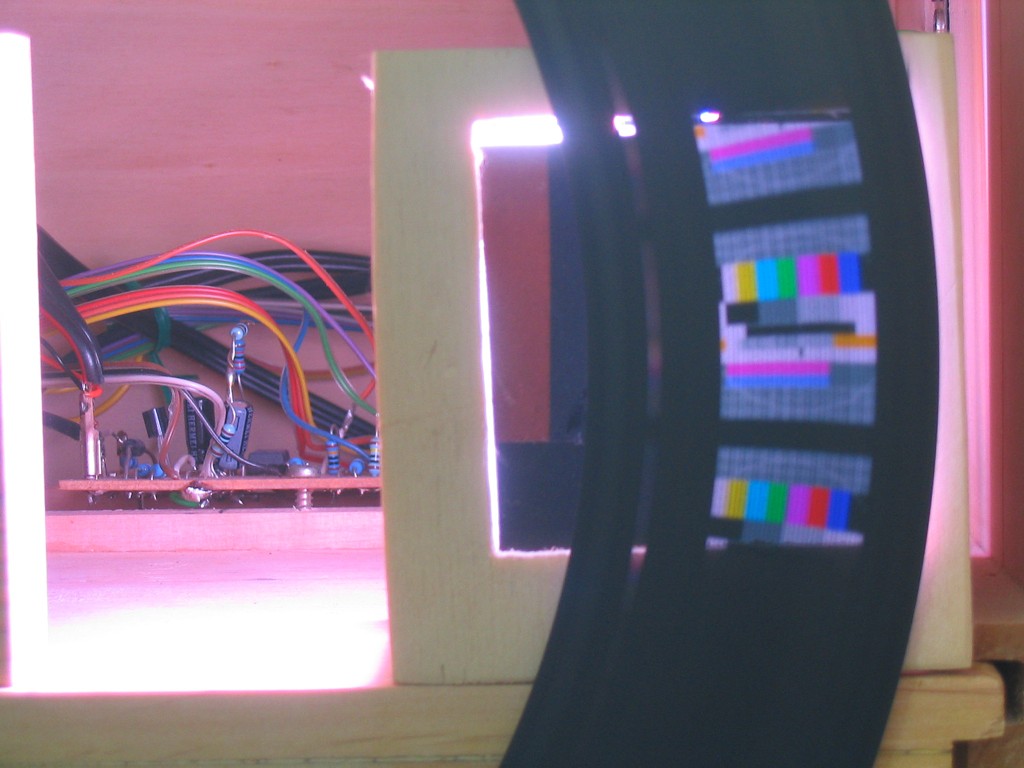
The scoping notes for this dive flagged one thing as unverified and important: whether this kit is a genuine mechanical television with a rotating Nipkow disc, or a solid-state imitation — a 32-line picture painted on an LED matrix, dressed in a period case. The distinction is not cosmetic. A matrix display would make the kit an emulator of mechanical television; a disc makes it an instance of it. Everything in the volumes that follow — the sync mechanism, the safety guard, the reason the picture is dim, the reason a cabinet needs ventilation and a removable disc — depends on which of those two the object is.
It is a disc. Four independent lines of evidence agree, and none of them is the manufacturer’s marketing copy.
The first is the Narrow-Bandwidth Television Association’s own discussion forum, where club members have troubleshot this specific kit at length. The advice given there is only meaningful for a physical disc: that the disc should run “almost flat”; that it frequently arrives around two millimetres off centre, with an awkward curl, and occasionally parts company with its hub because the adhesive is inadequate; that the disc must keep a consistent distance from the optical sensor or the sensor’s output amplitude wanders; and that a paper “stroboscope” disc must be kept clear of that sensor. None of those failure modes exists in a display with no moving parts.
The second is the retail description from Grand Illusions, which stocks the same kit and describes the assembly directly: the Nipkow disc requires care in placement to avoid fouling the sync sensor, and its rotation speed needs “some tweaking”. It explicitly credits the spinning disc with providing “the horizontal needed to see the image”.
The third is a builder’s account on a vintage-television forum describing the kit as “a plastic true-to-form copy in miniature of the Baird Televisor”, complete with an onboard test chart, and noting that two hardware revisions exist — an older board with conventional components standing proud of the motor board, and a newer design that moved subminiature surface-mount parts onto the disc side of that board.
The fourth is the Hackaday article covered in Vol 6, which describes the same kit as working on the Nipkow principle: a flat disc with a spiral of holes converting one lamp’s brightness variations into a monochrome image.
So the answer is settled, and it is the more interesting of the two answers. The doubt was reasonable — the modern hobby does build solid-state NBTV monitors, including LED-matrix panels and repurposed cathode-ray tubes, so a “32-line display” in a product listing genuinely could have been either. It is worth recording that the question was open and how it closed, because a reader coming to this dive from the product page has no way to tell from that page alone.
1.2 Where the Kit Came From
The kit has a history longer than its current listing suggests. The NBTVA’s own news page identifies it as “The Televisor Kit of the Middlesex University Teaching Resources (MUTR), now named Mindsets Online” — that is, the product began life as a university teaching resource, and the supplier was renamed rather than the kit reinvented. The association’s technical handbook carries a chapter on it, listed in the handbook contents as “MUTR miniature Televisor kit”, sitting between a chapter on sync-separator boards and one on the club’s own compact discs.
That chapter is not among the handbook chapters the association publishes on the open web. Its neighbours — the beginner’s construction chapter, the standards chapter, the chapter on typical NBTV equipment — are freely readable; this one is print-only, available in the purchasable handbook. This is worth stating rather than glossing, because it means the most authoritative single description of this kit was not available to this research pass, and some questions in Vol 8 remain open only for that reason.
The current listing prices the kit at £53.94 including VAT (£44.95 excluding), under product code NMP-003, and showed as “Awaiting stock (can be ordered now)” at the time of writing. The same kit appears elsewhere at a substantially higher price — Grand Illusions lists it at £90 — which is ordinary retail spread rather than a different product.
1.3 What Comes in the Box
The manufacturer’s page is unusually thin on specifics: it gives size, battery requirement, price and a one-paragraph description, and no parts list, no line count, no technical specification, and no linked manual. That absence shapes this dive. Almost everything technical in the volumes that follow is sourced from the NBTVA — the club standard, the construction literature, the forum — rather than from the vendor, and where a detail is known only from a builder’s account it is credited as such.
What can be established with confidence about the contents:
- A chassis and case in plastic, styled as a miniature of Baird’s own Televisor, roughly 260 × 195 × 70 mm assembled.
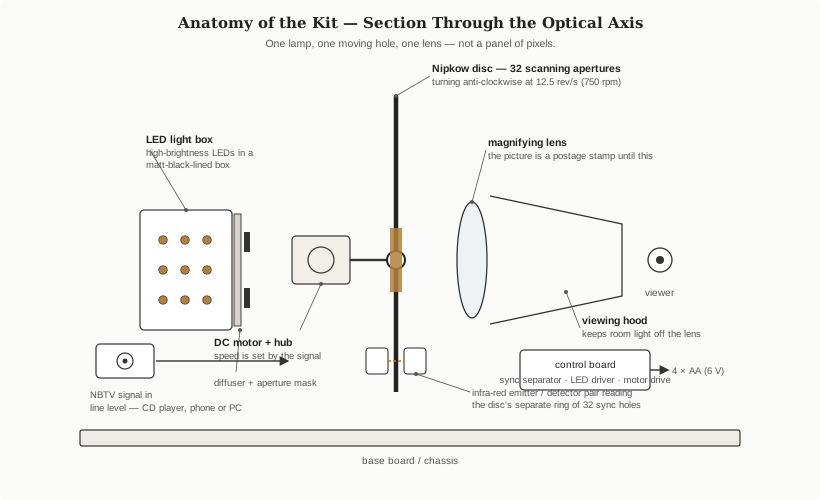
- A Nipkow disc carrying a spiral of 32 scanning apertures plus a separate ring of synchronising holes, described by builders as arriving imperfectly flat and sometimes off-centre.
- A small brushed DC motor, running from the kit’s 6-volt supply, coupled to the disc.
- An optical sensor assembly — an infra-red emitter and detector reading the sync ring.
- A control board carrying the sync separator, the lamp driver, and a phase-comparator loop built around the CD4046, with at least one user-adjustable preset (a potentiometer identified in forum discussion as R7) setting signal amplitude.
- An LED light source behind the disc, with a diffuser — in this design an LED does the job Baird’s neon plate did.
- An onboard test card, which will display without any external signal at all and is therefore the first thing to look for at switch-on.
- A compact disc carrying approximately twenty-five minutes of 32-line NBTV video, to the NBTVA club standard.
- Power from four AA cells, giving the nominal 6 volts the motor and board expect.
1.4 The Strange Part: the Video Arrives as Sound
The single most surprising thing about this kit is on the product page in plain language, easy to read past: “TV footage is encoded on a CD included in this kit. Simply plug the televisor into a CD player and play the CD to view the footage.”
That is not a simplification or an analogy. The video signal for a 32-line NBTV picture fits inside an audio bandwidth — the association’s published standard specifies 2 Hz to 10 kHz at −3 dB — which means the entire moving picture can be carried as an ordinary audio waveform, recorded on an ordinary audio CD, and delivered down an ordinary audio cable. The club’s discs are not CD-ROMs. They are normal audio CDs, and the association is explicit that they should be played in a hi-fi CD player, with the left channel carrying the picture and the right channel carrying sound.
Every later volume in this dive follows from that fact. Because the signal is audio, a modern computer can generate it with a sound card and no special hardware whatsoever (Vol 5). Because it is audio, an existing video clip can be converted into a wave file and played from a phone, a memory card or a CD (Vol 4). Because it is audio, it can be transmitted over an amateur radio channel, which is how club members have exchanged pictures for fifty years. And because it is audio, it is also vulnerable to being treated as audio by software that assumes nobody is looking at it — which is why the standard forbids lossy compression outright, a point Vol 4 returns to with some force.
1.5 What This Kit Is Not
Three honest limitations, stated at the outset rather than discovered in Vol 8.
It is not high fidelity, and cannot be made so. Thirty-two lines is thirty-two lines. The picture is portrait-format, at a 3:2 height-to-width ratio, and a scene with more than one person in it will not read. The subject matter that works is the subject matter that worked in 1930: a face, close up, well lit. A builder on one forum, having got the kit working from broadcast television, put it exactly right — anything mostly close-ups or waist-up shots is watchable, and nothing else is.
It is not entirely benign. The disc spins at twelve and a half revolutions per second — 750 rpm — and the NBTVA’s own construction literature does not hedge about this: a high-speed spinning disc is inherently dangerous and may cause serious injury if accidentally touched during operation, and the association strongly advises fitting a protective cover. That advice is written for the club’s own larger 12-inch designs, and this kit is a much smaller machine, but the principle scales down and the cabinet design in Vol 7 treats a guard as a requirement rather than a feature. There is a second, less obvious hazard: the ultra-bright LEDs used as light sources in NBTV monitors are, in the club’s own words, strong enough to injure eyes when viewed without a diffuser.
It is not a solved, turnkey device. Builders report discs off-centre, discs separating from hubs, sync circuits that lock too fast to control, vertical framing exactly half a frame out, and playback sources whose signal polarity is the wrong way up. None of these is a defect in the sense of a broken part; they are the ordinary adjustment surface of a machine that has to hold a physical object in step with a waveform. Vol 8 turns that list into a commissioning order.
1.6 How This Dive Is Organised
Eight volumes, arranged so that a reader can stop at the point their interest stops.
Vols 1–2 — the object. This volume establishes what the kit is and where it came from. Vol 2 takes it apart conceptually: the disc’s two rings of holes, the phase-locked loop that drags the motor into step, the light path, and why the picture is small and dim.
Vol 3 — the signal. The NBTV standard as the kit expects to receive it, verified line by line against the association’s own published standard: line count, frame rate, scan directions, aspect ratio, voltage levels, sync, bandwidth. This is the volume to read before connecting anything.
Vols 4–5 — making it show something. Vol 4 covers converting existing video into a playable NBTV wave file, centred on Gary Millard’s video2nbtv and the association’s own documented workflow. Vol 5 covers driving the kit live from a computer, the nbtv-design-tools package, sound-card output, levels and sync trim, and where the builder’s own code will live.
Vol 6 — a worked example. A published reference build in which someone played a video game on one of these kits, what the approach teaches about generating a signal, and one factual error in the coverage worth correcting.
Vols 7–8 — intent and commissioning. Vol 7 sets out the design of a steampunk cabinet to house the finished kit: materials, joinery, brass, ventilation, the viewing hood, and the disc guard — a plan, explicitly not a build. Vol 8 is the commissioning order, the reference tables, and an honest list of what remains unknown.
1.7 Cross-References
- The history this kit is a descendant of — Nipkow’s 1884 patent, Baird’s Televisor, the 30-line BBC service — is covered in the companion Mechanical TV Deep Dive on this site, especially its Vols 3, 5 and 6.
- The founding of the NBTVA, why the club settled on 32 lines rather than Baird’s 30, and what members build today are covered in that dive’s Vol 11.
- The NBTV signal in its general form, independent of any particular receiver, is set out in that dive’s Vol 12; Vol 3 of this dive covers the same standard from the point of view of a specific machine that has to be fed.
- Disc optics, aperture geometry and the brightness trade-off in depth: that dive’s Vol 13.
- Software the builder writes for this kit — signal generation, a live bridge, sound-card tooling — belongs in this project’s
code/software/directory, not in these volumes; see Vol 5.
Comments (0)