Mechanical TV Deep Dive · Volume 1
Introduction & Orientation
Somewhere in a rented room in Hastings around 1924, a sickly, half-bankrupt Scottish engineer sat over a contraption of darning needles, bicycle-lamp lenses, a cardboard scanning disc, and a framework improvised from a hatbox and a tea chest, turned by a small electric motor. He coaxed it into transmitting a crude, flickering shape; then, evicted after a short circuit, he carried the apparatus to an attic at 22 Frith Street in Soho, London — and it was there, in 1925, that a refined version produced the first television picture anyone had ever seen: a recognisable, moving, grey-scale human face, formed by a scanning disc pierced with a spiral of holes turning in front of a photocell and, at the far end of a wire, a neon lamp. It was not a metaphorical breakthrough. It was a literal spinning wheel with holes cut in it, decomposing a face into a stream of electrical pulses finer than the persistence of the human eye could separate, and reassembling it, pulse by pulse, as a glowing picture a few inches wide. That wheel is where this entire deep dive begins, and where — a century later, in sheds and workshops of hobbyists who never stopped building it — it has never entirely stopped turning.
1.1 A Machine Made of Light and a Spinning Disc
Mechanical television is, at its most basic, an old and slightly strange answer to a young question: how do you send a picture, rather than a sound, down a wire or through the air? The answer that made it work, first proposed in principle in 1884 and first built into a working set forty years later, was to stop treating a picture as a picture at all. Instead, a rotating disc — pierced near its edge with a single-turn spiral of small apertures — is placed in front of the scene to be transmitted. As the disc spins, each aperture in turn sweeps a narrow strip across the image, and a photocell behind the disc registers only the brightness of whatever tiny sliver of the scene that aperture happens to be passing over at that instant. One complete revolution of the disc sweeps every aperture across its own strip of the picture, and the photocell’s output — a continuously varying electrical voltage — becomes, for that fraction of a second, the entire image, flattened into a single wandering thread of brightness values. Do this fast enough, and reverse the process at the far end — a second synchronised disc spinning in front of a lamp that brightens and dims in step with the incoming signal — and the eye, unable to follow the individual flickers, perceives a continuous moving picture. It is a genuinely strange thing to grasp the first time: an entire two-dimensional scene, at any given moment, is being carried as nothing more than one number changing very quickly. That single insight — that a picture could be serialised into a signal and then faithfully rebuilt — is the whole of mechanical television’s founding idea, and every volume that follows is, in one way or another, an elaboration of it.
1.2 The Televisor and Its Place in the Story
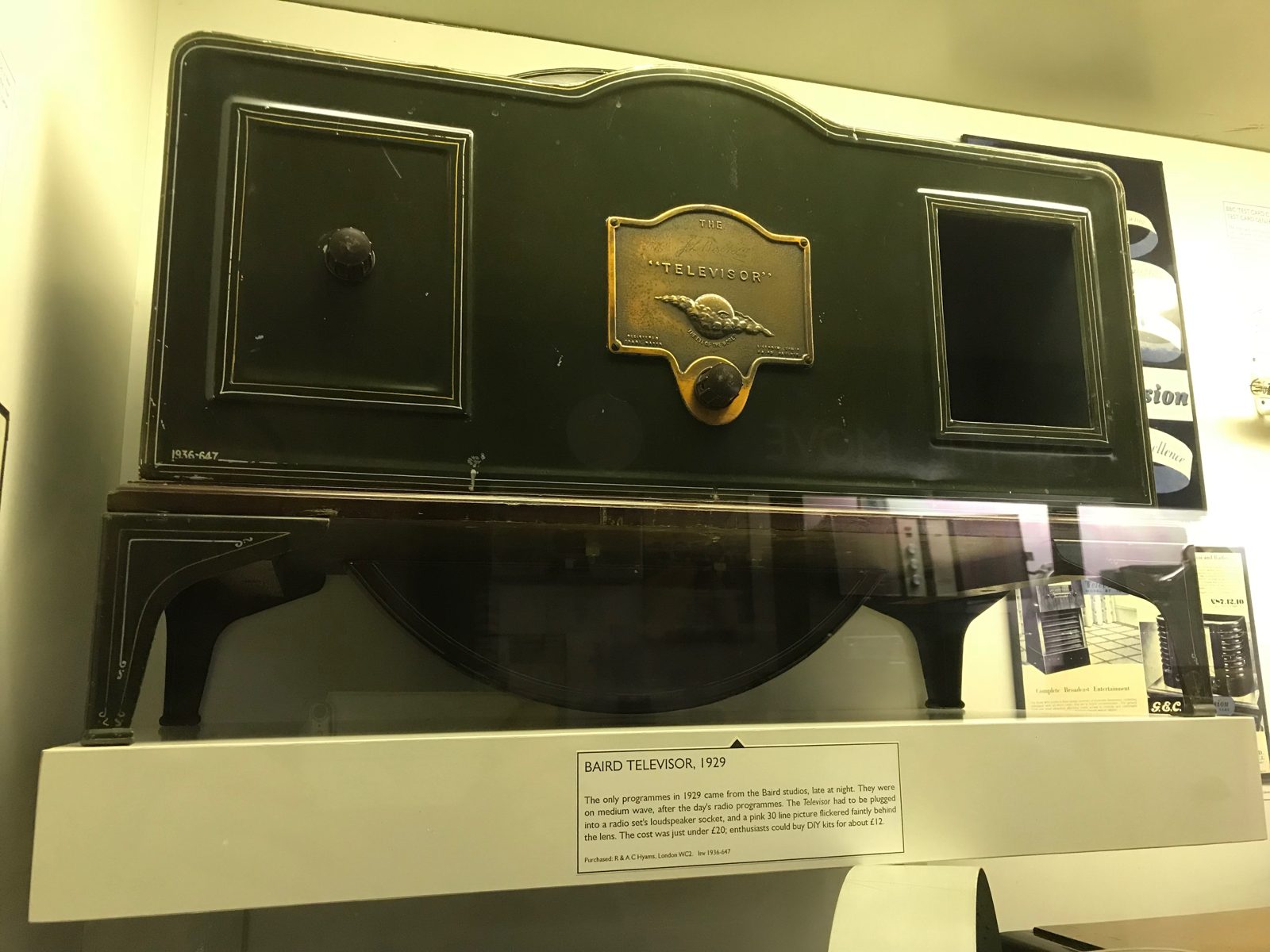
The specific machine at the centre of this series is the Televisor — the trademarked name John Logie Baird gave to the mechanical television receiver his company began selling to the British public in 1930. The Televisor was not the first apparatus to embody the scanning-disc principle, and Baird was not the only engineer racing to build one in the mid-1920s; but it was the Televisor, arriving in roughly a thousand British sitting rooms at around £18–26 apiece, that made television a purchasable domestic object for the first time anywhere in the world, tuned to the BBC’s own 30-line broadcasts between 1929 and 1935. Everything this series covers before that point — the nineteenth-century curiosity about seeing at a distance, the discovery that selenium’s conductivity responds to light, Paul Nipkow’s unbuilt 1884 patent for a scanning disc — is the prehistory that made the Televisor possible. Everything the series covers after that point — the rivals racing alongside Baird, the six years of BBC broadcasting the Televisor received, the colour and large-screen experiments that pushed the disc past its comfortable limits, and the electronic cathode-ray technology that replaced it entirely by 1937 — is the story of what the Televisor set in motion and what became of it. And the final third of this series is not history at all: it is an account of a hobby, the Narrow-Bandwidth Television Association, that has kept the scanning disc spinning, quite literally, for half a century after broadcasters abandoned it — building working receivers today from parts costing a few tens of pounds, to a modern standard that is a direct, deliberate descendant of the one the Televisor used.
1.3 Two Ways to Scan: The Disc and the Electron Beam
It is worth being precise, this early in the series, about a distinction that causes real confusion: mechanical television and the cathode-ray tube that eventually replaced it are not opposites. They are two different implementations of the same underlying idea — sequential scanning — built from entirely different physical means. In a mechanical system, an aperture or a mirror facet, cut into a spinning disc or drum, physically moves through the light path to decompose the scene line by line and, at the receiving end, physically moves again to paint the picture back together in front of a lamp. The motion is real, mechanical, and geometric: a hole tracing a spiral path, a motor holding that path to precise time. In an electronic system, no aperture moves at all. Instead, a beam of electrons — steered by electromagnetic or electrostatic fields inside an evacuated glass tube — sweeps across a photosensitive surface at the camera and a phosphor-coated screen at the receiver, tracing out exactly the same line-by-line raster that a Nipkow disc traces mechanically, but doing it with a beam that can be redirected essentially instantly rather than a wheel that has to be physically spun and rebalanced. Both approaches decompose a two-dimensional image into a one-dimensional, time-varying signal, transmit that signal, and reconstruct the image from it in synchrony. The disc and the electron beam are, in this precise sense, the same idea wearing two different coats — one built from spinning metal and glowing gas, the other built from vacuum and magnetic fields — and it was the electron beam’s freedom from mechanical limits, not some entirely different principle, that let it scan faster, sharper, and brighter than any disc ever could. (Vol 10 tells that transition in full; this paragraph is the whole of what a reader needs to carry forward until then.)
1.4 Why a Sixteen-Volume Deep Dive
It would be reasonable to ask why a device that vanished from broadcasting in 1937, replaced by a technology every reader has actually owned, deserves sixteen volumes of attention. Three reasons, each sufficient on its own. First, this is the origin of television as such — not a footnote to the medium’s history but its literal starting point, the first machine that ever put a moving, recognisable human face on a screen anywhere in the world, and every subsequent television technology, mechanical or electronic, inherited its central idea of sequential scanning from exactly the apparatus this series describes. Second, mechanical television is not actually extinct: it is a living, practiced hobby, maintained continuously since 1975 by an international club that still holds an annual convention, still publishes a quarterly newsletter, and still sells the parts for a working scanning-disc receiver to anyone who asks — which makes this series, unusually for a history project, a living-technology field guide as much as a historical account. Third, and most concretely, it is a buildable machine: unlike almost any other landmark technology from the 1920s, a determined reader with a workbench, a soldering iron, and a few tens of pounds can build a working example of the actual thing this series describes and watch a picture assemble itself, line by line, in real time. Few chapters of technological history offer a reader that much to actually do with what they have read.
1.5 How to Read This Series
The sixteen volumes are organised as a chronological spine with focused thematic volumes hung off it, and a reader is welcome to follow the spine from Vol 2 straight through to Vol 16, or to jump directly to whichever cluster answers the question that brought them here. The series breaks down into six clusters:
Origins and theory (Vol 2–4). Seeing at a Distance (Vol 2) traces the idea back before any working machine existed — persistence of vision, the 1873 discovery that selenium’s electrical resistance responds to light, and the earliest, unbuilt “telectroscope” proposals of the 1870s and 1880s. Nipkow’s Disc (Vol 3) is the single most important theoretical volume in the series: Paul Nipkow’s 1884 patent, which described the complete scanning-disc principle forty years before anyone built it, and the geometry of how a spiral of holes turns a two-dimensional scene into a one-dimensional signal. Theory of Operation (Vol 4) generalises that principle into the full physics and mathematics of scanning — frame rate, flicker, bandwidth, synchronisation — that every later volume assumes a reader already understands.
Baird and the hardware (Vol 5–6). John Logie Baird & the First Television (Vol 5) is the human story: a sickly, resourceful engineer’s path from a Hastings attic to the first tonal television image in 1925 and the first public demonstration in 1926, and how “Televisor” became a brand people could buy. Inside the Baird Televisor (Vol 6) opens the cabinet itself — disc, motor, neon lamp, synchronisation circuitry, and the original 30-line standard’s exact parameters — as an engineering object rather than a historical figure.
Rivals, broadcast, and the fall (Vol 7–10). The Rivals (Vol 7) widens the frame to the other engineers — Jenkins in America, Mihály in Germany, Rosing in Russia, Takayanagi in Japan — who were building variants of the same idea at roughly the same time, and asks how much “who was first” can really be settled. The 30-Line Broadcast Era (Vol 8) covers the six years the Televisor actually had something to receive: the BBC’s own service, the lived experience of “Looking In,” and the extraordinary story of Phonovision, the world’s first television recordings, cut onto wax discs and only recovered by forensic signal processing sixty years later. Pushing the Limits (Vol 9) follows the mechanical principle as far as engineers could stretch it — colour, stereoscopic depth, cinema-sized screens — before it ran out of road. Why Electronic TV Won (Vol 10) is the hinge of the entire series: the rise of the camera tube and the cathode-ray display, the head-to-head trial at Alexandra Palace in 1936–37, and the decisive, well-earned victory of an entirely different scanning technology.
The modern revival: NBTV, its signal, and its engineering (Vol 11–13). The Modern Revival (Vol 11) tells how a hobby that refused to die became, in 1975, a formal international club — the Narrow-Bandwidth Television Association — and why its modern standard settled on 32 lines rather than Baird’s original 30 (the answer, refreshingly, has nothing to do with technical superiority and everything to do with how easy 32 is to mark out on a disc with a compass). The NBTV Signal Explained (Vol 12) follows a single frame end to end through that standard’s audio-bandwidth waveform — the genuinely startling fact that a modern NBTV picture is, electrically, indistinguishable from a sound, and can be carried on a CD, a tape, or a radio signal without any special video circuitry at all. Optics, Discs & Mechanics in Depth (Vol 13) is the engineering deep-dive proper: disc geometry, aperture size, materials, motors, and the tolerances that separate a disc that resolves a picture from one that doesn’t.
Acquiring and building (Vol 14–15). Acquiring a Mechanical Television (Vol 14) is a deliberately honest market survey: what a genuine Baird Televisor actually costs when one surfaces (tens of thousands of pounds, at one specialist auction house, perhaps once every few years), and what is realistically buyable instead — parts, period radios, and modern club-built receivers costing a few tens of pounds. Restoration & Building (Vol 15) is the hands-on volume: two honest paths, conserving a genuine or partial period set versus building a working modern receiver from scratch, with safety, sourcing, and calibration covered for both.
Reference (Vol 16). Reference & Cheatsheet closes the series with the glossary, the side-by-side standards table (Baird 30-line against modern NBTV 32-line), the full timeline, and an index back into every volume above — the volume to bookmark rather than read start to finish.
A reader who wants the machine, not the history, can jump straight to Vol 6 and Vol 13. A reader who wants to actually build something can skip to Vol 11 through Vol 15. A reader who wants the story from the beginning should simply keep turning pages from here.
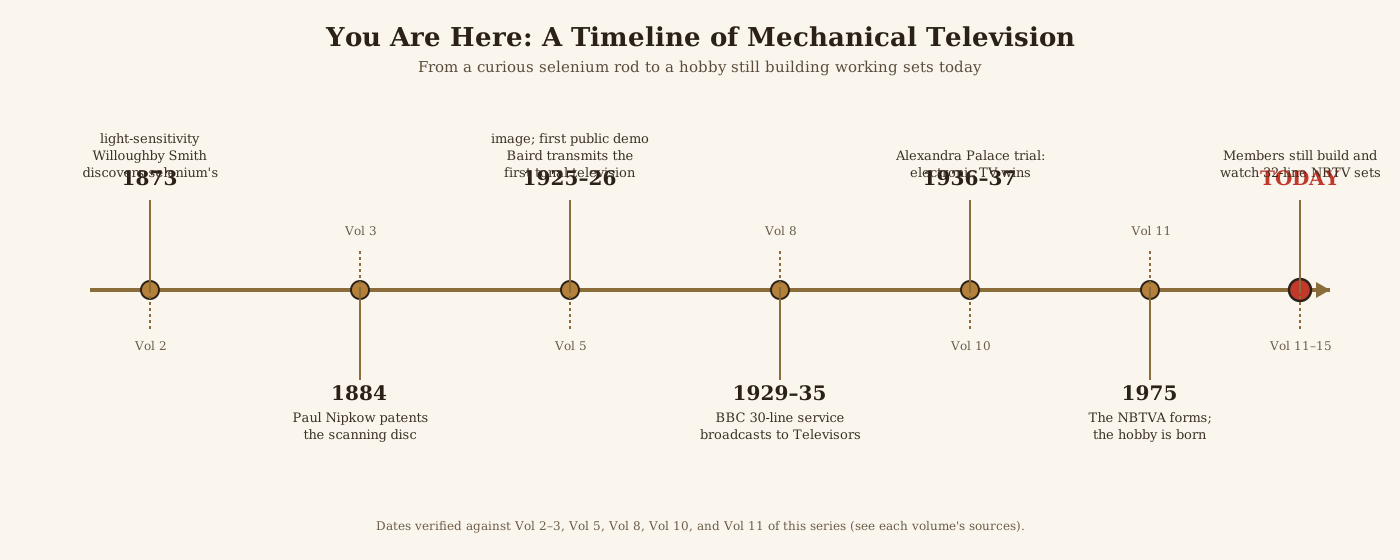
1.6 You Are Here: A Timeline
1.7 Cross-References
- The prehistory of the scanning idea — persistence of vision, selenium, and the earliest proposals for seeing at a distance — begins in Vol 2 — Seeing at a Distance.
- Paul Nipkow’s 1884 patent and the geometry of the scanning disc are covered in full in Vol 3 — Nipkow’s Disc (1884).
- The complete physics and mathematics of scanning — frame rate, bandwidth, synchronisation — is set out in Vol 4 — Theory of Operation.
- John Logie Baird’s life and his first television demonstrations are told in Vol 5 — John Logie Baird & the First Television; the Televisor’s internal engineering is dissected in Vol 6 — Inside the Baird Televisor.
- Baird’s contemporaries and rivals are surveyed in Vol 7 — The Rivals; the BBC’s broadcast era and Phonovision are covered in Vol 8 — The 30-Line Broadcast Era (1929–35); colour, stereoscopic, and large-screen experiments are covered in Vol 9 — Pushing the Limits.
- The rise of electronic television and the 1936–37 Alexandra Palace trial are the subject of Vol 10 — Why Electronic TV Won.
- The modern hobbyist revival, the NBTVA, and the 32-line standard are covered in Vol 11 — The Modern Revival: NBTV and the NBTVA; the modern signal itself is explained end to end in Vol 12 — The NBTV Signal Explained; the underlying optics and mechanics are covered in Vol 13 — Optics, Discs & Mechanics in Depth.
- The realities of acquiring a genuine or modern set are covered in Vol 14 — Acquiring a Mechanical Television; building or restoring one is covered in Vol 15 — Restoration & Building.
- A glossary, standards table, and full timeline appear in Vol 16 — Reference and Cheatsheet.
Comments (0)