Mechanical TV Deep Dive · Volume 7
The Rivals
The story of mechanical television’s invention is not a story with one protagonist. While John Logie Baird — cramped into his laboratory at 22 Frith Street in London — was pressing his way toward the first tonal television image in the autumn of 1925, other engineers in Washington, Berlin, St. Petersburg, and Hamamatsu were working on variants of the same fundamental idea. Some used different scanning geometries. Some combined mechanical scanning with electronic display. Some arrived earlier by certain measures, later by others. Who deserves the title of “first television inventor” depends entirely on what one decides to call television — and the question has never been settled to everyone’s satisfaction.
This volume introduces the principal rivals to Baird and maps the international landscape of early television development. It does not attempt to resolve the priority dispute; instead, it tries to lay out what each experimenter actually demonstrated, when they demonstrated it, and what those demonstrations did and did not achieve. The comparison table at the end of this volume gathers the key figures side by side.
7.1 Charles Francis Jenkins and the American Effort
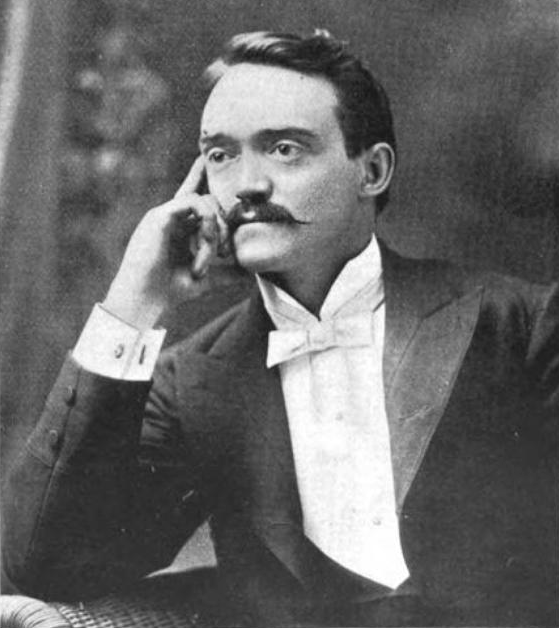
Charles Francis Jenkins was an American inventor with a long background in optical and electrical devices — he held patents for early motion picture projectors before he turned his attention to the problem of transmitting moving images by radio. His system used the term “Radiovision” for the transmission method and “Radiovisor” for the receiver that audiences and amateur experimenters would use to receive the signal.
On 13 June 1925, Jenkins transmitted a moving silhouette image from a naval radio station to his laboratory in Washington DC. The subject was a toy windmill — chosen specifically because its rotating blades would make motion unambiguous in the image. The technical parameters of his system at this point were 48 lines per picture at 16 pictures per second, using a lensed disc scanner rather than the simple perforated Nipkow disc. The image produced was a silhouette: the distinction between the dark shape of the windmill blades and the brighter background was conveyed, but not the intermediate tones — the gradations of grey — that give a face its features or a scene its depth.
Jenkins went on to establish W3XK, a dedicated “radiovision” broadcast station near Washington DC that conducted nightly transmissions of moving silhouette images. He offered the Radiovisor in kit form for home assembly, producing pictures approximately six inches square through a helical-aperture scanning drum and a neon lamp. The amateur construction community embraced the kit, and W3XK attracted a small but engaged audience of experimenters.
The Jenkins demonstration of June 1925 predates Baird’s public demonstration to the Royal Institution by some seven months, and it predates the Selfridges silhouette run of March 1925 by several months in terms of a transmitted (rather than publicly exhibited) moving image. On the specific question of silhouette television — can a moving shape be transmitted? — Jenkins has a legitimate claim to precedence in the United States context. On the question of tonal television — can a moving image with the full range of light and shadow that makes a face legible be transmitted? — his system did not cross that line in 1925 or 1926. The grey-scale threshold is the distinction that Baird crossed on 2 October 1925, and Jenkins did not match it in the same period.
Both accomplishments are real. They are answering different questions.
7.2 Dénes von Mihály and the Telehor
Dénes Mihály (7 July 1894 – 29 August 1953) was born in Hungary and moved to Germany, where he worked at AEG — Allgemeine Elektricitäts-Gesellschaft — in Berlin. He conceived of his “Telehor” system as early as 1919, initially as a means of transmitting still images at a distance; from 1924 onward, his experiments at AEG extended toward transmitting motion pictures.
The Telehor became a mechanical television system in the Nipkow disc tradition. Mihály eventually established Telehor AG in Berlin to commercialise the technology. His public demonstrations, however, came later than is sometimes assumed in popular accounts: secondary sources occasionally place Mihály in the 1925–26 pioneer cohort, but this is not supported by the evidence. His earliest confirmed public demonstrations of moving images fall in 1928. A cable transmission reportedly took place in early 1928; more significantly, the Telehor was demonstrated at the 5th Große Deutsche Funkausstellung (Berlin Radio Exhibition) in August 1928 — the same exhibition at which Paul Nipkow was publicly identified as the originator of the scanning disc principle. An additional confirmed demonstration occurred at the 1931 Berlin Radio Show, where Mihály’s system operated in both 30-line and 48-line variants at 10 frames per second.
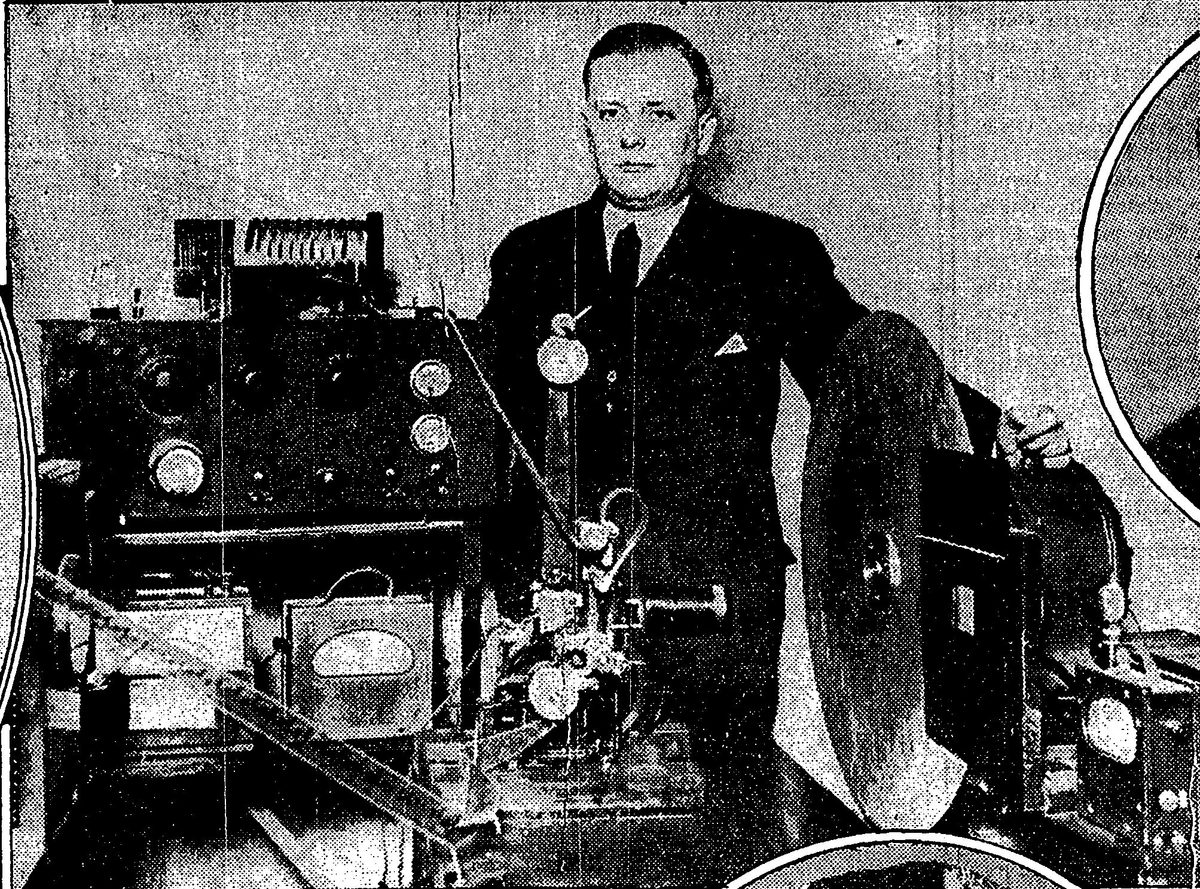
The 1929 New York Times photograph reproduced here shows Mihály with his television apparatus in Berlin, noting “Film Similar to That Used in Standard Motion Pictures” — a reference to a film-loop element in his scanning approach at that stage of the technology’s development.
Mihály was a serious and persistent experimenter whose contribution to German television development was real; he should not, however, be cited as a 1925–26 pioneer of moving-picture television on the basis of unverified claims. His confirmed public demonstrations place him in 1928, concurrent with — not prior to — the beginning of organised mechanical television broadcasting.
7.3 Boris Rosing and the Russian Line
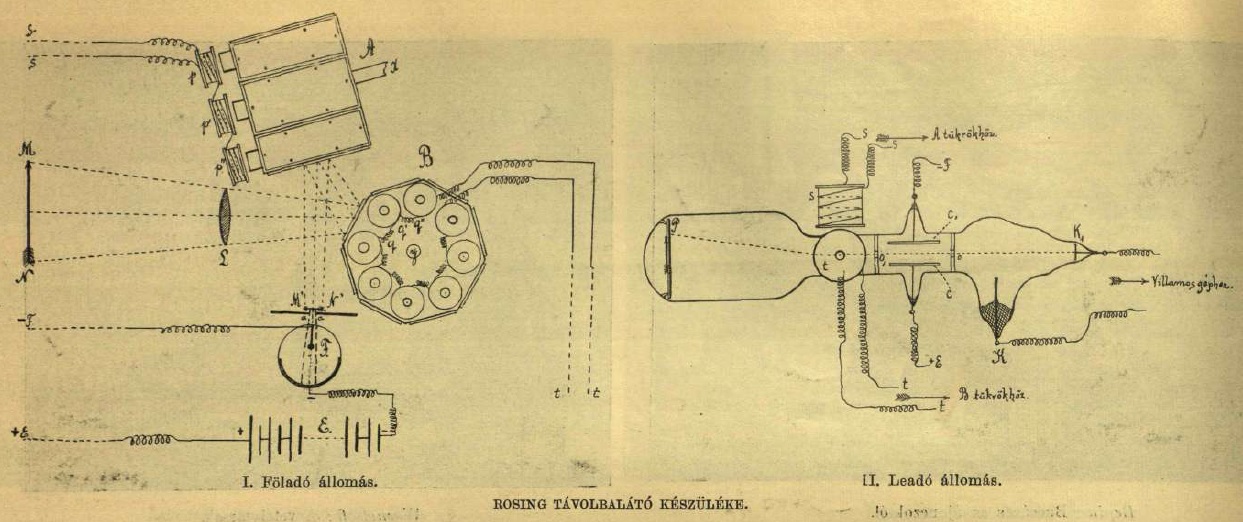
Boris Lvovich Rosing (1869–1933) was a Russian scientist whose contribution to early television sits in a category of its own. Where Jenkins and Mihály used mechanical scanning at both the transmitting and receiving ends of their systems — a Nipkow disc or equivalent to break the image into a signal, and a corresponding disc with a lamp to reconstruct it — Rosing proposed a fundamentally different architecture: a mirror-drum scanner at the transmitter combined with a cathode-ray tube (CRT) at the receiver. This hybrid approach made him an early pioneer of electronic display, not purely of mechanical television.
Rosing filed his patent for “A method of electrical transmission of images over a distance” in Germany on 26 November 1907, with UK and German patents granted in 1908–1909. In 1911, he demonstrated the system’s operation, transmitting simple black-and-white silhouettes of geometric shapes. The images were crude — the technology of the time could not yet resolve a face or a moving scene — but the principle was demonstrated: a mirror-drum scanner at the sending station swept a light beam across the subject, a photoelectric cell converted the reflected light into an electrical signal, and a Braun tube at the receiving station deflected an electron beam to trace the received signal onto a fluorescent screen.
The historical significance of Rosing’s work lies less in what he demonstrated in 1911 and more in the direction it pointed. The CRT receiver, in Rosing’s conception, was not merely an alternative to the neon lamp; it was a step toward an entirely electronic display, capable in principle of resolutions far beyond what any mechanical system could achieve. Rosing died in 1933, before electronic television reached its full development — but his student, Vladimir Zworykin, carried the CRT approach forward at RCA in the United States. Zworykin’s iconoscope camera tube and kinescope receiver, the systems that ultimately displaced mechanical television in the late 1930s, have their conceptual roots in the work Rosing was doing in St. Petersburg in the years before the First World War. That thread is picked up in Vol 10 of this series.
Rosing’s role in the television story is therefore that of a pivot: looking backward, he belongs to the generation of early experimenters who tried to make image transmission work with whatever technology was available; looking forward, his insistence on the CRT as a receiver placed him at the opening of a different, ultimately triumphant line of development.
7.4 Kenjiro Takayanagi and Japan
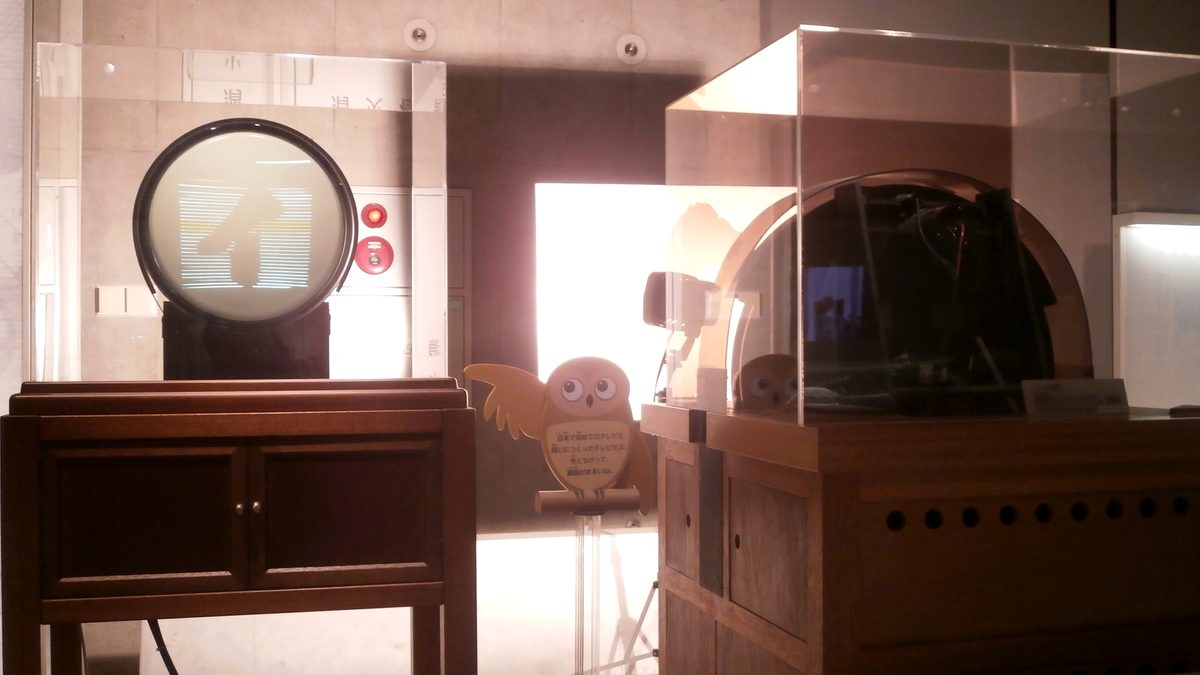
On 25 December 1926, at the Hamamatsu Industrial High School in Japan, Kenjiro Takayanagi demonstrated a television system that resolved to 40 lines and transmitted the Japanese katakana character イ. Takayanagi is known as “the father of Japanese television.” His system prototype is preserved at the Takayanagi Memorial Museum at Shizuoka University’s Hamamatsu campus.
The technical architecture of Takayanagi’s system is critical to understanding his place in television history: he used a Nipkow disc at the transmitter but a cathode-ray tube at the receiver. This makes him a hybrid pioneer — he inherited the mechanical scanning principle of the disc, but his display was electronic. The significance of the CRT receiver is that it was the first time a cathode-ray tube was used as a television receiver in a working demonstration. Where Rosing had proposed and demonstrated the concept in Russia from 1907 onward, Takayanagi’s 1926 demonstration is a confirmed instance of the hybrid approach operating with a higher line count and a more refined CRT display.
Takayanagi, like Rosing before him, understood that the mechanical receiver — the spinning disc in front of a neon lamp — was an inadequate endpoint for high-definition television. A CRT could respond far faster than a neon lamp behind a disc aperture, could display with higher brightness and sharper definition, and was not mechanically constrained by the physics of a spinning disc. His 1926 demonstration prefigured the direction the technology would take, while remaining within the Nipkow-disc tradition on the transmitter side.
The demonstrated 40-line resolution exceeds both the Jenkins 48-line (silhouette) and the Baird 30-line standards in line count, though the comparison must be made with care: Takayanagi’s character イ is a simpler subject than a human face, and line count alone does not determine image quality. What Takayanagi established on Christmas Day 1926 was not the best-quality image yet transmitted — that distinction in tonal terms belongs to Baird’s October 1925 work — but the first confirmed working demonstration of a CRT television receiver.
7.5 National Efforts: Germany, the Soviet Union, and Beyond
The development of mechanical television in the late 1920s and early 1930s was not confined to individual inventors. Several national efforts involved organisations, broadcast institutions, and state backing that gave the technology a different character from the improvised laboratory work of the earlier pioneers.
7.5.1 Germany: Fernseh AG and the Road to Broadcasting
Germany’s path toward organised mechanical television was consolidated on 11 June 1929 with the formation of Fernseh AG in Berlin — a joint-stock company that brought together four partners: Baird Television Ltd. (London), Robert Bosch (Stuttgart), Zeiss Ikon (Dresden), and D.S. Loewe (Berlin). The formation of Fernseh AG represents a significant moment in the internationalisation of mechanical television: Baird’s British technology was being licensed and developed by German industrial partners, giving Germany immediate access to an established system rather than requiring development from scratch.
Fernseh AG conducted Germany’s first mechanical television broadcasts in 1929. In August 1932 (a month given by Fernseh’s own corporate history), the company produced what is believed to be the first outside-broadcast (OB) television vehicle — a remote truck housing an intermediate-film camera that processed and transmitted moving pictures almost live from the field. The company’s broadcast operations came under state control in 1935, alongside the Fernsehsender Paul Nipkow — the world’s first regular public television service, named in honour of the scanning disc’s inventor and opened on 22 March 1935 (covered in Vol 10).
A separate strand of German experimentation in the mid-1920s came from Max Dieckmann and Rudolf Hell, who were working in Germany in 1925. Their system, however, was not a Nipkow-disc mechanical television: Dieckmann and Hell used an electronic image-dissector and cathode-ray tube (Braun tube) — a CRT-based approach on both sides. Dieckmann belongs in the history of early electronic television, not in the roster of mechanical-disc rivals. Listing him among the scanning-disc pioneers of 1925–26 would be a category error; his work was, if anything, closer to the Rosing line of development than to the Jenkins or Baird line.
7.5.2 The Soviet Union: Building on Rosing
Soviet television development was shaped from the outset by the work Rosing had done in St. Petersburg before the revolution. The Soviet state invested in television as a vehicle for demonstrating technological progress under the five-year plans, and Soviet engineers built their early experimental systems on the mechanical scanning-disc model.
The first Soviet experimental television transmissions took place on 29 April and 2 May 1931 from a laboratory in Moscow. The initial transmissions showed still photographs of well-known public figures rather than live moving pictures. Regular 30-line mechanical television broadcasts commenced on 1 October 1931, with the signal in principle receivable in Moscow and Leningrad. A concert broadcast from Moscow in November 1934 marked a further step in the development of Soviet television programming. By 1938, Soviet television had transitioned to electronic standards, with full-time test broadcasts beginning on 1 March 1938.
The Soviet mechanical television era was thus roughly parallel to the British one — both ran 30-line mechanical systems in the early-to-mid 1930s before transitioning to electronic television in the latter part of the decade.
7.5.3 Other Efforts
Secondary sources mention mechanical television experiments in various other countries — France, Italy, Hungary, and Japan (beyond Takayanagi’s work) — during the late 1920s and early 1930s. The details of these efforts have not been independently verified for this volume; readers who wish to pursue them should consult specialist histories of national broadcast development. What can be said in general terms is that the scanning-disc principle was never proprietary after Nipkow’s patent expired in the late 1890s, and any competent electrical experimenter with access to 1920s vacuum-tube technology could, and apparently did, attempt to build a working system.
7.6 Who Was First? The Question the Race Cannot Settle
The history of early television is haunted by the question “who invented it?” — a question that resists a clean answer because “television” is not one thing, and “invention” is not one event.
If television means the transmission of a moving silhouette image — distinguishing light areas from dark areas in motion — then Charles Francis Jenkins has a serious claim to precedence in the June 1925 timeline, and Baird’s Selfridges demonstrations of the same year are in the same category.
If television means the transmission of a moving tonal (grey-scale) image — reproducing the intermediate gradations of light and shadow that make a human face recognisable — then Baird’s 2 October 1925 demonstration stands as the confirmed first, and Jenkins’s system did not cross that threshold in the same period.
If television means a system using an electronic display (CRT receiver) rather than a spinning disc and neon lamp, then Rosing’s 1911 demonstration places the concept of a CRT receiver firmly before 1925, and Takayanagi’s 1926 system was the first to combine a Nipkow disc transmitter with a working CRT display.
If television means a system that is publicly broadcast on a regular schedule, then the British 30-line BBC service from 1929 and the Soviet 30-line service from 1931 stand as the first regular services; Germany’s Fernsehsender Paul Nipkow (1935) was the first dedicated public television station.
None of these framings is wrong; they are simply answering different questions. The “race to invent television” was not a single race but several overlapping ones, run in different countries on different tracks. What the competitors had in common was the Nipkow scanning-disc principle (with the exception of Rosing and Dieckmann, who bypassed it on the receiver side), the neon lamp or CRT as a display, and the problem of synchronising the scanning disc at transmitter and receiver to within a fraction of a revolution. What they did not share was a common definition of success — and it is that absence of a shared definition that makes the question of precedence unanswerable in simple terms.
7.7 System Comparison
The table below places the principal figures in the early television race side by side. It captures only the best-confirmed facts from each experimenter’s record; blanks indicate that a reliable figure was not available for this volume. Baird is included as the reference system. Dieckmann and Hell are included to mark the boundary between the mechanical-disc and electronic-display traditions.
Table 1 — System Comparison
| Inventor | Country | System name | Transmitter | Receiver | Lines | FPS | Image type | Key date |
|---|---|---|---|---|---|---|---|---|
| Baird | UK | Televisor | Nipkow disc | Nipkow disc / neon lamp | 30 | 12.5 | Tonal (grey-scale) | 2 Oct 1925 (tonal, private); 26 Jan 1926 (public) |
| Jenkins | USA | Radiovision / Radiovisor | Lensed disc | Drum scanner / neon lamp | 48 | 16 | Silhouette only | 13 Jun 1925 |
| Rosing | Russia | — | Mirror-drum scanner | CRT (Braun tube) | — | — | Silhouette (geometric shapes) | 1911 |
| Takayanagi | Japan | — | Nipkow disc | CRT | 40 | — | — | 25 Dec 1926 |
| Mihály | Hungary / Germany | Telehor | Nipkow disc | Nipkow disc / lamp | 30 and 48 | 10 | Unconfirmed | Aug 1928 (first confirmed public demo) |
| Dieckmann & Hell | Germany | — | Electronic image dissector | CRT (Braun tube) | — | — | — | 1925 — electronic system, not mechanical-disc |
The mechanical television era was more crowded and more international than any single-inventor narrative can accommodate. What emerged from it — a set of demonstrated principles, a body of practical knowledge, and the confirmed possibility of transmitting a moving tonal image electrically — provided the foundation on which the electronic systems of the 1930s were built. The disc and the neon lamp gave way to the camera tube and the kinescope; but the scanning principle itself, and the fundamental architecture of decompose–transmit–reconstruct, survived the transition entirely.
The transition from mechanical to electronic television — why the scanning disc ultimately lost and the cathode-ray tube won — is the subject of Vol 10 (Why Electronic TV Won). The 30-line BBC broadcast service and the era of domestic mechanical television viewing are covered in Vol 8 (The 30-Line Broadcast Era).
Comments (0)