Mechanical TV Deep Dive · Volume 5
John Logie Baird & the First Television
The man who made television work was not a professor with a laboratory budget, a corporate engineer with a team behind him, or a government-funded researcher. He was a sickly Scotsman with a series of failed businesses behind him, a rented attic in a seaside town, and a collection of salvaged bicycle lenses, cardboard discs, and darning needles. John Logie Baird’s path to the first working television was defined as much by chronic ill-health and financial desperation as by engineering genius — which makes the achievement, in its way, more remarkable than if he had done it with resources to spare.
5.1 A Sickly Engineer from Helensburgh
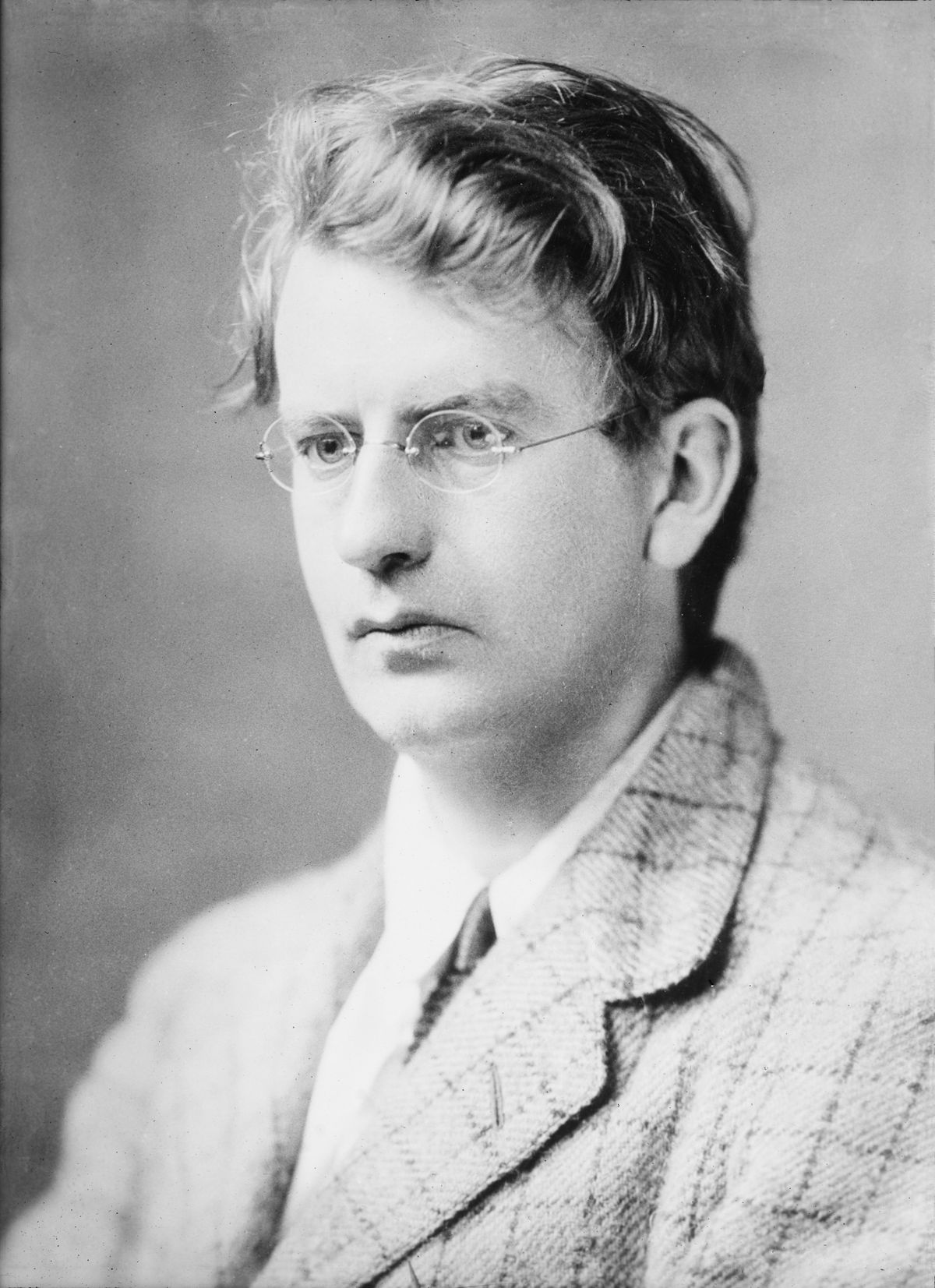
John Logie Baird was born on 13 August 1888 in Helensburgh, a seaside town on the Firth of Clyde in the west of Scotland, a son of the Reverend John Baird and Jessie Morrison Inglis. From childhood he was chronically unwell, suffering from circulatory problems that dogged him throughout his life and periodically interrupted his work for weeks or months at a time. His health was never robust; his enthusiasm for electrical tinkering was absolute.
By his mid-teens he had wired his family home with a private telephone exchange connecting his bedroom to those of his neighbours — a characteristically practical response to the question of what to do with an interest in electrical engineering and a confined, domestic world. He went on to study at the Royal Technical College in Glasgow (now the University of Strathclyde), and later enrolled at Glasgow University, though his studies were repeatedly interrupted by illness and, eventually, by the outbreak of the First World War. He was medically unfit for military service.
What followed was a decade of restless, often unsuccessful entrepreneurship that bears some examination, because it reveals the character that would later drive the television experiments. Baird was constitutionally incapable of simply working for someone else. In 1919 he went to Trinidad with a scheme to manufacture and sell jam from local produce; the business did not prosper. He returned to Britain and tried selling boot polish and soap under the name “Baird’s Speedy Cleaner.” He had a modest success with undersocks — wool socks with an inner layer that kept the wearer’s feet warm and dry — for which he held a patent and which he reportedly sold in Woolworths. None of these ventures brought him more than a subsistence income; all of them shared the characteristic of being operated by a man who was frequently too ill to run them properly.
By the early 1920s, Baird was living on the south coast of England, having moved to Hastings in search of a milder climate than Scotland’s. He had little money, poor health, and, increasingly, a fixed obsession: the transmission of a moving image by electricity.
5.2 The Attic in Hastings
Baird had been interested in the general problem of image transmission since at least the early 1920s. The theoretical framework was already known: Paul Nipkow’s 1884 patent (described in Vol 3 of this series) had laid out the scanning-disc principle, and by the early 1920s, the two critical enabling technologies — thermionic amplifiers and neon glow-discharge lamps capable of rapid modulation — had become practical. The question was no longer whether a scanning-disc system was theoretically possible, but whether someone could actually make one work with available components.
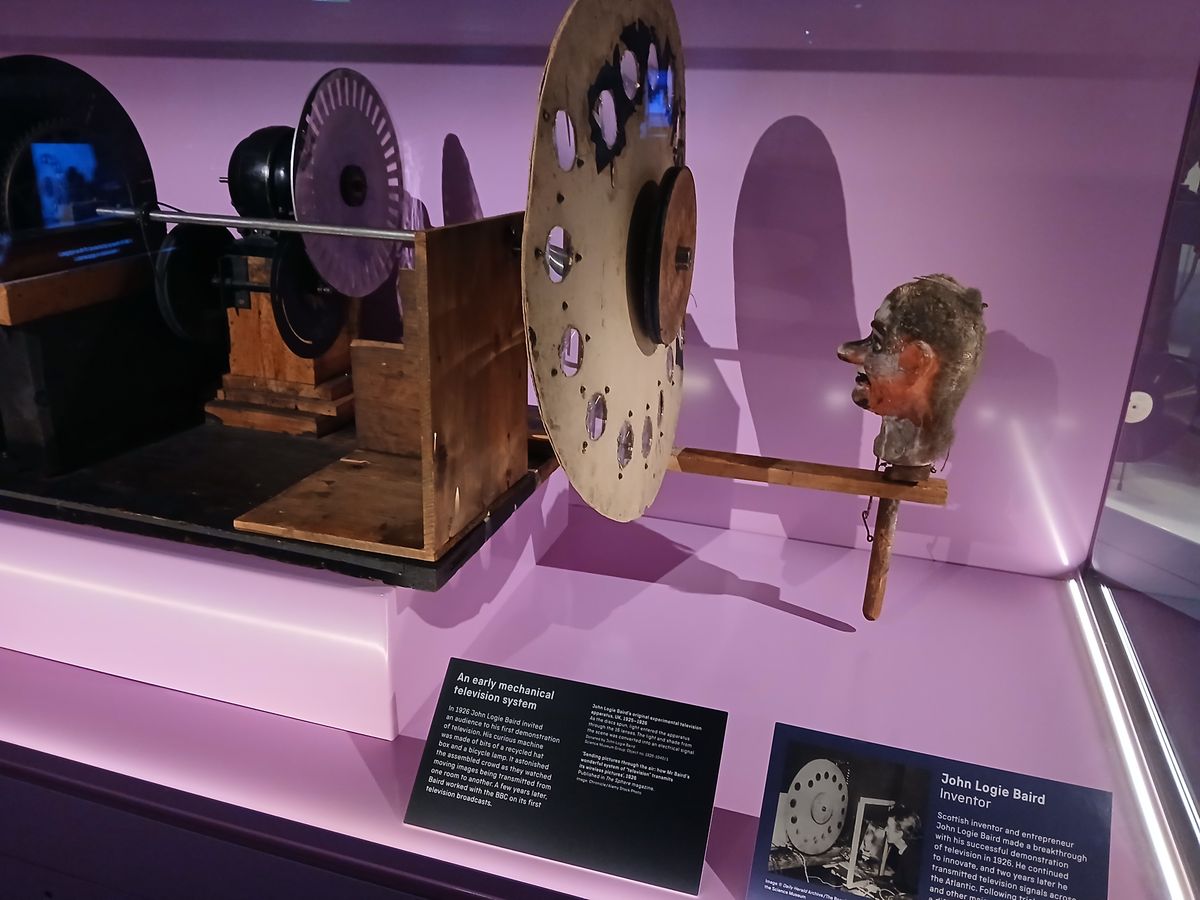
Baird’s first apparatus was famously improvised. Working in a rented attic in Hastings, with no institutional backing and no significant capital, he built a scanning system from whatever materials came to hand. The transmitter disc was cut from cardboard. The lenses were salvaged from bicycle lamps. The photoelectric cell was a thermionic device from a previous experimental project. The disc’s central axle was a darning needle. A tea chest and a hatbox provided the structural framework. The components were held together with sealing wax and string, quite literally — photographs of early Baird apparatus from this period show a contraption that looks more like a failed art project than a television system.
He had at least one near-disaster during these early experiments. While working with high voltages — trying to improve the sensitivity of his photocell circuits — he caused a short circuit severe enough to knock out the electrical supply to his floor of the building. His landlord, unimpressed, evicted him shortly afterwards. Baird moved to London, eventually settling at 22 Frith Street in Soho, above a shop. The cramped upstairs rooms at Frith Street would be the scene of every significant breakthrough in his television story.
What he was trying to demonstrate in these early years was not yet what we would recognise as television. His first systems transmitted recognisable images, but the images were silhouettes — dark shapes against a light background, with no grey-scale gradation. The light-sensitive components available to him, and the amplifier gains he could practically achieve, were sufficient to distinguish bright from dark but not to resolve the intermediate tones that make a photograph or a face legible. This distinction — between silhouette transmission and true tonal television — would define the three crucial milestones of the next two years.
5.3 The First Milestone: Selfridges, 25 March 1925
On 25 March 1925, Baird gave the first public demonstration of a working television system, mounted in the electrical department of Selfridges department store on Oxford Street in London. The demonstration ran for approximately three weeks.
What visitors saw was carefully chosen to match what the system could actually deliver: moving silhouette images. A Nipkow disc at the transmitting end scanned the subject; a neon lamp at the receiving end reconstructed the result. The test subjects were ventriloquist’s dummy heads — a type of subject that proved well-suited to the constraints of the system, being inanimate, patient, and possessed of strongly contrasted features that showed up clearly even without tonal gradation. The apparatus conveyed motion and recognisable shape, but not the full range of light and shadow that a human face requires to be truly legible.
This is the first milestone, and its character matters: the Selfridges demonstration was the first public demonstration of moving images by Baird’s television system. It was not the first demonstration of tonal (grey-scale) television. The image was a silhouette, not a face in any photographic sense. Baird himself understood the distinction and was already working, in the rooms at Frith Street, on improving the system’s sensitivity to the point where genuine tonal gradation could be reproduced. The public, pressing their faces to the display at Selfridges, saw something historically unprecedented — moving images transmitted electrically — but they saw it in silhouette only.
5.4 The Second Milestone: Stooky Bill and William Taynton, 2 October 1925
The moment Baird had been working toward came on the morning of 2 October 1925, in the upstairs laboratory at 22 Frith Street. He had been refining the system throughout the summer — improving the photocell sensitivity, adjusting the lamp drive, optimising the disc and its apertures — and on that October morning, the components finally came together.
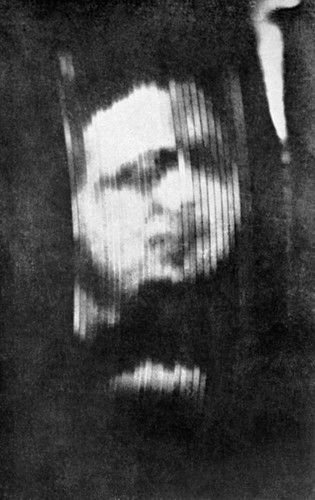
Baird’s test subject was the ventriloquist’s dummy head he called Stooky Bill — a plaster or papier-mâché figure with the strong, fixed features that made it a reliable subject for image-transmission experiments. When Baird looked at the receiver as Stooky Bill sat in front of the transmitter, he saw something categorically different from what he had shown at Selfridges: a face, rendered in genuine grey-scale, with the graduations between highlight and shadow that make a human countenance recognisable. The lips, the nose, the eyes — the features were there, in tone, not silhouette. For the first time, a recognisable tonal image had been reproduced by television.
Baird’s immediate reaction, by his own later account, was to go downstairs and bring back a human being to test whether the system would work on a living face as well as a plaster dummy. He found William Edward Taynton, a twenty-year-old clerk from the office on the floor below. Taynton is accordingly the first human being to have been televised in full tonal range — the first person whose face, in its actual gradations of light and shadow, was reconstructed on a television receiver.
The historical record preserves one notable detail about this transaction: Taynton required persuasion to sit still under the intense lighting Baird’s flying-spot system demanded. The light source was powerful enough to be genuinely uncomfortable, and the young clerk declined to cooperate without recompense. Baird bribed him with half a crown — approximately twelve and a half pence in today’s currency, though considerably more in 1925’s purchasing power. The first human television subject was paid for his participation.
The significance of 2 October 1925 cannot be overstated, but its nature must be stated precisely. It was the first time a tonal, grey-scale, recognisable image had been transmitted and received by television — the moment that separated electrical image transmission (which Baird and others had demonstrated) from television in the meaningful sense. The silhouettes at Selfridges were image transmission; what the receiver showed on the morning of 2 October 1925 was television.
5.5 The Third Milestone: The Royal Institution Demonstration, 26 January 1926
The third milestone was public and documented in a way the second was not. On 26 January 1926, Baird demonstrated his system to an audience of members of the Royal Institution and to a correspondent from The Times of London, in the laboratory at 22 Frith Street.
This demonstration, before an audience that could speak to what it had seen, constituted the first public and press demonstration of true television — live, moving, tonal images transmitted electrically. The Royal Institution was not the most august scientific body in Britain (that was the Royal Society), but its members were technically literate and credible witnesses, and the Times correspondent’s account the following day is the documentary record that establishes the event’s place in history.
The images shown on 26 January 1926 were transmitted at approximately 12.5 frames per second and resolved to around 30 lines — enough to make a close-up face legible. The system that Baird demonstrated to the Royal Institution was not a demonstration model or a polished product; it was the working laboratory apparatus from Frith Street, operated by Baird himself, showing live images of subjects seated a few feet away.
Contemporary press coverage reflects something between scepticism and astonishment. The Times article treated the demonstration as a genuine scientific achievement — not a conjuring trick or a deception — but also conveyed the limitations honestly: the image was small, the quality low, and the practical utility of such a system was far from obvious. This balanced reaction captures the historical moment accurately. What Baird had demonstrated was real, and it worked; what it could do was, at that stage, extremely limited.
The three milestones — Selfridges in March 1925 (silhouette, public), Frith Street in October 1925 (tonal, private), Royal Institution in January 1926 (tonal, public) — are sometimes collapsed in popular accounts into a single “first television demonstration.” The distinction between them is important, not merely as a matter of historical precision but because it captures something essential about what television actually is: not merely the transmission of a moving shape, but the transmission of a moving image with tonal gradation sufficient for a human face to be recognisable. The first two milestones represent progress toward that definition; the third represents its public confirmation.
5.6 The Shape of the Work
Any account of these demonstrations that omits the conditions under which they were achieved risks giving a false impression of the achievement. Baird was not operating with institutional support. He had no laboratory in the university sense, no assistants with technical training, and, for long periods, no reliable income. He funded his television experiments from whatever he could raise — loans from friends, earnings from the novelty demonstrations at Selfridges, and later, the proceeds from demonstrations to investors and journalists.
His health continued to undermine him. The intense heat generated by his flying-spot transmitter lamps in a small, poorly ventilated room was a constant problem. He had no air conditioning, no regulated power supply, and no ready access to precision-machined components. The discs were cut by hand; the gears were salvaged; the framework was improvised. Every step forward required him to identify the limiting factor in a complex system, acquire or fabricate a better component with minimal resources, and integrate it into an apparatus that was, in its physical realisation, barely above the level of a model.
That the three milestones fell in a span of less than ten months — from late 1924 (when Baird first managed to transmit a flickering image of a cross — the precise month is uncertain in the sources) through to January 1926 — suggests both the rate at which the technology was improving and the intensity with which Baird was working it. He was not the only person pursuing this problem; Charles Francis Jenkins in the United States demonstrated silhouette image transmission on 13 June 1925, some two months after the Selfridges run had closed. The specific claim that belongs to Baird — and that was confirmed on 2 October 1925 — is the first tonal, grey-scale, recognisable image. Jenkins’s system, which used a different scanning geometry, transmitted silhouettes; it did not achieve grey-scale gradation in the same period.
5.7 Further Firsts: Long Distance, Transatlantic, and Colour
Having established the fundamentals at Frith Street, Baird proceeded to extend the reach of his system in a series of demonstrations that underlined its practical potential.
In May 1927, he transmitted a television signal between London and Glasgow — a distance of approximately 438 miles — using the telephone network as the transmission medium. This was the first long-distance television transmission: the signal originated in London, was carried north by landline, and was received and displayed in Glasgow.
On 8 February 1928, Baird achieved the first transatlantic television transmission, sending a signal by shortwave radio from London to a receiver in New York. The image quality was crude and the demonstration required favourable propagation conditions, but the transatlantic connection was made and documented.
In July 1928 — though this date rests on a single source and should be treated with appropriate caution — Baird demonstrated a form of colour television. The colour effect was produced by placing colour filters over the apertures of the Nipkow disc, so that each scan line was illuminated through a different colour filter. The resulting images were very rudimentary and the colour rendition primitive, but the demonstration established that colour information could be encoded and transmitted through the scanning-disc principle. Baird returned to colour television repeatedly in later years with more sophisticated approaches.
These demonstrations collectively positioned Baird as the leading figure in mechanical television development. By the end of the 1920s he had, in collaboration with the BBC, moved from laboratory experiments to something approaching a broadcast service — a development taken up in Vol 8 (The 30-Line Broadcast Era).
5.8 The Televisor: Television as a Product
The name Televisor was Baird’s own coinage and trademark for the receiver units he developed for domestic use. It was a product name in the same register as “Gramophone” or “Hoover” — a brand that aspired to become a generic noun for the device it described. The Televisor was manufactured from 1929 by Plessey in England, and commercially offered to the public from 1930. Approximately 1,000 units were sold at a price that varied by source and period — figures of approximately £18 and approximately £26 (around 25 guineas) both appear in the historical record, and the discrepancy likely reflects different models or different sales periods. Kits were also available for the technically inclined, and appear to have outsold the factory-built sets among the enthusiast audience. Buyers signed a contract specifying the available programming.
The hardware inside the Televisor — the Nipkow disc arrangement, the synchronous motor, the neon lamp, the framing and phasing controls — is examined in detail in Vol 6 (Inside the Baird Televisor), as are the specific parameters of the 30-line transmission standard that the device was designed to receive. What matters here is the conceptual step: Baird moved from laboratory demonstration to commercial product, giving the public the means to participate in television from their own homes. That the sets were expensive, finicky, produced a postage-stamp-sized orange image of limited resolution, and required adjustment before each viewing session are facts that belong to Vol 6 and to the honest account of what the Televisor was. The commercial launch was, nonetheless, a real threshold: television had become, however tentatively, a consumer product.
5.9 What Baird Made Possible
The story of John Logie Baird from 1925 to 1930 is a story of three distinct achievements, each necessary for the next. The first — the Selfridges demonstration of March 1925 — proved that a working scanning-disc television system could be shown to a public audience and that moving images could be transmitted electrically. The second — the tonal image of 2 October 1925, with Stooky Bill and then the reluctant William Taynton — proved that television could reproduce the tonal gradations that make a human face recognisable, crossing the boundary from image transmission into television proper. The third — the Royal Institution demonstration of January 1926 — brought credible public and press witnesses to what had previously been a private laboratory event, establishing the scientific and social reality of the achievement.
Beyond these three milestones, the long-distance and transatlantic demonstrations of 1927 and 1928 showed that the system could operate at useful range, and the colour experiments of 1928 hinted at where the technology might go. The launch of the Televisor as a commercial product in 1930 translated five years of laboratory work into something a member of the public could buy and use.
None of it happened without the constraints described in the previous volumes of this series — the Nipkow disc’s geometry, the neon lamp’s orange emission, the audio-bandwidth signal, the synchronisation problem — and the limitations those constraints imposed were visible in every Televisor that left the Plessey factory. But the limitations were real and the achievement was real, and they were made by the same person in the same cramped rooms in Soho, with bicycle lenses and darning needles and a dummy head called Stooky Bill.
Comments (0)