Mechanical TV Deep Dive · Volume 9
Pushing the Limits
By the early 1930s, the Nipkow scanning disc had proven itself in the one arena that mattered most: it had put real moving pictures into real homes, on a real schedule, for six years of BBC broadcasts. But the engineers and experimenters who had built that service were not content to stop at thirty lines and a postage-stamp image. Throughout the late 1920s and into the 1930s, a series of experiments pushed the mechanical television principle into territories it had never been designed to inhabit — colour, stereoscopic depth, and screens large enough to fill a cinema auditorium. Some of these experiments were one-afternoon demonstrations; others grew into serious commercial ventures that came startlingly close to entering the market. All of them were, at their root, ingenious attempts to compensate for the fundamental limitations of a spinning disc by engineering around them. This volume examines how far those attempts reached, and what they reveal about the limits mechanical television ultimately could not transcend.
9.1 Colour Television
The idea that a mechanical television system might transmit colour images was not deferred to some future era of electronic wizardry. John Logie Baird addressed it in 1928, only months after his transatlantic television demonstration of February that year.
According to contemporary accounts — reported in Nature and by observers present at his Long Acre studio in London — Baird gave what is claimed to be the first demonstration of colour television on 3 July 1928. The claim has been recognised by Guinness World Records and is corroborated by multiple sources from the period, though the primary documentation rests on those contemporary press accounts rather than on a surviving technical specification or independent engineering record.
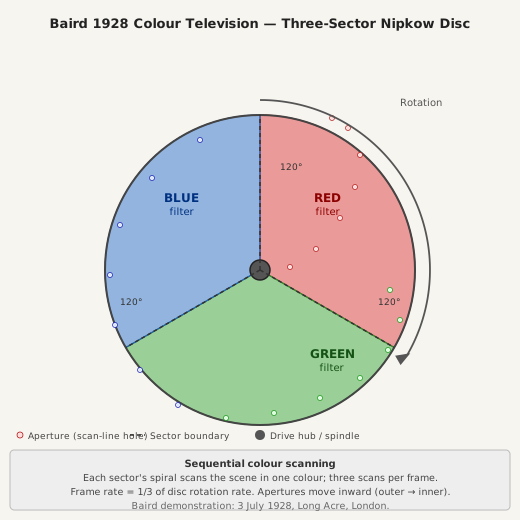
The method was characteristically mechanical. Rather than separating and recombining colour signals electronically, Baird divided the Nipkow disc into three sectors. Each sector carried its own inward spiral of apertures, and each spiral was covered by a filter in one of the three primary colours — red, green, and blue. As the disc rotated, the three spirals swept the subject in rapid sequence: one scan in red light, one in green, one in blue. At the receiving end, a corresponding disc with matching coloured sectors reassembled the three sequences into a composite image.
The result was crude by any subsequent standard. The frame rate was necessarily divided by three — each colour channel received only one-third of the available scanning cycles — and the image was small, poorly lit, and subject to colour fringing wherever motion or vibration disturbed the careful synchrony between the three spirals and the three filter sectors. The subjects chosen for the demonstration were deliberately vivid: delphiniums and carnations “appeared in their natural colours,” Nature reported, and a basket of strawberries “showed the red fruit very clearly.” A policeman’s helmet, a glowing cigarette end, red and blue scarves, and a bunch of roses all featured in the demonstration. These were not subtle subjects; they were chosen because the system’s colour discrimination was broad and bright objects in strong primaries showed best.
The demonstration established a proof of concept. Whether it constituted a practical colour television system was another question, and Baird made no claim that it did. The approach was never developed into a broadcast service.
Baird returned to colour television later in his career, but by then his work had left the mechanical domain entirely. In 1942–44, working with only two assistants in a private laboratory during the wartime suspension of the BBC service, Baird developed the Telechrome — a fully electronic colour picture tube using two electron guns and a phosphor screen with cyan and magenta patterns. The Telechrome was demonstrated publicly on 16 August 1944 and represented a completely different class of technology from the 1928 disc experiments. It was a cathode-ray tube, not a mechanical scanner; its principles were electronic through and through. The Telechrome is mentioned here because it represents the end of Baird’s personal colour line — but it belongs to the history of electronic television, not to the mechanical era. The only surviving example is held at the National Science and Media Museum.
9.2 Stereoscopic Television
Colour was not the only dimension Baird added to his demonstrations in 1928. The same year he showed colour television, he also demonstrated stereoscopic — three-dimensional — television.
The demonstration took place on 10 August 1928 at his company’s premises at 133 Long Acre, London, before an audience of scientists and press representatives. As with the colour demonstration, the primary evidence comes from contemporary accounts rather than from any surviving engineering record.
The mechanism was again rooted in the disc. A single Nipkow disc at the transmitter was perforated with two spirals rather than one. The first spiral occupied one half of the disc’s circumference; the second occupied the other half, displaced inward by approximately four inches — roughly the average interocular distance of a human face. As the disc rotated, the two spirals alternately scanned the scene from two slightly different horizontal positions, separated by the distance between the two imaginary eyes of the transmitter. The electrical signal thus encoded two slightly offset perspectives in rapid alternation.
At the receiving end, the corresponding disc similarly alternated between two display positions matching the two scanned views. A viewer looking into the apparatus would, with appropriate optical arrangement, see the left-eye view with the left eye and the right-eye view with the right eye, recovering from the alternating signal the sense of depth and solidity that binocular vision provides.
The practical result was, by all accounts, more striking in concept than in execution. A thirty-line stereoscopic image is still a thirty-line image; the depth information enriches what little the resolution allows, but does not expand the fundamental scarcity of detail. Baird himself noted that by combining colour and stereoscopic scanning — both achieved through disc geometry — “the complete illusion of images in natural colours, and with depth and solidity” became possible in principle. Whether the achieved result matched that description in practice was a matter observers viewed with varying degrees of optimism.
Both the colour and the stereoscopic demonstrations of 1928 shared the same limitation: every additional dimension squeezed from the Nipkow disc was purchased at a direct cost to image quality, frame rate, or both. Adding colour divided the frame rate by three. Adding stereo compressed the available image field into two interleaved half-discs. The disc’s geometry was finite; every additional function claimed a portion of that geometry, and the image suffered accordingly.
9.3 Large-Screen Mechanical Television
The third limit mechanical engineers attacked — and in some respects the most commercially significant — was the size and brightness of the image. A thirty-line neon lamp image, glowing faintly orange behind a postage-stamp-sized window, was adequate as a curiosity but inadequate as an entertainment medium. Filling a cinema screen with a television picture required something categorically different.
9.3.1 Mirror-Drum and Mirror-Screw Receivers
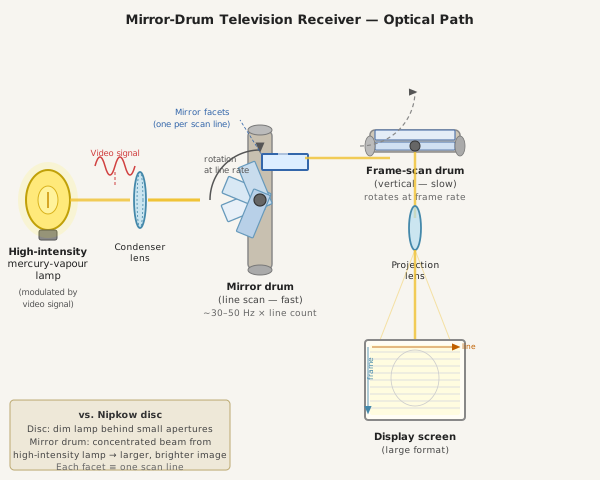
The first approach to large-screen mechanical television involved substituting a powerful light source for the neon lamp and using rotating mirrors rather than a perforated disc to scan the projected beam across the screen.
In a mirror-drum receiver, a set of small flat or slightly curved mirrors is mounted around the circumference of a fast-spinning drum. Each mirror deflects a bright beam of light — typically from a high-intensity mercury vapour lamp — across the screen for the duration of one scan line, then hands off to the next mirror as the drum rotates. The drum’s angular velocity determines the line scan rate; a separate, slower drum provides the vertical frame scan. The system trades the Nipkow disc’s mechanical simplicity for higher optical efficiency: a concentrated, focused beam of intense light can illuminate a much larger screen than the diffuse glow of a neon lamp behind a small aperture.
The mirror screw, an alternative geometry patented by Gardner in 1928, achieved a similar result with a different mechanism: a helical arrangement of small mirror facets on a rotating shaft, one facet per scan line, sweeping the light beam in a spiral path that covered the full image area. The mirror screw had the practical advantage of producing images free from visible line structure — the transitions between mirror facets were smoother than the transitions between adjacent disc apertures — and it could produce a brighter image than a comparably sized disc receiver.
Both approaches were in experimental use in Britain and Germany during the late 1920s and into the 1930s. Neither, however, fully solved the large-screen problem. The fundamental constraint was the video signal: thirty or even a few hundred scan lines, displayed over a large area, simply spread the available information too thinly. A large, bright, blurry image is not the same as a large, sharp one.
9.3.2 The Scophony System
The most technically sophisticated of all large-screen mechanical television systems — and the one that came closest to commercial deployment — was developed in Britain by a company called Scophony Limited.
Scophony Limited was established by entrepreneur Solomon Sagall in the early 1930s to exploit a body of patents held by inventors George William Walton and William Stephenson. The company attracted early investment from Ferranti (£3,500 in 1932) and later from EKCO, which replaced Ferranti as principal backer in 1935. The technical centrepiece of Scophony’s work was a device called the Jeffree cell, developed by J. H. Jeffree in 1934.
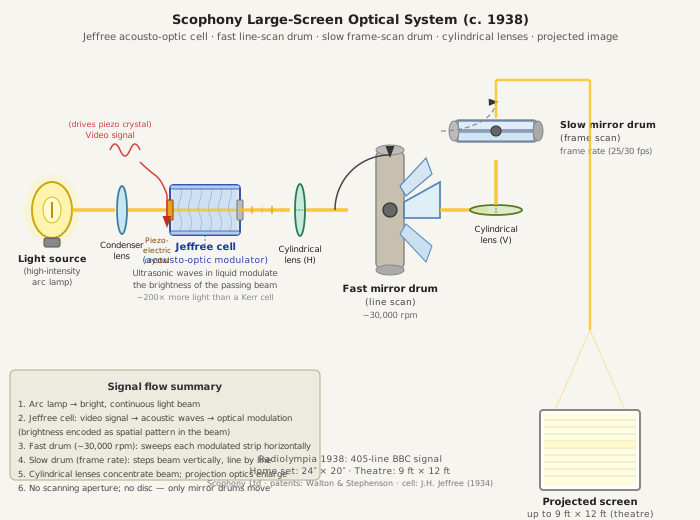
The Jeffree cell was a transparent chamber filled with liquid — typically water or another suitable transparent fluid — through which a beam of light was passed. A piezoelectric crystal at one end of the liquid column was driven by the incoming video signal, generating acoustic (ultrasonic) waves that propagated through the liquid. These waves created a pattern of compressions and rarefactions in the fluid that acted as a diffraction grating, bending the light beam passing through it in proportion to the amplitude of the video signal at each point along the wave. The cell thus translated the electrical video waveform into a spatial optical modulation pattern — a strip of light whose brightness varied, point by point, according to the picture content — without any moving aperture, disc, or lamp shutter.
The Jeffree cell represented a major improvement over earlier light-modulation methods. Its predecessor, the Kerr cell, required very high voltages and produced relatively little modulated light. The Jeffree cell, using acousto-optic modulation rather than an electric field effect, made available approximately two hundred times as much light at the screen — the critical factor for large-image projection. One IEEE paper from the period described the approach as “supersonic light control.”
The modulated light from the Jeffree cell was then swept across the screen by two rotating mirror drums. A small, high-speed drum — spinning at speeds around 30,000 rpm in some implementations — performed the rapid line scan, sweeping each individual modulated strip of video across the horizontal width of the image at the line rate. A much larger, slower drum handled the vertical frame scan, stepping the beam downward from one line position to the next at the frame rate. The combination of the two drums produced a complete raster scan of the image on the screen, with the Jeffree cell controlling the brightness at every point.
The optical geometry required careful engineering to focus the modulated strip correctly onto the screen at all positions, and crossed cylindrical lenses were used to concentrate the light efficiently, reducing the demands on the mirror optics and keeping the system within practical size and cost boundaries.
In 1938, Scophony demonstrated the results of this development at the Radiolympia exhibition in London. The company showed three types of mechanical receivers for the BBC’s 405-line signal — all operating on the contemporary BBC 405-line signal, not on the obsolete 30-line standard. The home receiver produced a picture area of approximately 24 inches by 20 inches, using the Jeffree cell and mirror-drum projection in a domestic cabinet. Two theatre systems were also shown: one producing an image of six feet by five feet, and the other producing an image of nine feet by twelve feet — genuinely cinematic dimensions, in the class of the small theatrical screens of the day.
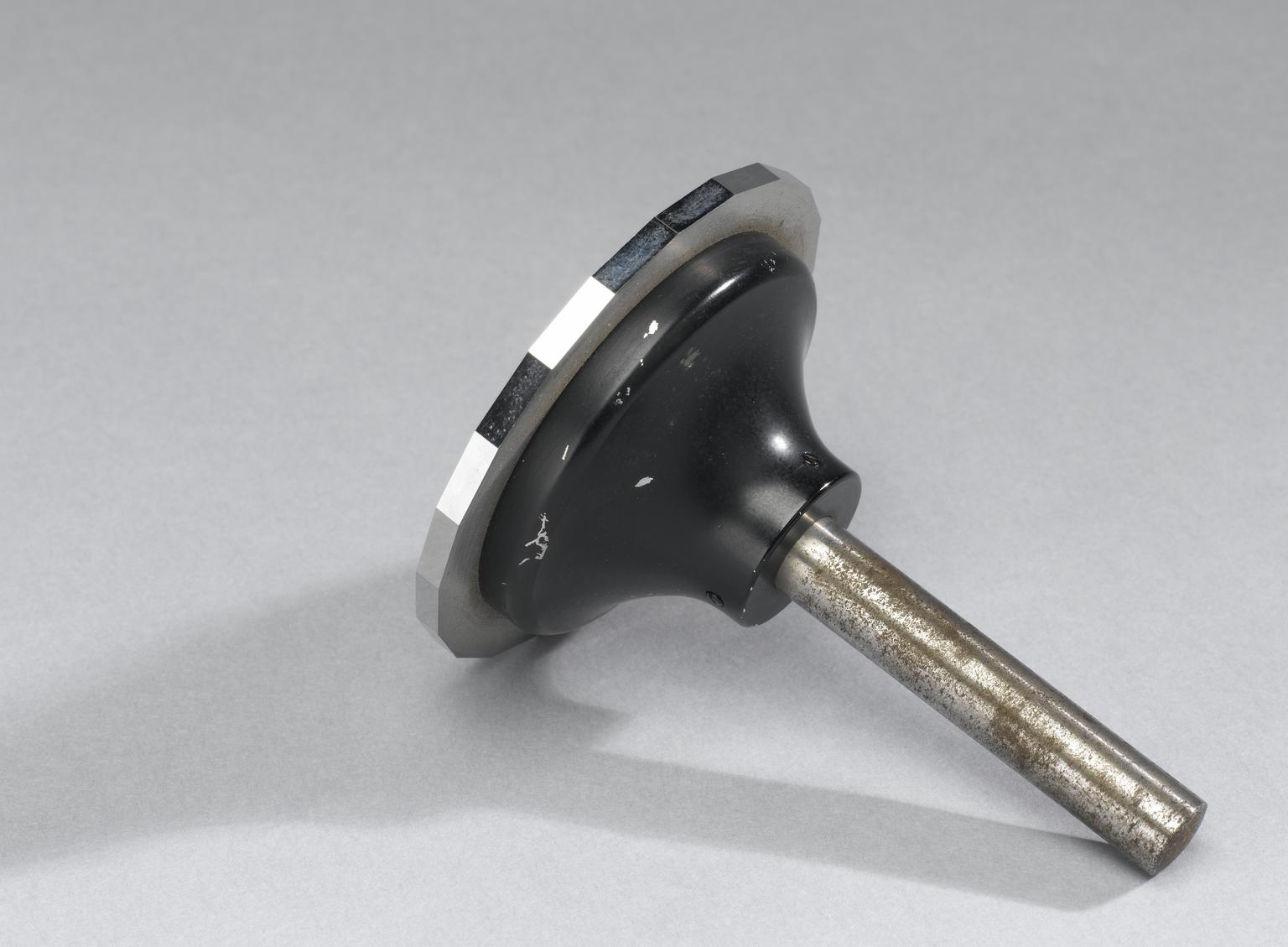
Several theatre installations of the Scophony system were put into operation, and those who saw the results described an image of unexpected clarity and brightness — the 405-line definition was genuinely legible on a large screen in a way that thirty-line images never could be, and the Jeffree cell’s high light efficiency made the projection bright enough for a darkened but not blacked-out auditorium. The system was, by the accounts of those who observed it, not a laboratory curiosity but a system with genuine commercial potential.
None of the home receivers, however, were sold to the public. The demonstration at Radiolympia took place in 1938, and the production of receivers was halted by the onset of the Second World War in 1939. The war imposed a complete suspension of civilian television broadcasting in Britain on 1 September 1939, and with no signal to receive and manufacturing priorities redirected toward the war effort, commercial deployment of the Scophony system became impossible. After the war, in November 1948, Scophony Limited merged with John Logie Baird Ltd to form Scophony-Baird, but the commercial moment had passed and the merged company did not revive the large-screen mechanical receiver in any form.
9.4 The Intermediate-Film System
Separate from the display-side experiments of colour, stereoscopy, and large-screen projection, engineers in both Britain and Germany pursued a different class of improvement: making mechanical television cameras capable of work outside the studio.
The flying-spot scanner used in the BBC’s 30-line studio (described in Vol 8) was an indoor, stationary instrument that required subjects to sit still in front of a scanning beam in a darkened room. It was completely unsuitable for outdoor or location work. The electronic camera tubes that would eventually solve this problem — the Emitron and the iconoscope — were not yet reliable or available for broadcast use in the early 1930s. The intermediate-film system was the mechanical engineer’s answer to the problem of camera mobility.
The principle was conceptually simple. A standard motion picture camera was used to film the subject — any subject, anywhere, with the same flexibility as a newsreel camera. The exposed film, rather than being processed in a conventional darkroom over hours, was fed immediately into a compact development unit attached to the camera head, where it was processed as rapidly as the chemistry would permit. The developed film — wet, not yet fixed, handled with care — was then threaded directly into a flying-spot film scanner, which read the image off the freshly processed negative and transmitted it as a television signal.
The delay between the moment of filming and the moment of transmission was approximately 45 seconds — long enough for the development process, short enough to qualify as near-live from the viewer’s perspective. The cyanide-based developer used to achieve this processing speed was both effective and hazardous; the apparatus required careful engineering to keep the chemistry contained and the operators safe. One operational difficulty that emerged during service was the formation of gas bubbles in the developing tank, which could temporarily interrupt the film’s optical path and produce an audible “pop” in the viewer’s receiver.
The intermediate-film system was conceived in Germany. Georg Oskar Schubert developed the underlying idea, and it was first demonstrated in public by Fernseh AG in 1932 — using the mobile outside-broadcast truck that the company built in August of that year (noted in Vol 7). Baird began developing his own version of the process in 1932, borrowing and adapting the German approach for the British context.
The system was used in production. German television incorporated intermediate-film cameras for the 1936 Berlin Summer Olympics broadcasts, making it possible to cover outdoor events — sprint finishes, jumping competitions, rowing races — with a television image that could not have been captured by any studio-bound flying-spot transmitter. The BBC employed Baird’s version of the system during the first three months of the Alexandra Palace high-definition television service, from November 1936 through February 1937, before the service transitioned entirely to the Marconi-EMI electronic cameras that had been running alongside it. (That transition, and its consequences, are covered in Vol 10.)
The intermediate-film system’s limitations were real. The 45-second delay, tolerable for sporting highlights, precluded truly live coverage; the chemistry was messy, hazardous, and mechanically complex; the film stock added a layer of optical quality loss before scanning even began; and the entire apparatus was bulky compared to what an electronic camera — once reliable enough — could achieve. The system existed because the electronic alternative was not yet ready. When it became ready, the intermediate-film system was discarded immediately.
9.5 The Shape of the Limits
Looking across these experiments together — colour filters on a disc, two spirals for stereoscopy, Jeffree cells and mirror drums for large screens, cyanide-developer film for mobile cameras — a consistent pattern emerges. Each innovation solved one specific problem by adding mechanical or optical complexity to a system that was already mechanically intricate. Each solution worked, within its intended domain; some of them worked impressively. The Scophony system, in particular, produced results that were genuinely competitive with the electronic projectors of the same era. But each innovation also consumed resources — frame rate, disc real estate, processing time, optical efficiency — that the baseline system could not spare without loss.
The Nipkow disc and the neon lamp were adequate instruments for a postage-stamp image of a face, transmitted across a medium-wave broadcast channel on a modest schedule. They were instruments of limited capacity. The mechanical tradition responded to that limitation with ingenuity rather than resignation, producing a series of solutions that pushed the technology further than any simple extrapolation of the disc’s capabilities would have suggested possible. But the solutions were engineering workarounds, not physics breakthroughs. The fundamental constraints — rotating discs are heavy, wear out, and can only spin so fast; neon lamps are dim; sequential scanning wastes most of a frame’s time — could be mitigated but not removed.
By the late 1930s, the parallel development of electronic camera tubes and cathode-ray tube displays was removing those constraints one by one in a way that mechanical ingenuity could not match. The electronic alternative did not just solve the problem Scophony had addressed; it solved all of the problems simultaneously. How that happened, and what it meant for mechanical television’s practitioners and advocates, is the subject of Vol 10 — Why Electronic TV Won.
9.6 Cross-References
- Baird’s biography, earlier demonstrations, and the 1926 Royal Institution demonstration are in Vol 5 — John Logie Baird and the First Television.
- The BBC 30-line broadcast era and the flying-spot scanner studio are covered in Vol 8 — The 30-Line Broadcast Era (1929–35).
- Fernseh AG’s formation, structure, and the 1932 outside-broadcast vehicle are introduced in Vol 7 — The Rivals.
- The Alexandra Palace competition between the Baird intermediate-film system and Marconi-EMI electronics, and the 1937 decision, are covered in Vol 10 — Why Electronic TV Won.
- The Baird 30-line standard parameters (line count, frame rate, aspect ratio) are defined in Vol 6 — Inside the Baird Televisor and tabulated in Vol 16 — Reference and Cheatsheet.
Comments (0)