Mechanical TV Deep Dive · Volume 2
Seeing at a Distance
The desire to see far-off things without traveling to them is older than any technology. Myths of remote seeing recur in cultures across the ancient world — crystal balls, magic mirrors, the visionary trances of oracles. But the scientific question — whether a machine could transmit a living image across a wire as the electric telegraph already transmitted words — had to wait for two discoveries: one about the human eye, and one about a soft grey metal that changes its electrical character in light.
Both discoveries arrived in the nineteenth century. Together they made television possible, and together they set off a decade of fevered proposals that competed, contradicted one another, and eventually converged on a single crucial insight: that time could stand in for space, and one wire could carry everything, if only you were willing to wait a moment.
2.1 The Perceptual Foundation: Persistence of Vision
Any practical scheme for transmitting a moving image over a wire had first to reckon with the human eye. An image is two-dimensional; a wire carries, at any given moment, exactly one value. If you wanted to transmit a useful picture, you could not transmit every point simultaneously — that would require an impractically large number of wires. But if you transmitted the points one at a time, in sequence, the picture would not exist as a whole at any single moment; it would be assembled over a span of time. Whether a human observer would perceive it as a complete, coherent image depended on a property of human vision that scientists had only recently begun to examine with precision.
The relevant phenomenon — that a bright impression on the retina persists briefly after the stimulus has ceased — was demonstrated experimentally in the early nineteenth century. Peter Mark Roget, best remembered for his Thesaurus, presented a paper to the Royal Society in December 1824 (published in the Philosophical Transactions in 1825) in which he analysed an optical illusion involving rotating spoked wheels viewed through vertical slits. He observed that when the wheel rotated at sufficient speed, the eye fused successive views into the impression of stationary spokes — a consequence of what was later called persistence of vision. Joseph Plateau in Belgium pursued related experiments through the late 1820s and early 1830s, producing the phenakistiscope (1832–33), which created the illusion of smooth motion by presenting a rapid succession of still images on a rotating disc. Michael Faraday conducted parallel observations in 1831. The phenakistiscope, and the later zoetrope and flip-book, were practical proofs that the human eye would integrate a rapid sequence of still images into the perception of continuous motion.
The practical implication for electrical image transmission was direct: if you could scan an image — decompose it into a rapid sequence of brightness measurements, transmit those measurements one at a time, and reconstruct them at the receiving end at a matching rate — the viewer’s eye would fuse the sequence into a complete picture, provided the complete cycle repeated fast enough. Ten to sixteen repetitions per second, it was generally understood, was sufficient to suppress obvious flicker. Below that, the eye perceived a sequence of separate images rather than continuous motion.
This threshold set the clock speed against which every practical television scheme had to race.
2.2 The Discovery That Made Sensing Possible: Selenium and Light
The persistence of vision gave engineers a target — ten or more complete images per second — but it told them nothing about how to convert light into electricity. For a device to sense the varying brightness of a scene and turn it into a varying electrical signal, some physical phenomenon had to link illumination to current. In 1873, Willoughby Smith found it.
Smith was an English electrical engineer employed by the Telegraph Construction and Maintenance Company to oversee the testing of submarine telegraph cables. He was searching for a high-resistance test element and had been using rods of crystalline selenium. In the course of this work — exactly how the observation was first made is not recorded in detail, but Smith later attributed it to an assistant’s remark about variable resistance — he found that selenium’s electrical resistance changed dramatically when light fell on it. A selenium rod in darkness had a measurable, stable resistance; the same rod in sunlight had a much lower resistance, as if the light were somehow releasing more current carriers within the material.
Smith presented his findings to the Society of Telegraph Engineers on 12 February 1873, under the title “Electrical Properties of Selenium and the Effect of Light Thereon.” He published a short note, “Effect of Light on Selenium during the passage of an Electric Current,” in Nature on 20 February 1873. The discovery, promptly disseminated through the scientific press, was immediately recognised as remarkable: for the first time, a material existed that converted the intensity of light into a proportional change in electrical resistance. Include it in a circuit with a battery, and any change in illumination would produce a corresponding change in current. Here, at least in principle, was the light-to-electricity transducer without which no optical-electrical sensing device could function.
Selenium’s practical limitations were real and would prove decisive for decades: it responded slowly — far too slowly to follow the rapid brightness changes of a scanning image — and it was difficult to prepare in consistent, stable forms. But in 1873, and for the ten years of speculation that followed, those limitations were not yet apparent. What seized the imagination of engineers and amateur inventors was the simple fact that a material existed which turned light into electricity. That was enough to set off a wave of proposals.
2.3 The First Proposals: Telectroscopes and Mosaics (1877–1881)
Within five years of Smith’s discovery, inventors on both sides of the Atlantic had proposed devices — largely theoretical, none yet practical — for transmitting images electrically using selenium as the sensing element. The word “telectroscope” entered use: it was coined in 1877 by the French abbé and science writer François-Napoléon-Marie Moigno and popularised the following year by Louis Figuier, both responding to speculative reports of a device that could transmit visual images over a wire, in analogy to the way the telephone transmitted voice.
These early proposals divided, though their authors may not have recognised it clearly at the time, into two fundamentally different approaches. The distinction between those two approaches is the intellectual core of this volume.
2.3.1 George R. Carey and the Selenium Mosaic (1878)
Among the earliest documented proposals in the English-speaking world was that of George R. Carey, a surveyor employed by the City of Boston. Carey later claimed that his first conception of an electrical image-transmission system dated to January 1877, though the earliest verifiable documentary evidence of his design work dates from 1878 and onwards. His ideas first appeared in public in a brief note in Scientific American in May 1878, under the heading “The Telectroscope,” and in more detail in Scientific American and in The Operator in June 1880.
The scheme Carey proposed in his principal published work was straightforwardly parallel. He imagined dividing the image plane — at both the camera and the receiver — into a grid of small cells. At the transmitter, each cell would contain a selenium element exposed to the corresponding portion of the image. At the receiver, each cell would contain a light-emitting element — Carey suggested either photographic paper exposed by a current-controlled stylus, or an array of points heated or illuminated in proportion to the current received. Every transmitter cell would be connected by its own individual wire to the corresponding receiver cell. All cells would operate simultaneously. The image would be transmitted, in effect, all at once — not sequentially, but in parallel.
The appeal of this scheme was intuitive: it preserved the spatial structure of the image intact, requiring no timing or synchronisation beyond keeping the apparatus energised. Its fatal defect was equally obvious, to anyone who thought it through. A useful image required a large number of cells. Carey’s own published diagrams suggested arrays of perhaps a few dozen; but an image with any claim to recognisable detail required hundreds of cells per side, meaning tens of thousands of individual connecting wires. No practical electrical infrastructure could accommodate such a cable. Carey filed no patents for this scheme and did not build it.
2.3.2 Constantin Senlecq and the Telectroscope (1878–1881)
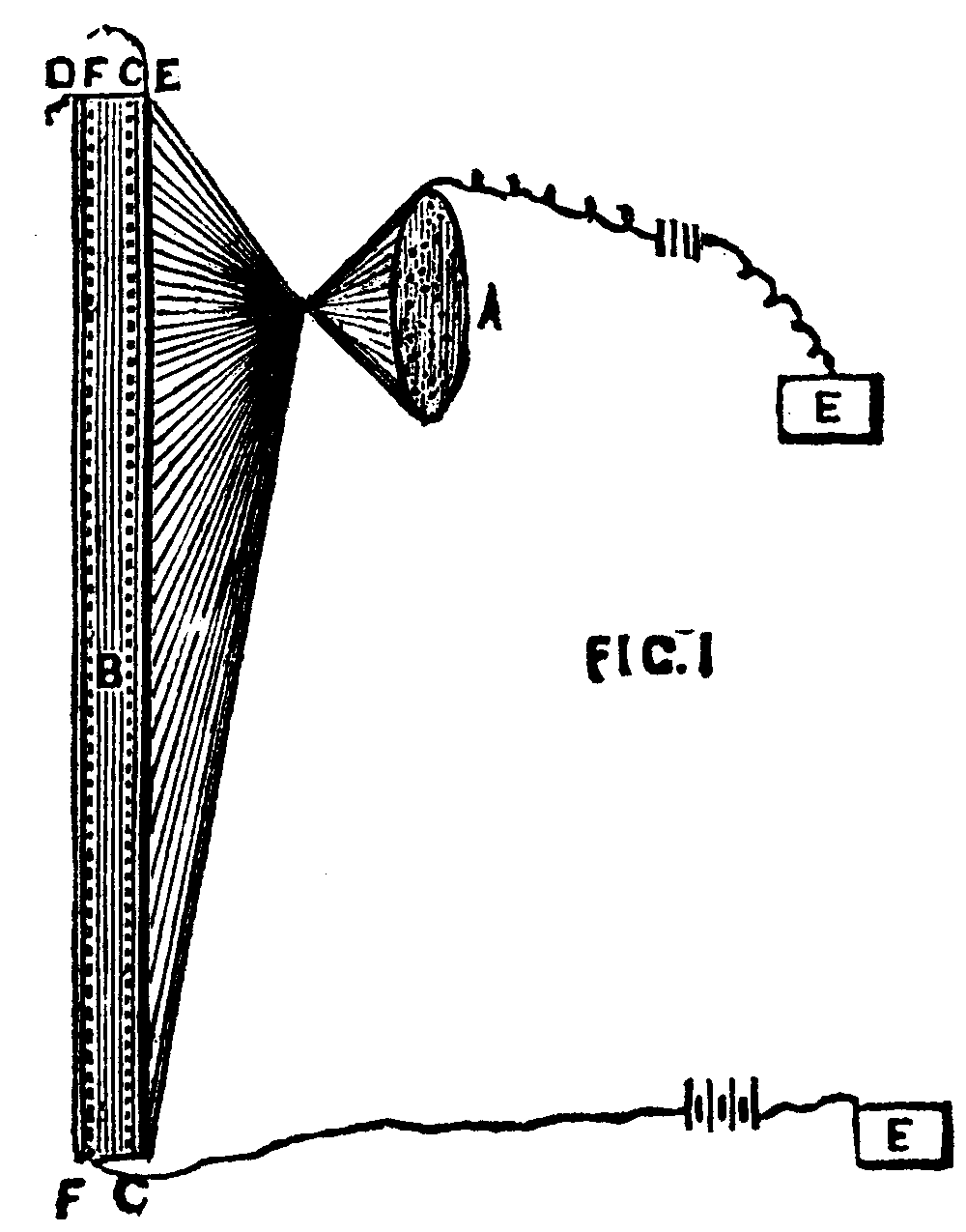
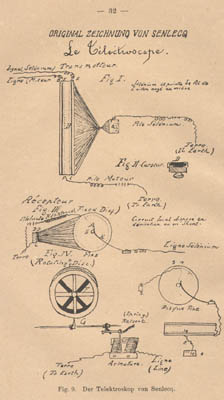
Working independently in France, Constantin Senlecq, a notary from Fauquembergues, developed a proposal that was technically quite different from Carey’s, even though both were inspired by selenium photoconductivity and both used the word “telectroscope.” Senlecq later claimed that his idea had come to him in the course of 1877; his first documented public communication was a letter to Comte du Moncel in November 1878, with his proposal appearing in the French scientific press in December 1878 and January 1879 — in Science pour tous, Les Mondes, and in English translation in Nature in January 1879. He developed his ideas further and published a 36-page brochure, Le télectroscope, in 1881.
Senlecq’s scheme was explicitly sequential rather than parallel. His device used a selenium-tipped stylus that traversed a glass plate point by point, with varying electrical resistance based on the light and shadow at each position. At the receiver, an electromagnet controlled the pressure of a pencil on chemically treated paper, reproducing tone at each corresponding point. The two sides were intended to scan in synchrony: transmitter and receiver stylus moving in the same path at the same rate.
The resolution to Senlecq’s advantage was that his scheme required only a single electrical circuit — one wire, whatever the resolution. Its difficulties were different from Carey’s: synchronisation between the stylus at transmitter and receiver was hard to maintain, and the speed of scanning was limited. In the slow mode Senlecq envisaged, the device was closer to a facsimile machine than a true television — it could transmit a still picture, laboriously, but not a moving one. Nevertheless, the principle was correct: sequential scanning, a single wire, and synchronisation at the receiving end.
2.3.3 Adriano de Paiva (1878)
The Portuguese physicist Adriano de Paiva, professor at the Polytechnic Academy of Oporto, published an article in the journal O Instituto in March 1878 titled “A telefonia, a telegrafia e a telescopia” (“Telephony, Telegraphy, and Telescopy”). Written in the wake of Alexander Graham Bell’s telephone demonstrations, which had reached Portugal in late 1877, de Paiva’s article proposed the theoretical basis for an “electric telescope” using selenium as the light-sensitive element. A second article, “A telescopia eléctrica,” followed in October 1879, and a 48-page brochure, La téléscopie électrique basée sur l’emploi du sélénium, appeared in 1880.
De Paiva’s contribution was primarily theoretical: he articulated the possibility of such a device and identified selenium as its necessary enabling material. His publications did not present a detailed engineering scheme distinguishing between parallel and sequential approaches; the level of technical specificity was closer to a conceptual argument than a working proposal. His claim to priority in the literature rests on the March 1878 publication date, which is among the earliest in print.
Some older summaries have dated de Paiva’s first article to June 1877; this appears to be an error arising from the running-date structure of the O Instituto volume (Volume XXV ran from July 1877 through June 1878), with issue No. 9 having appeared in March 1878. The March 1878 date is supported by primary-source analysis.
2.3.4 Ayrton and Perry (1880)
William Edward Ayrton and John Perry, British electrical engineers who had worked together in Japan before returning to the United Kingdom, published a proposal titled “Seeing by Electricity” in Nature on 22 April 1880. Their scheme was parallel: like Carey’s, it called for a mosaic of selenium cells at the transmitter, each connected by its own wire to a corresponding receiver element — in their version, electromagnetically controlled shutters that regulated light through a ground-glass viewing screen.
Ayrton and Perry were aware of the wire-count problem and acknowledged it explicitly: their system would require “a prodigious number of wires.” They could offer no practical solution, though they proposed telegraph multiplexing as a possible future remedy. Their scheme was no more buildable than Carey’s for the same reason. Nevertheless, their paper was widely discussed and helped circulate the idea of electrical image transmission in the British scientific community.
2.3.5 W.E. Sawyer (1877–1880)
William Edward Sawyer, a New York electrician and inventor best known in other fields, later claimed that he had described a television proposal verbally to witnesses in the autumn of 1877 — a date that would place him among the earliest proponents. His scheme, as he described it, was sequential: a single selenium element scanning the image in a spiral path. The difficulty is that this claim rests on Sawyer’s own retrospective account; no contemporaneous written record of the autumn 1877 description has been found.
Sawyer’s most certain contribution to the debate appeared in print in June 1880, in Scientific American, in the form of a sceptical critique of all the image-transmission proposals then circulating — including, implicitly, his own. He wrote that there was “no likelihood of any plan of this kind ever being reduced to practice, for some of the difficulties in the way of all of the plans are insuperable.” This pessimism, expressed by someone who had thought seriously about the problem, was not unreasonable for 1880; the practical obstacles — selenium’s slowness, the absence of amplification, the synchronisation problem — were real.
2.3.6 Shelford Bidwell and Telephotography (1881)
Of all the experimenters of the early period, Shelford Bidwell came closest to demonstrating that sequential scanning could work. Bidwell was a physicist elected Fellow of the Royal Society in 1886. On 10 February 1881, he published “Tele-Photography” in Nature, volume 23, describing a device he had built and tested. He demonstrated it at the Physical Society of London on 26 February 1881, and delivered a Friday Evening Discourse at the Royal Institution on 11 March 1881 titled “Selenium and Its Applications to the Photophone and Tele-photography.”
Bidwell’s apparatus was the earliest television-related object in the Science Museum’s collection. The transmitter used a selenium cell mounted inside a rotating cylinder that scanned across an image on an illuminated glass slide; the receiver used a platinum wire that darkened chemically treated paper in proportion to the current received, its motion synchronised with the transmitter by being mounted on the same shaft. This mechanical linkage solved the synchronisation problem — at the cost of making remote transmission impossible in this first form.
What Bidwell transmitted was not a moving image: the device was slow-scan, closer in character to a facsimile machine than to television. Transmitting a single image required approximately ten minutes. He transmitted silhouettes and, later, an image of a butterfly. The demonstration was nonetheless significant: it showed that a sequential scanning system could actually reproduce a two-dimensional image from a one-dimensional electrical signal, with the timing of the scan substituting for the spatial relationship of the points. The principle was demonstrated, even if the speed was nowhere near what persistence of vision required.
2.4 One Wire or Many? The Decisive Distinction
The debate among these early proposals was not primarily about selenium, or about synchronisation, or even about the speed of response — those were implementation problems that engineers might eventually solve. The fundamental debate was about architecture: how many wires did you need?
The answer determined everything else.
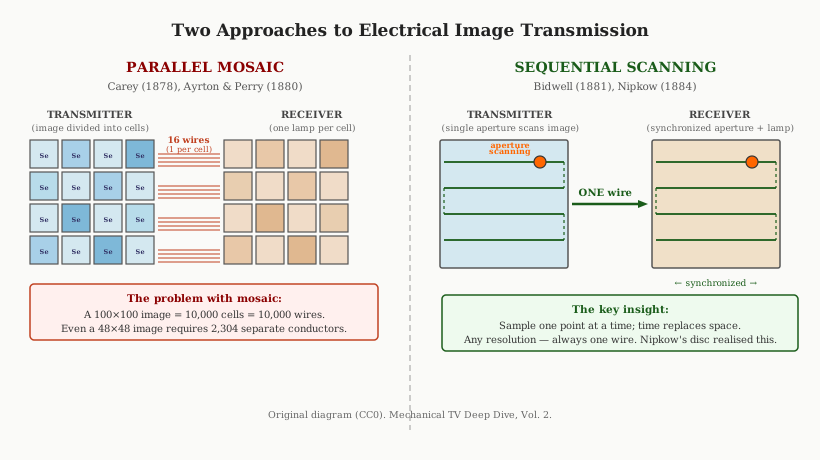
The parallel-mosaic approach was intuitive. An image is a two-dimensional array of brightness values; to transmit all of them, why not connect each cell at the transmitter to its corresponding cell at the receiver? All cells transmit at the same moment; the image arrives all at once; no synchronisation of a scan path is required.
The flaw was arithmetic. Suppose an image of useful clarity required only one hundred cells per side — a very coarse picture. That was ten thousand cells, and ten thousand separate wires. A finer image of three hundred cells per side — still crude by any standard — required ninety thousand wires. Even the telegraph networks of the 1870s could not accommodate such a cable, and no such cable could be strung between cities. The parallel approach, at any useful resolution, was a physical impossibility.
The sequential approach demanded only one wire, regardless of resolution. Instead of transmitting all image points simultaneously, you transmitted them one at a time, in a systematic sequence — scanning across the image. The varying brightness at each position was converted into a varying electrical signal that changed over time. At the receiver, a corresponding scanning motion reconstructed the image, point by point, in the same order. The complete picture existed not at any single moment but across a span of time — the time taken to complete one scan of the image. Provided both ends of the system were synchronised, and provided the complete scan was repeated fast enough for persistence of vision to fuse successive frames into the perception of a continuous picture, a viewer would see the transmitted image as whole and real.
This was the key insight: in an electrical system, time can substitute for space. The two spatial coordinates of the image — horizontal position and vertical position — could both be encoded in a single time axis, if the scanning motion was systematic and both ends were kept in step.
Two practical conditions followed. First, synchronisation: transmitter and receiver had to scan in perfect time with each other, step for step and frame for frame, or the reconstructed image would be scrambled. Second, speed: the complete scan had to repeat fast enough for persistence of vision — ideally ten or more complete images per second — or the viewer would see successive images as separate flashes rather than continuous motion.
In Bidwell’s 1881 apparatus, synchronisation was achieved by linking transmitter and receiver mechanically, on the same shaft. That worked for a tabletop experiment but not for remote transmission. Speed was not remotely achieved: ten minutes per frame rather than ten frames per second. The engineering gap was enormous.
But the principle was right. The question that consumed the next decade was not whether sequential scanning could work in theory — Bidwell had shown that it could — but whether any mechanism existed that could scan an image fast enough, and keep transmitter and receiver synchronised over a distance, for persistent-vision television to become real.
2.5 The Path to Nipkow
By 1881, the field had produced a collection of proposals, most of them on paper, one of them (Bidwell’s) demonstrated in a limited form. The parallel-mosaic ideas of Carey and Ayrton and Perry had been articulated and, to anyone thinking carefully about the wire-count arithmetic, effectively ruled out as impractical at useful resolutions. The sequential-scanning idea had been proposed (Senlecq), critiqued (Sawyer, pessimistically), and demonstrated in a slow-scan form (Bidwell).
What was missing was a mechanism. Senlecq’s stylus was slow. Bidwell’s rotating cylinder was mechanical but still slow, and its synchronisation depended on a shared shaft rather than an electrical signal. No one had yet proposed a mechanism that could scan a two-dimensional image in a systematic pattern at the speed persistence of vision demanded — ten or more complete scans per second — while keeping transmitter and receiver synchronised over a distance by a means compatible with real-world electrical transmission.
That proposal came from a twenty-three-year-old German engineering student, sitting alone in a rented room in Berlin on Christmas Eve 1883, who conceived a remarkably elegant solution: a flat disc, perforated with a single turn of a spiral of holes, spinning at a constant and controllable speed in front of the scene to be transmitted. One complete revolution of the disc swept every hole past the image in sequence, covering the entire image area in a series of strips — lines. Ten revolutions per second delivered ten complete images per second, exactly at the persistence-of-vision threshold. Synchronisation could, in principle, be maintained by keeping both discs turning at the same speed — which synchronous motors, once they existed, could accomplish.
The description of that disc, and the complete theory of the scanning television system it embodied, belongs to the next volume. What this volume has established is the landscape into which Paul Nipkow’s idea arrived: a decade of proposed but unworkable parallel-mosaic schemes, one demonstrated but impractically slow sequential device, and a clear understanding — held by everyone who thought the problem through — that the serial, sequential approach was the only architecture that could ever scale. Nipkow’s disc was the engineering embodiment of that understanding.
Comments (0)