Mechanical TV Deep Dive · Volume 8
The 30-Line Broadcast Era (1929–35)
The BBC’s 30-line television service was, by almost every measurable standard, a negligible broadcasting operation. Its transmissions lasted half an hour to an hour on most evenings, after the main radio programme had closed. Its audience numbered in the low thousands, at most — people who had paid a substantial sum for a Baird Televisor, or who had built their own receiver from a kit, and who were willing to spend twenty minutes adjusting the motor speed and framing phase before they could see anything at all. What they saw, when the adjustments came right, was a postage-stamp-sized, orange-tinged, flickering image of a face, rendered in thirty vertical strips.
And yet the BBC 30-line service was real broadcasting. For six years — from September 1929 to September 1935 — it put television into British homes on a schedule, day after day, with a studio, performers, programmes, and an audience. It was the world’s first regularly scheduled television service that anyone could receive with a commercially available set. What it represented was not what television would become, but where television began.
8.1 The Road to Broadcasting
The relationship between John Logie Baird and the BBC in the late 1920s was one of mutual wariness. The BBC, then under John Reith’s austere stewardship, was not in the business of experiment; it was a broadcasting organisation with standards to uphold and a sceptical governing body to satisfy. Baird, for his part, was a promoter as much as an inventor, and his claims for what television could do were not always supported by what the Televisor could actually deliver. The negotiations that led to the BBC’s involvement took years of lobbying, demonstration, and institutional caution.
The first concession came on 20 August 1929, when the BBC allowed Baird’s team to make an experimental 30-line television transmission using the BBC’s medium-wave transmitter. The transmission was not a programme in any conventional sense; it was a technical test, demonstrating that the system could be broadcast over a real transmitter to real receivers in the field. The significance was infrastructural rather than artistic.
Regular transmissions followed quickly. From 30 September 1929, the BBC began a scheduled 30-line service, with Baird Television Ltd producing the programmes and the BBC providing the transmitter. The first programme included speeches, a comedian, and a song — modest fare, but representative of what the system could convey. A single close-up face, lit by the flying-spot lamp, speaking or performing within the narrow confines of what thirty vertical scan lines could resolve: this was television in 1929.
8.2 The Transmission Path
The technical path from studio to receiver passed through several stages, each introducing its own constraints.
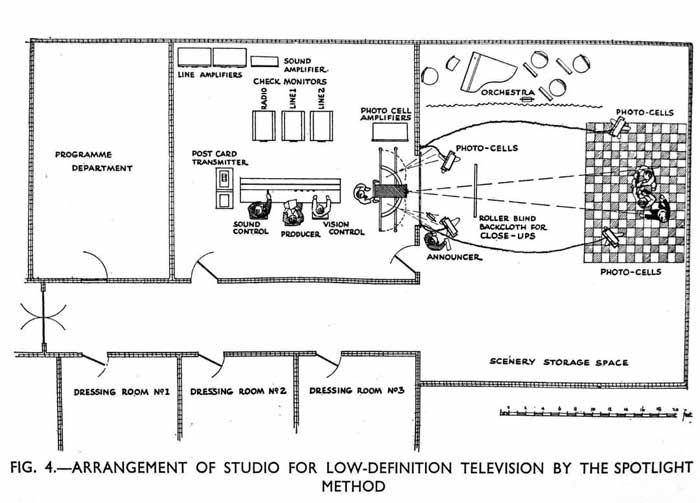
The studio itself housed a flying-spot scanner — a system in which the subject sat motionless in darkness while a rapidly moving spot of light, produced by a cathode-ray tube, swept the face in a raster of thirty vertical strips, the reflected light varying as the spot moved across the features. This was the standard mechanical television transmission approach: not a camera lens focused on the subject, but a scanning beam reading the scene point by point. The subject had to remain almost perfectly still, seated close to the scanner, with the flying-spot lamp producing sufficient heat and glare to make any performance demanding work. Gestures were possible only within a narrow field; a head turned too far disappeared entirely from the frame.
The studio signal — the electrical equivalent of the video, running at audio frequencies because the 30-line bandwidth of roughly ten kilohertz fell within the audio range — was then sent from the studio to the BBC’s transmitter via a telephone landline. This was a standard telephone circuit hired from the General Post Office, which owned and operated the telephone network. The landline imposed its own bandwidth and distortion constraints on the signal, typically limiting the upper frequency response and introducing phase shifts that experienced operators learned to compensate for in the transmitter drive levels.
At the BBC’s Brookmans Park medium-wave transmitter in Hertfordshire, the video signal modulated a standard medium-wave carrier and went out over the air in exactly the manner of a radio broadcast. Any receiver within range that was tuned to the correct frequency and connected to a Televisor display section would, in principle, receive a picture.
8.3 The Sound-and-Vision Problem
The 30-line service’s first eighteen months or so were characterised by a technical inconvenience that made the viewing experience considerably more cumbersome than it later became. Before March 1930, the BBC transmitted the vision signal and the programme sound on separate wavelengths — two different medium-wave frequencies, one for the picture and one for the accompanying audio. The viewer who wished to follow both image and sound had to tune between the two: set the receiver to the vision frequency to watch, then retune to the sound frequency to hear, and back again if they wanted the picture. No viewer could conveniently follow both simultaneously with a single receiver.
This arrangement was a consequence of spectrum management rather than engineering choice. The audio-bandwidth video signal, once placed on a medium-wave carrier, occupied approximately the same channel width as a radio broadcast, and the BBC could not, under its initial arrangements, pair a sound channel with the vision channel in the same transmission.
From March 1930, this changed. The BBC began transmitting sound and vision in a combined signal on a single medium-wave channel — the sound accompanying the vision, as viewers of later television would take entirely for granted. The improvement in the practical viewing experience was substantial: a single tuning operation sufficed, and the sound and picture were guaranteed to be in synchrony. The Televisor sets manufactured from 1930 (the commercial launch year) were designed for this combined arrangement, though they typically retained the two-step tuning process for those who still wished to listen to the audio separately.
8.4 What It Was Like to “Look In”
The phrase “looking in” was the contemporary idiom for watching television, borrowed from the language of radio (where “listening in” similarly distinguished the active engagement of the set’s owner from a more passive encounter). It captured the physical reality accurately: the Televisor viewer pressed their face into the viewing hood at the front of the cabinet and looked in, excluding the room’s light from around the display window.
What they saw, once the motor had been locked to speed and the phasing control had aligned the frame, was a small, rectangular, orange-tinted image in portrait orientation — taller than it was wide, in the 7:3 proportions dictated by the Baird standard. The display measured roughly 30 millimetres across and 70 millimetres tall (the exact dimensions varied by set and lamp). At arm’s length this was approximately the apparent size of a large postage stamp held at twenty centimetres from the eye; through the viewing hood, with the face pressed close to the lens, it appeared somewhat larger.
The image flickered. Twelve and a half complete frames per second is below the threshold at which flicker becomes imperceptible under all conditions; in bright surrounding light the flicker is more visible, in darkness less so. Inside the viewing hood, with the eye adapted to the dim orange glow, the flicker was perceptible but tolerable, described by contemporary reviewers variously as “a slight unsteadiness” and “a rapid trembling of the picture.” It was not the smooth motion of cinema; it was a rapid sampling of the face’s position in time, with the gaps between frames just visible.
The content was almost invariably a single face in close-up — a performer, a presenter, or a demonstration subject sitting within the scanning beam of the flying-spot transmitter. The face was the only subject that thirty vertical strips of resolution could convey with sufficient recognisability to reward the viewer’s effort. Detailed backgrounds were invisible; hands could be shown if held close to the face and in adequate light; full figures were illegible. A caption card, held close to the scanner, could be read if the lettering was large and simple. Everything else — sets, props, costumes, scenery — was either absent from the frame or reduced to a dim, unidentifiable smear.
The experience was still, by almost every contemporary account, extraordinary. The viewer in a Birmingham sitting room or a Glasgow flat was seeing a face from a London studio, in real time, by electricity. The word that recurred in contemporary descriptions was “wonder” — not satisfaction or clarity or entertainment value, but wonder. Something previously impossible was now possible, and the possibility was its own reward.
8.5 The Audience
The audience for the 30-line service was small and self-selecting. To “look in,” one needed either a Baird Televisor — a commercial set selling for approximately £18 to £26 (around 25 guineas), a substantial sum in the early 1930s — or a DIY kit-built equivalent. The kit sets were reportedly cheaper and more popular among the technically inclined, but either way, television ownership required both money and motivation. The total number of domestic television sets in Britain during the 30-line era was probably in the low thousands; the BBC’s own estimates of the “television audience” were correspondingly modest.
Buyers of a Televisor signed a contract specifying the available programming, which underlined the novelty of the arrangement: television was, at this stage, a service one subscribed to as much as a device one purchased. The contract also set expectations: the purchaser understood they were receiving an experimental service of limited hours and uncertain technical quality, not the polished daily output of a mass medium.
The audience was dominated by radio enthusiasts, electrical engineers, and technically curious members of the public — people who already understood the medium-wave spectrum, who had experience building or operating wireless sets, and who were equipped to deal with the Televisor’s motor-speed adjustments, phasing controls, and reception variables. Letters to the BBC and to the technical press from this period suggest a community of engaged, patient experimenters who tracked the improvements in the service (the combined sound-and-vision arrangement of March 1930 was widely celebrated), reported reception problems, and compared notes on disc alignment and framing techniques.
8.6 Programming: From First Transmissions to “Looking In”
The range of programming on the 30-line service was constrained by the same technical limits that defined the viewer’s experience. Performers appeared close to the flying-spot scanner, usually seated, delivering a monologue, a song, or a short comedic routine directly to the camera. Musicians could appear, though only their face was generally visible; instrumentalists were limited to what could be conveyed without a full-body view. Magicians and conjurers found the close-up format suited their craft. Newsreel footage could not be transmitted; drama was essentially impossible; sport was out of the question.
Nonetheless, the BBC and Baird Television Ltd worked within these constraints to build a genuine schedule. By the early 1930s, the service transmitted most evenings, typically for thirty minutes to an hour after the close of the main radio broadcast. Individual performers made repeated appearances, building something like a roster of television regulars.
The landmark programme of the 30-line era came in April 1933 with the BBC’s Looking In — described by the BBC as “the world’s first television revue.” A television revue was a variety programme in television form: a sequence of short acts, performances, and spoken pieces, conceived specifically for the television medium rather than simply transposed from stage or radio. The Looking In programme established that television could have its own formats and conventions, distinct from the theatrical or broadcast traditions it had borrowed from. A domestic enthusiast recorded approximately four minutes of this broadcast onto an aluminium disc using a home cutting device — a Silvatone type recorder — and that fragment would later become one of the most historically significant television recordings ever recovered.
8.7 Phonovision: The World’s First TV Recordings
The fact that any moving image from the 30-line era survives at all is the result of a technical coincidence and a remarkable piece of subsequent detective work. The coincidence was this: the 30-line video signal was audio-bandwidth. Its highest frequency — approximately ten kilohertz — fell within the range that a gramophone cutting head could follow and a gramophone playback stylus could read. A 30-line television signal and a gramophone recording were, electrically, the same kind of signal. The disc that recorded one could record the other.
John Logie Baird understood this from the outset of his television work, and he had experimented with disc recording of the television signal as early as 1927. He called the method Phonovision — a compound of “phonograph” and “television” — and it represented the first systematic attempt to record a television signal for later playback.
8.7.1 Baird’s Experimental Discs (1927–28)
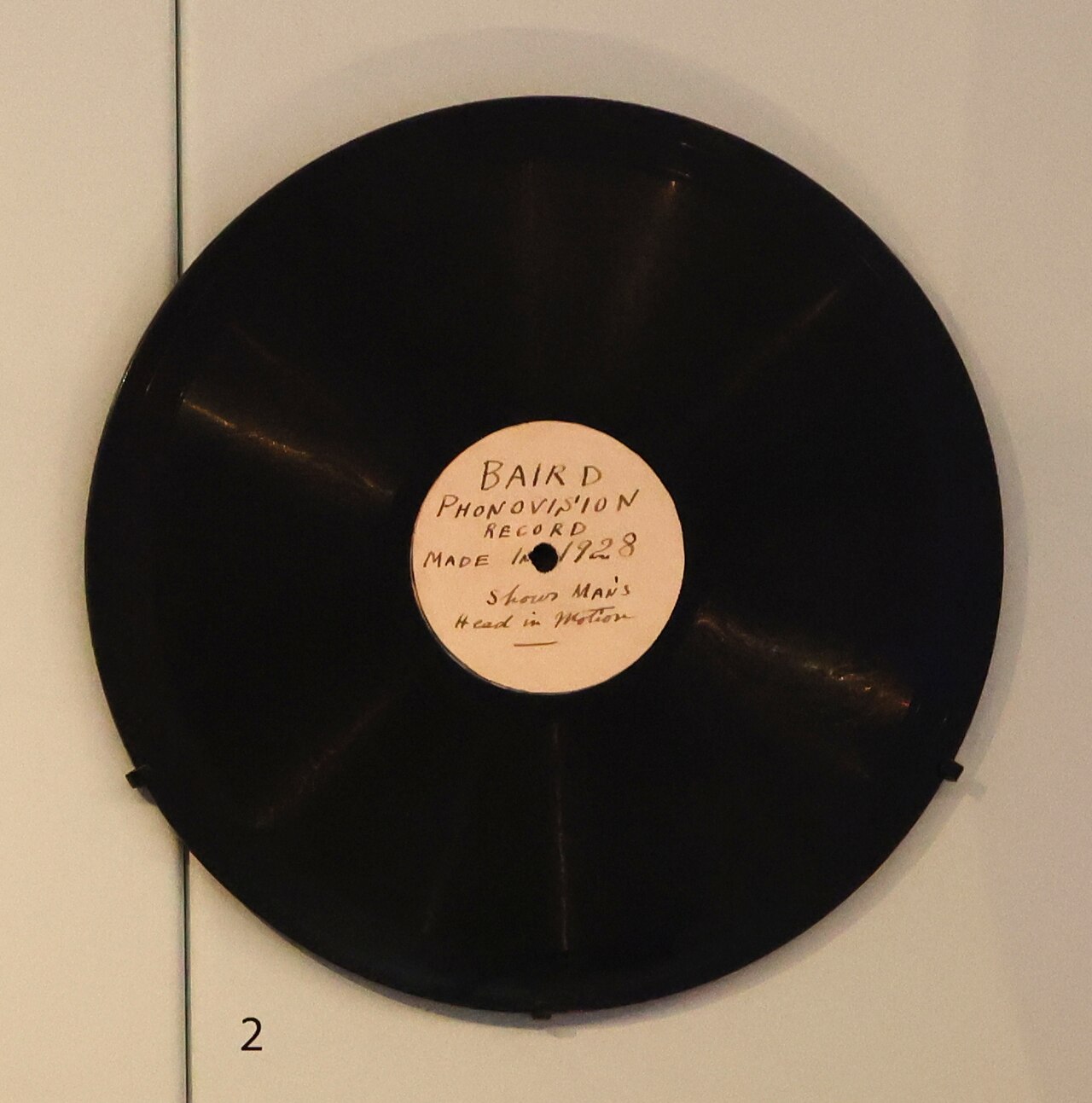
Between September 1927 and March 1928, Baird made a series of experimental Phonovision recordings in his Soho laboratory, cutting the electrical video signal directly onto wax gramophone discs at 78 rpm in the manner of a conventional gramophone recording session. The signal on each disc was the raw electrical output of the flying-spot scanner: not audio, but a modulated carrier in the audio-frequency range, encoding the brightness values of successive scan lines as amplitude variations in the groove.
Five Phonovision discs from this experimental period were later identified by the researcher Donald McLean. The earliest is dated 20 September 1927 and shows a dummy head — test footage of the type Baird routinely used for laboratory trials. This disc predates Baird’s transatlantic television demonstration of February 1928, making it the earliest known recording of a television signal, from the earliest period of practical television.
The next significant disc is dated 10 January 1928 and shows a human face — that of Wally Fowlkes, a member of Baird’s laboratory staff, making him the earliest known human being whose televised image was preserved in any form.
The most famous of the Phonovision discs is dated 28 March 1928. Its subject, identified in the 1990s by McLean and by relatives who recognised her features in the recovered images, was Mabel Pounsford, a secretary employed in Baird’s laboratory. She appears smiling, moving her head slightly — a recognisable human presence captured in thirty orange scan lines on a wax disc nearly a century ago.
8.7.2 Phonovision and the BBC Service Recordings — a Critical Distinction
It is important to distinguish between two different categories of historical disc recording from the 30-line era, which are sometimes conflated.
The Phonovision discs of 1927–28 were Baird’s own experimental recordings, made before the BBC service began. They recorded the output of Baird’s Soho laboratory apparatus, not a BBC broadcast. Their subjects were dummy heads and members of Baird’s own staff. They are, in the literal sense, the world’s first recordings of a television signal.
The off-air recordings of the BBC service were made later and by different means. During the period of the BBC 30-line broadcasts (1929–35), a small number of private enthusiasts cut recordings of the transmitted signal onto aluminium discs using home recording equipment — domestic cutting devices sold under names such as “Silvatone.” These were analogous to home recording from radio: a receiver tuned to the BBC’s television transmission, its output fed to a cutting head, preserving the broadcast signal on a disc at home. The resulting aluminium discs degraded less readily than wax; several survived.
The most significant of these BBC-service recordings is the fragment of Looking In (April 1933) — approximately four minutes of the broadcast cut onto an aluminium disc by a domestic enthusiast. This is the oldest surviving recording of an actual BBC television programme.
Both categories of disc — Baird’s wax Phonovision discs and the later aluminium off-air recordings — were physically similar, electrically compatible, and ultimately recovered by the same researcher. But their origins, dates, and historical context are distinct.
8.8 Donald McLean and the Recovery of the Past
For decades after the 30-line era ended, the Phonovision discs and off-air recording discs sat in collections and archives as curiosities: clearly television-related, clearly old, but essentially unplayable. A conventional gramophone stylus would follow the groove, but the output — the raw 10-kilohertz television signal — bore no resemblance to audio. The picture information was encoded in modulation patterns that no standard playback system could interpret as images. The discs were historical objects that no one could actually watch.
Donald F. McLean changed this. McLean, a British electronics engineer with a professional background in broadcast signal processing, became aware of the Phonovision discs in the early 1980s and began investigating whether their contents could be recovered. His first investigation dates from 1982, when he examined the discs and attempted rudimentary playback. The fundamental problem was not electronic but mechanical: disc recordings of this age, made on imperfect equipment, were subject to mechanical warping and to variations in the cutting speed that meant the recovered signal was geometrically distorted — scan lines of unequal length, frames of unequal duration, the image smeared and compressed in ways that varied across the disc as the recording speed drifted.
Recovering a coherent image required correcting these mechanical distortions with a precision that analogue methods could not easily achieve. The solution came with the advent of digital signal processing in the early 1990s. By the mid-1990s, McLean had developed a computational approach that could:
- digitise the audio-frequency output of a disc playback system at high sample rates;
- analyse the encoded video signal to identify the timing of scan-line transitions and frame boundaries;
- correct for mechanical wow and flutter on a line-by-line basis, stretching or compressing each scan line to its correct geometric length;
- reconstruct a coherent video frame from the corrected scan data.
The resulting images were the first time anyone had seen a moving face recorded before 1928. Mabel Pounsford’s expression on 28 March 1928; Wally Fowlkes photographed by television on 10 January 1928; the dummy head test footage from 20 September 1927 — these images, locked for over sixty years in grooves that no standard equipment could interpret, emerged from McLean’s analysis as viewable, recognisable images.
McLean documented the full story of the discs and his recovery methodology in his book “Restoring Baird’s Image”, published by the Institution of Engineering and Technology (IET) in 2000. It remains the definitive account of Phonovision and of the techniques used to recover its contents.
The Looking In fragment — the aluminium-disc off-air recording of the April 1933 BBC television revue — was also recovered and analysed by McLean. This approximately four-minute fragment is the oldest surviving recording of a scheduled BBC television programme, and McLean’s recovery of it preserved a piece of television history that would otherwise have existed only in contemporary written accounts.
8.9 The Social and Cultural Meaning
The 30-line service mattered, and it is worth being precise about why, because the conventional framing — “the first television broadcasts, but too limited to be practical” — risks understating what actually happened.
What the BBC and Baird Television Ltd constructed between 1929 and 1935 was not a prototype or a demonstration. It was an operational television service: a studio, a transmission chain, a schedule, a set of performers, a commercial receiver, and an audience. It established the institutional, technical, and regulatory precedents for everything that followed. The BBC was a public broadcasting organisation; when it began transmitting television, television became subject to the same standards of editorial responsibility, scheduling discipline, and public accountability that governed radio. Those norms, established during the 30-line years, shaped British television in its higher-definition successors.
The social experience of “looking in” in the early 1930s was also formative in ways that the small audience numbers do not capture. The people who owned Televisors in 1930, 1931, and 1932 were, in many cases, writing letters to the press, talking to their neighbours, and describing television to people who had never seen it. The accounts they gave — of the small orange image, the wonder of seeing a face from a London studio in their sitting room, the difficulty of adjustment and the satisfaction when it came right — built public awareness of and appetite for television years before the majority of the population had any prospect of owning a set. The 30-line era created the concept of domestic television in British public consciousness.
The performers who appeared on the 30-line service — the comedians, singers, and demonstrators who sat under the flying-spot lamp in the Baird studio — were the first television performers in history. They worked without scripts displayed on monitors, without a studio audience for feedback, in conditions of considerable physical discomfort (the flying-spot lamp required both stillness and tolerance of bright light), in a medium whose audience was invisible and whose reach was limited. They improvised a performance vocabulary for a medium that had no predecessors.
8.10 The End of the Service
The 30-line service came to an end on 11 September 1935, when the BBC transmitted the final broadcast on the Baird 30-line standard. By that date, the limitations of the system had become increasingly apparent against the backdrop of what electronic television was beginning to offer. Baird himself had spent the preceding years pushing the boundaries of what the mechanical approach could do — in colour, in large-screen projection, in higher line counts — and the BBC was preparing for the higher-definition service that would launch from Alexandra Palace in November 1936.
The Televisors that had served as the receiver for the 30-line service became, overnight, obsolete. Approximately 1,000 had been sold; their owners had nothing left to watch. The British public that had followed the service in the newspapers, and the few thousand who had owned sets, waited two years for the next development.
The six years of regular broadcasting from 1929 to 1935 left behind the institutional foundations of BBC television, a small but significant body of survivor disc recordings, and the knowledge — established by practical operation rather than theoretical argument — that domestic television was possible. The limitations that were apparent in the 30-line image were the limitations of thirty lines, not the limitations of the idea.
What the limits of thirty lines were, and what Baird attempted to transcend them before the mechanical era closed, is the subject of Vol 9 (Pushing the Limits). Why electronic television ultimately overtook the mechanical approach, and what happened at Alexandra Palace, is the subject of Vol 10 (Why Electronic TV Won).
8.11 Cross-References
- The hardware of the Baird Televisor receiver — the disc, motor, neon lamp, and controls used to receive the 30-line service — is described in detail in Vol 6 — Inside the Baird Televisor.
- The transmission standard parameters (30 lines, 12.5 fps, 7:3 portrait, vertical scan) are defined and verified in Vol 6 and in the reference table in Vol 16 — Reference and Cheatsheet.
- Baird’s biography and the earlier demonstrations that preceded the BBC service are covered in Vol 5 — John Logie Baird and the First Television.
- The rival international services that developed alongside the BBC’s 30-line output are surveyed in Vol 7 — The Rivals.
- Baird’s own large-screen, colour, and high-definition experiments during and after the 30-line years are covered in Vol 9 — Pushing the Limits.
Comments (0)