Mechanical TV Deep Dive · Volume 11
The Modern Revival: NBTV and the NBTVA
Mechanical television, as a broadcasting technology, ended twice: first in Britain in September 1935, when the BBC closed its 30-line service in favour of an electronic future still a year from launch, and again more decisively in February 1937, when the 240-line Baird system lost its trial at Alexandra Palace to the all-electronic Marconi-EMI system. By any measure that mattered to broadcasters, engineers, and audiences, the scanning disc was finished. What nobody could switch off was curiosity. Scattered individuals — the kind of people who had built their own 30-line receivers as teenagers, or who simply found something irresistible in the idea of a picture carried as a spinning disc and a glowing lamp — kept tinkering in sheds and spare rooms long after the BBC had moved on. That undirected, half-invisible persistence took forty years to organise itself into a club, but when it did, it produced something unusual in the history of any obsolete technology: a living standard, actively maintained by an international membership, that people still build working television sets to. This volume tells that story — the founding of the Narrow-Bandwidth Television Association, the people who built it, what it does today, and the modern 32-line standard it maintains, including the surprisingly mundane reason it settled on 32 lines rather than Baird’s original 30.
11.1 A Hobby That Refused to Die
Between the end of the 30-line broadcasts and the mid-1970s, mechanical television survived only as private enthusiasm. There was no club, no newsletter, no shared standard — only individuals who had kept a disc, a neon lamp, or simply a fascination with the idea, and who experimented alone or in small, disconnected correspondence with others who shared the interest. Some of this activity left traces in amateur radio and electronics magazines of the period: letters, small write-ups, the occasional home-built receiver. What it lacked was any mechanism for the scattered enthusiasts to find one another, compare notes, or agree on common technical ground — the same problem that broadcasters had solved in the 1920s and 1930s by settling on the Baird 30-line standard, and that the hobby would now have to solve for itself, from nothing, four decades later.
The catalyst, when it came, was almost accidental: a schoolteacher’s idea for a class project, a letter to a magazine, and a small advertisement — the unremarkable, granular way most durable institutions actually begin.
11.2 Founding the Low Definition Television Association
In 1972, Doug Pitt, a science teacher in Nottingham, proposed to a colleague, the amateur engineer Stan Kujawinski, that building a mechanical television system would make an interesting project. Around the same time, Pitt read a letter to the editor in the magazine Wireless World from an Australian schoolboy named Chris Long, who — remarkably for someone still in school — had already built a working 30-line disc camera using a photomultiplier tube and had transmitted signals on the amateur radio bands with the help of a licensed “ham” friend. It occurred to Pitt that if a science teacher, an amateur engineer, and a schoolboy on the other side of the world had each independently arrived at the same idea, there were probably many more people thinking along similar lines who simply had no way of finding each other.
Pitt placed advertisements in a number of technical magazines, inviting correspondence from anyone interested. The response was immediate. A “low definition circle” formed, and single-page “Ideas Sheets” began circulating among the growing list of correspondents at irregular intervals. By 1975 the circle had grown to more than forty people, and in April of that year a meeting was called at the Clifton Training College in Nottingham — now Nottingham Trent University — which drew more than a dozen of the correspondents in person. That meeting established the Low Definition Television Association (LDTVA), open worldwide to anyone interested in the techniques.
The new association’s first officers reflect how informal its beginnings were: there were only two volunteers for administrative roles, with Stan Kujawinski agreeing to serve as Membership Secretary and Treasurer while Doug Pitt handled everything else. Fred Ward, callsign G2CVV, agreed to be the club’s first President. That same April, the association held its first exhibition — an event that would become an annual fixture, and the direct ancestor of the Convention the club still holds today.
11.3 From LDTVA to NBTVA
The young association grew steadily through the second half of the 1970s. In 1976 it published its first newsletter — twelve pages that established the format the club’s newsletter still follows today — and in 1978 the association changed its name to the one it carries now: the Narrow-Bandwidth Television Association (NBTVA). The club defines itself, in its own words, as “an association of experimenters in low definition and mechanical television” — a description that has needed no revision since.
Through the 1980s and 1990s the club’s administration and technical culture both matured. In 1981, Jeremy Jago took over the job of dispatching the quarterly newsletter, and from 1984 also took over the printing of the photographs that illustrated it. In 1993, Les Robotham (G8KLH) took over the Club Sales operation, strengthening the club’s ability to supply members with components difficult to find elsewhere. In 1996, Grant Dixon (G8CGK) organised the club’s first website — a new departure that made the association and its activities visible to a far wider audience than a quarterly print newsletter ever could.
The technical character of the hobby changed too, in step with the wider electronics industry. The earliest member-built cameras — by Long, Kujawinski, and Pitt themselves — were photomultiplier-based, drawing on the broader tradition of light-sensitive photocells that Willoughby Smith’s 1873 discovery of selenium’s response to light had opened up almost a century earlier — though the photomultiplier’s photoemissive vacuum tube works by a different physical mechanism from selenium’s change of resistance. After 1977 and 1978, when members Dave Sumner (G3PVH) and Alan Short demonstrated cameras built around the newer phototransistor, semiconductor-based designs became the dominant approach — smaller, cheaper, and far more forgiving to build than a vacuum photomultiplier tube. A further leap came in 1988, when Don McLean — the same Donald McLean whose forensic recovery of Baird’s Phonovision discs is described in Vol 8 — demonstrated a digital standard converter for NBTV signals, opening an era in which computer-based generation and enhancement of images became a normal part of the hobby rather than a novelty.
The club’s reputation grew alongside its membership. Members have given talks on NBTV to bodies as varied as the Society for Information Displays, the Institution of Electrical Engineers, the British Association for the Advancement of Science, and the Royal Society — the same Royal Society, as it happens, that heard Peter Mark Roget’s 1824 paper on the optical effect later popularised as “persistence of vision,” a century and a half before the hobby it helped make possible had a name.
11.4 What the Association Does Today
The NBTVA today operates much as it has for decades, run entirely by volunteers in their spare time, and explicitly not as a commercial venture. Its core activities are simple and durable: a quarterly newsletter, a website, an online forum, an annual Convention, and a Club Sales operation supplying parts that would otherwise be hard for an individual builder to source.
The newsletter remains a twelve-page A4 magazine mailed to members four times a year, mixing technical articles, historical pieces, and news, illustrated with colour photographs — often of members’ own constructions. The club’s website (nbtv.org, itself reachable only over plain HTTP and redirecting to nbtv.wyenet.co.uk — a small anachronism appropriate to an association devoted to an obsolete medium) links out to the wider constellation of NBTV-related pages members have built themselves, and hosts an online forum at taswegian.com/NBTV/forum where day-to-day discussion, project diaries, and troubleshooting happen year-round. That forum is not a historical archive: at the time of this research, its boards showed active posting within days of the fetch, spanning well over a thousand topics and many thousands of posts in the mechanical-television section alone — a small but genuinely live community, not a relic of one.
The Annual Convention, held each April in Loughborough in the English Midlands, is the club’s central social and technical event: an afternoon of demonstrated equipment, hands-on help from experienced members for anyone building or troubleshooting a set, and an Annual General Meeting to close the day. Some years’ proceedings have been recorded on video and released to members as a club CD encoded in the club’s own 30- or 32-line format — a fittingly self-referential way to document a meeting about narrow-bandwidth television. Beyond the national Convention, regional groups of members organise their own local meetings later in the year, and the club’s radio amateurs maintain a weekly on-air schedule on the 80-metre band, coordinated through the newsletter and website, for members who prefer to send and receive their pictures over the air rather than by cable or disc.
11.5 The Modern 32-Line Standard
Central to all of this — the newsletter’s technical articles, the Convention’s demonstrations, the Club Sales stock of pre-drilled discs — is a shared technical standard that lets members’ equipment actually talk to one another. Just as the BBC’s 30-line broadcasts only worked because transmitter and receiver agreed on line count, frame rate, scan direction, and aspect ratio, the modern hobby needed its own agreed standard once it moved beyond isolated individual experimentation into a community that wanted to exchange signals, discs, and equipment designs.
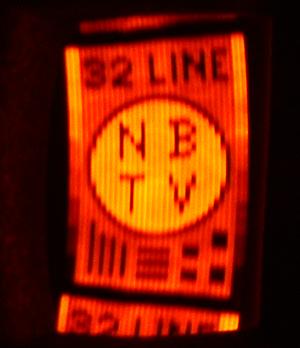
The standard the NBTVA settled on and still maintains is 32 lines per frame at 12½ frames per second — close kin to the Baird broadcast standard in almost every other respect (the same vertical, bottom-to-top line scan; the same horizontal, right-to-left frame scan; the same portrait picture orientation), but with a slightly taller-and-narrower 3:2 aspect ratio in place of Baird’s 7:3, and two more lines per frame than Baird ever broadcast. The signal itself is deliberately kept within audio frequencies — its baseband video occupies roughly 2 Hz to 10 kHz — which means, remarkably, that a complete NBTV picture can be recorded on an ordinary audio CD, played back through a sound card, or even sent out over an amateur radio voice channel, exactly as Baird’s own engineers discovered when they cut the Phonovision discs in the late 1920s. The full technical parameters of the standard — sync-pulse timing, signal polarity, bandwidth tolerances, and how the 30-line and 32-line standards compare line by line — are set out in full in Vol 12 and tabulated for reference in Vol 16; this volume is concerned with the standard’s origin and its people, not its waveform.
One number in that standard, though, deserves its own explanation, because it is the detail every newcomer to NBTV asks about first: why 32 lines, and not simply Baird’s original 30?
11.6 Why 32, Not 30
It would be easy to assume the modern club chose 32 lines for some principled technical reason — to keep the signal more comfortably within audio bandwidth, say, or deliberately to distinguish the revival from the historical Baird standard. Both explanations circulate informally among newcomers to the hobby, and both are plausible-sounding. Neither, it turns out, is what actually happened, and the club itself has settled the question in its own historical record.
In a 2008 discussion on the NBTVA’s own forum, member Dave Moll quoted a passage from the NBTV Newsletter (volume 33, number 3) in which Stan Kujawinski — the amateur engineer who had co-founded the club with Doug Pitt in the early 1970s — explained the decision in a reminiscence about his late colleague. Kujawinski’s own words: “We made the decision to try and base our attempt using 32 vertical scanning lines rather than the original 30 used by Baird. The decision was made for practical reasons to do with accurately marking out the angles for scanning discs using compasses and dividers.”
The reasoning behind that “practical” phrase is itself a small piece of hobbyist ingenuity, worked out by several forum members in direct reply to Kujawinski’s quoted account in that same 2008 discussion. Thirty-two is two raised to the fifth power — and a circle can be divided into 32 equal sectors by nothing more sophisticated than repeated halving: draw a line through the centre for 180 degrees, a second line at right angles for four quadrants, then bisect each resulting angle in turn — 8 divisions, then 16, then 32 — using only a straightedge, a compass for the original circle, or even a folded paper template. Thirty holes at 12 degrees apart, by contrast, does not fall out of that kind of repeated bisection nearly as cleanly and generally calls for a protractor instead. For a kitchen-table hobbyist in the mid-1970s marking out a disc by hand — exactly the audience the founders had in mind, and exactly the constraint Kujawinski was describing — the geometric convenience of a power-of-two line count was a genuinely practical consideration, whatever the two extra lines cost in fidelity to Baird’s original figure.
It is worth being honest that this explanation, while it is the club’s own on-the-record account from a founding member, has not silenced every doubt within the club itself — in the very forum post that first quoted Kujawinski, Dave Moll admitted the rationale puzzled him, remarking that he would have thought it far easier to mark out 30 holes 12 degrees apart than 32 holes 11¼ degrees apart with the same compasses and dividers, and the discussion has the good-natured, unresolved texture of engineers arguing about a colleague’s forty-year-old design decision. The audio-bandwidth and Baird-differentiation explanations that circulate informally are not supported by the club’s own published standard, which gives the historical 30-line signal a comparable theoretical bandwidth (roughly 13 kHz) to the modern 32-line standard’s roughly 10 kHz — so bandwidth is not the deciding factor either way. What can be said with confidence is that the choice of 32 traces to a specific named founder’s account of a specific practical problem — laying out equally spaced holes on a disc with hand tools — and not to any deeper theoretical rationale.
11.7 What Members Build Today
The NBTVA’s own literature treats building a disc televisor as the natural first project for anyone joining the hobby, and its published construction chapter recommends exactly that path: build a disc-based receiver first, using one of the club’s own test CDs as a signal source, before attempting a camera or an electronic pattern generator. The parts list for a basic build reads like a hybrid of 1920s and 21st-century technology in the same sentence — a wooden baseboard; a small 12-volt DC motor, often simply a recycled cassette-deck motor sold through Club Sales; a pre-drilled Nipkow disc, cut to precise tolerance on a numerically controlled machine rather than marked out by hand; a cluster of high-brightness LEDs in place of the historic neon lamp; a magnifying glass; and a light-tight viewing tunnel to exclude ambient light exactly as the Baird Televisor’s own viewing hood once did (see Vol 6). One documented example, built by member Peter Smith, is deliberately minimalist — components mounted openly on a baseboard rather than hidden in a cabinet — while Smith has also built a considerably more elaborate reproduction of a full Baird Televisor cabinet. Belgian member Denis Asseman has built a replica receiver modelled on Dénes von Mihály’s Telehor system (see Vol 7), reviving a rival 1920s design rather than Baird’s own.
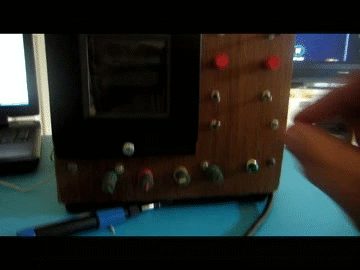
Beyond the classic spinning disc, the club’s own equipment guide documents a wider menu of scanning and display technologies still in active use among members. The aperture drum wraps a strip of drilled material around a rotating cylinder rather than a flat disc — mechanically a variant of the Nipkow principle. The mirror drum, using angled mirror facets around a drum’s circumference to sweep a beam of light, is the very technique the BBC itself adopted for its own 30-line studio work from 1932 onward (see Vol 5), and remains a technique some members reproduce today. The mirror screw — a helical “spiral staircase” of polished mirror strips capable of a genuinely large projected image — is explicitly flagged in the club’s own literature as unsuitable for beginners, since the alignment and polish of every mirror strip is critical to a usable picture. And modern electronics has opened routes the original 1920s and 1930s engineers never had: a standard cathode-ray tube, turned on its side for portrait orientation and with its deflection speeds altered, can display a 30- or 32-line NBTV signal directly; an ordinary vidicon camera tube can be converted to capture NBTV video; and digital scan converters can translate between NBTV and ordinary consumer video formats, letting an unmodified camcorder or television serve as an NBTV source or display. Members have gone further still, experimenting with LCDs, photosensitive welding goggles, and even inexpensive commercial laser projectors as scanning light sources — the latter demonstrated at a club Convention by member Colin Hopper, with the club’s literature adding the entirely reasonable caution that lasers should be handled only by people competent in using them safely.
The club is equally particular about how NBTV signals should be recorded and shared, precisely because the signal’s audio-frequency nature is both its greatest practical convenience and its most fragile property. The NBTVA recommends CD-R, CD-RW, or DVD-Audio as the best media for storing or distributing NBTV material — ordinary 44.1 kHz stereo digital audio, with video carried on one channel and sync or accompanying sound on the other — because digital audio recording preserves the waveform essentially without distortion and plays back at a crystal-stable, precisely known speed. The club’s own literature is equally direct about what does not work: lossy compressed audio formats such as MP3, tuned by their designers to discard whatever the human ear will not miss, discard exactly the fine waveform detail an NBTV picture depends on, and will visibly corrupt the image even where the sound loss would be inaudible to a listener. Members who prefer to send their pictures out over the air rather than by disc or file do so much as the club’s radio amateurs always have, using AM, FM, or vestigial-sideband transmission schemes documented in the club’s own standards literature and coordinated through the weekly 80-metre net.
11.8 A Living Standard
What distinguishes the NBTVA from a museum or a re-enactment society is that its standard is not a fixed historical artefact being faithfully copied — it is a working specification that a currently active membership builds against, tests against, and occasionally still argues about, exactly as Kujawinski and his fellow founders argued about disc geometry in the 1970s and as members still debate it on the club forum today. New members download the same standard, order the same discs from Club Sales, and can plug their newly built receiver into a signal from another member’s camera on the other side of the world and expect it to work — a small, durable act of standardisation that the Baird company itself, competing against Marconi-EMI, never managed to make permanent. The hobby that refused to die in the decades after 1937 did something more than keep an old idea alive: it kept a shared, working, revisable standard alive, in continuous use, for half a century and counting.
That standard — its exact sync pulses, its bandwidth tolerances, its signal polarity, and precisely how a two-dimensional picture becomes a one-dimensional, audio-frequency waveform and back again — is the subject of the next volume. Vol 12 takes the 32-line standard introduced here and follows a single frame all the way from a camera’s photocell, through encoding, transmission, and reception, to the glow of a modern LED or the flicker of a modern hobbyist’s own spinning disc. It is also, not coincidentally, the chapter that matters most for anyone assembling the modern NBTV kit described in the companion Televisor Kit Build dive on this site, since that kit speaks precisely the signal this volume has only introduced.
11.9 Cross-References
- The end of mechanical broadcasting and the beginning of the decades-long informal hobbyist interest this volume picks up are described in Vol 10 — Why Electronic TV Won.
- The Baird 30-line standard that the modern 32-line standard deliberately echoes (and departs from) is set out in full in Vol 8 — The 30-Line Broadcast Era (1929–35), including Donald McLean’s Phonovision recovery work — the same McLean who later built an NBTV digital standard converter, as described above.
- Dénes von Mihály’s Telehor system, replicated today by NBTVA member Denis Asseman, is introduced in Vol 7 — The Rivals.
- The Baird Televisor’s own viewing hood, cabinet, and receiver construction — echoed in the modern hobbyist builds described here — are dissected in Vol 6 — Inside the Baird Televisor.
- The modern NBTV signal — sync pulses, bandwidth, and the full encode-to-display chain only introduced here — is explained in complete technical depth in Vol 12 — The NBTV Signal Explained.
- The 30-line and 32-line standards are tabulated side by side for quick reference in Vol 16 — Reference and Cheatsheet.
Comments (0)