Mechanical TV Deep Dive · Volume 16
Reference & Cheatsheet
Fifteen volumes back, this series opened with a spinning disc of darning needles and bicycle-lamp lenses in a rented Hastings room, and it has since carried that one idea — decompose a picture into a stream of light, transmit the stream, reconstruct the picture — through a century of names, numbers, dates, and technical terms: Nipkow, Baird, Jenkins, Mihály, Rosing, Takayanagi, Phonovision, Emitron, Telechrome, the NBTVA. No reader is expected to have memorised all of it, and no reader should have to page back through fourteen volumes to check whether the Baird standard ran at 12.5 or 7.5 frames per second, or whether a genuine Nipkow disc’s holes were round or square. This volume exists to answer exactly those questions in one place: a standards table with the numbers that matter, a glossary of every recurring term, a timeline of the whole story end to end, a roster of the people who built it, a list of where the real hardware lives today, a short shelf of further reading, and an index back into every volume above. Read it start to finish if you like, but it is built to be opened at a single page and closed again — the volume to bookmark, not to read once and shelve.
16.1 Standards Table: Baird 30-Line vs. NBTV 32-Line
The single most-referenced table in this series. Every number below is checked against the verified-facts research record (§4 for the Baird standard, §8b/§8d for the modern NBTVA standard) and is not restated differently anywhere else in this series.
Table 1 — Standards Table: Baird 30-Line vs. NBTV 32-Line
| Parameter | Baird 30-line (BBC broadcast standard, 1929–35) | NBTV 32-line (modern NBTVA club standard) |
|---|---|---|
| Lines per frame | 30 | 32 |
| Frame rate | 12.5 fps | 12.5 fps |
| Lines per second | 375 (30 × 12.5) | 400 (32 × 12.5) |
| Line scan | Vertical, bottom to top | Vertical, bottom to top |
| Frame scan | Horizontal, right to left | Horizontal, right to left |
| Aspect ratio (height:width) | 7:3, portrait | 3:2, portrait |
| Video bandwidth | ~10 kHz in practice (~13 kHz theoretical) | 2 Hz–10 kHz at −3 dB |
| Scanning method | Progressive (no interlace) | Progressive (no interlace) |
| Signal amplitude | Not standardised to a specific voltage in surviving records | 1 volt peak-to-peak |
| Video polarity | Not standardised in surviving records | White most positive, black most negative |
| Sync pulses | An ordinary black bar between lines — no “blacker-than-black” scheme; consequently, an all-black picture could not be transmitted without losing sync, so black pictures were never permitted on the BBC service | ”Blacker than black” — 33%–50% more negative than black level, AC-coupled |
| Frame sync | Achieved by disc geometry and motor synchronisation (no missing-pulse convention documented) | The line-sync pulse is deliberately omitted between line 32 and line 1; video is held black during the gap |
| Disc rotation (typical club practice) | Not separately standardised in surviving records | Anti-clockwise; viewing position on the disc: right |
A footnote worth reading before quoting the 7:3 figure elsewhere: the NBTVA’s own standards.htm notes that on the actual Baird Televisor, “the first three and last three lines were made wider and spaced further apart” than the rest, which altered the effective aspect ratio of the viewed picture to something closer to 2:1 — so 7:3 is the nominal scanning-geometry ratio, not necessarily the exact shape of the picture a Televisor owner actually saw. Both figures are correct; they answer slightly different questions, and this volume keeps them straight rather than picking one.
A third historical variant is worth a single mention for context, without complicating the table above: a German standard used by the TeKaDe receiver ran 30 lines at 375 lines/sec like Baird’s, but scanned horizontally left-to-right for the line and vertically top-to-bottom for the frame — a landscape orientation, aspect ratio 3:4 — proof that the vertical-line/horizontal-frame/portrait choice common to both standards in the main table was a design decision, not a physical necessity of the scanning-disc principle itself.
Glossary
Alphabetical. Each entry is one to two sentences; volume numbers point to where a fuller treatment lives.
- Aperture (scanning hole). One of the perforations in a Nipkow disc’s spiral, through which light passes to (or from) the photocell or lamp behind it. Genuine production Baird Televisor discs are documented with square-section apertures, not round ones — do not describe Baird holes as circular (Vol 6, Vol 13, Vol 14).
- Aspect ratio (portrait). The height-to-width proportion of the scanned image; both the Baird (7:3) and NBTV (3:2) standards scan a picture taller than it is wide, suited to a single head-and-shoulders subject (Vol 4, Vol 16).
- Bandwidth (video). The range of frequencies a video signal occupies; both mechanical standards keep their bandwidth low enough to fit within an ordinary audio channel — around 10 kHz for Baird, 2 Hz–10 kHz for NBTV (Vol 4, Vol 12).
- Blacker-than-black sync. The modern NBTV convention of driving the sync pulse 33%–50% more negative than the video’s own black level, so a receiver can distinguish “sync” from “genuinely black picture content” even during an all-black scene — something the historical Baird signal could not do (Vol 12).
- Club Sales. The NBTVA’s members-only parts shop — pre-drilled discs, motors, driver boards, and free CAD files — the practical, low-cost route into building a working modern receiver (Vol 11, Vol 14).
- Condenser lens. A lens (often salvaged from a slide projector) placed behind a Nipkow disc to concentrate the light diverging from a single scanning aperture onto the photocell (Vol 13).
- Emitron. The camera tube developed by EMI for the Marconi-EMI 405-line system; the electronic camera that beat Baird’s mechanical/intermediate-film system at Alexandra Palace (Vol 10).
- Flying-aperture (receiver). A receiving Nipkow disc’s aperture, sweeping past a fixed lamp, reconstructing the image line by line — the mirror image, at the display end, of the flying-spot scan at the camera end (Vol 4).
- Flying-spot (scanner). A scanning method in which a moving spot of light is projected onto the scene or onto film, with a fixed photocell reading the reflected or transmitted brightness; used in Baird’s later studio cameras and intermediate-film scanners (Vol 4, Vol 9).
- Framing / phasing. The manual controls on a Televisor (or a modern disc receiver) that adjust the disc’s rotational position relative to the incoming signal so the picture sits square in the viewing window rather than sliding sideways or wrapping around (keystoned or torn) (Vol 6, Vol 13).
- Gamma. The non-linear relationship between a display’s input signal and its output brightness; a plain neon-lamp or LED disc televisor is close to gamma = 1 (linear), unlike a CRT (gamma ≈ 2), which is why unmodified broadcast-style video can look “bleached out” on a linear disc set (Vol 13).
- Iconoscope. Vladimir Zworykin’s camera tube design for RCA, patented (in application) 1923 but not working until 1933; the American electronic counterpart to EMI’s Emitron (Vol 10).
- Intermediate film (system). A television method in which a scene is filmed on ordinary movie film, rapidly developed (in roughly 45 seconds), and then scanned by a flying-spot scanner — a workaround for early electronic cameras’ insufficient light sensitivity, used by both Fernseh AG and Baird (Vol 9).
- Keystone distortion. A trapezoidal warping of the scanned picture caused by imperfect disc-to-lamp or disc-to-lens geometry; one of the practical faults a framing/phasing adjustment is meant to correct (Vol 6, Vol 13).
- Line scan. The direction in which a single scanning line is traced; both the Baird and NBTV standards trace each line vertically, bottom to top (Vol 4, Vol 16).
- Lines per frame. The number of scan lines that make up one complete picture; 30 for the Baird standard, 32 for modern NBTV (Vol 4, Vol 16).
- Low Definition Television Association (LDTVA). The original 1975 name of the club later renamed, in 1978, the Narrow-Bandwidth Television Association (Vol 11).
- Mirror drum. A scanning device using angled mirror facets around the circumference of a spinning drum, each facet sweeping the light beam across one scan line; the technique the BBC itself favoured in its studio cameras from 1932 (Vol 9, Vol 11).
- Mirror screw. A helical, “spiral staircase” arrangement of mirror facets on a rotating shaft, one facet per line; capable of larger, brighter images than a disc scanner but demanding critical alignment and polish tolerances (Vol 9, Vol 11).
- Missing-pulse frame sync. The modern NBTV convention that marks the start of a new frame not by adding a special pulse but by deliberately omitting the ordinary line-sync pulse that would otherwise fall between line 32 and line 1 (Vol 12, Vol 13).
- Narrow-Bandwidth Television (NBTV). The modern hobbyist standard and signal convention — 32 lines, 12.5 fps, audio-bandwidth video — that keeps the scanning-disc tradition alive today (Vol 11, Vol 12).
- Narrow-Bandwidth Television Association (NBTVA). The international hobbyist club, founded 1975 (as the LDTVA), that defines and maintains the modern 32-line standard, sells parts, and holds an annual Convention (Vol 11).
- Neon lamp (flat-plate). The glow-discharge lamp used as the display element in a Baird Televisor and in some modern club builds; neon’s emission spectrum is essentially monochrome orange, which is why every historical mechanical television picture was rendered in shades of orange rather than grey (Vol 4, Vol 6).
- Nipkow disc. A flat disc pierced near its edge with a single-turn spiral of apertures; rotating it in front of a scene (or a lamp) decomposes (or reconstructs) an image line by line. Conceived by Paul Nipkow in 1884 and never built by Nipkow himself (Vol 3).
- Persistence of vision. The perceptual effect by which the eye fuses a rapid enough sequence of still images into the impression of continuous motion; the practical threshold used throughout this series is roughly 10–16 complete frames per second (Vol 2).
- Phonovision. John Logie Baird’s experimental method (1927–28) of recording a 30-line television signal directly onto a wax gramophone disc, because the signal’s audio-range bandwidth allowed it to be cut like ordinary sound; the world’s first television recordings, forensically recovered decades later by Donald McLean (Vol 8).
- Progressive scanning. Scanning every line of a frame in a single, uninterrupted pass, without interlacing separate half-frames — the method used by both the Baird and NBTV standards (Vol 4).
- Radiovisor / Radiovision. Charles Francis Jenkins’s American mechanical-television receiver and transmission method, using a lensed scanning disc; demonstrated silhouette (not tonal) images from June 1925 (Vol 7).
- Scan converter. A modern electronic device that translates an NBTV signal to and from ordinary broadcast-style (CCIR) video, letting an unmodified camcorder or television act as an NBTV source or display (Vol 11, Vol 12).
- Scophony (system) / Jeffree cell. A 1930s large-screen mechanical television system using rotating mirror drums and an acousto-optic light modulator (the Jeffree cell, 1934) to project images many feet across; demonstrated at Radiolympia 1938 on the 405-line BBC signal, not the 30-line standard (Vol 9).
- Selenium cell. A photoconductive element — its electrical resistance falls as light falling on it increases — first characterised by Willoughby Smith in 1873; the basic light-sensing component behind every 19th- and early 20th-century image-transmission proposal, including the Nipkow disc’s transmitter side (Vol 2, Vol 3).
- Telechrome. Baird’s fully electronic, cathode-ray-tube colour television system, first shown in 1944; not a mechanical system, and the technological endpoint of Baird’s own colour-television work (Vol 9).
- Telehor. Dénes von Mihály’s mechanical television system and company name (Hungary/Germany); publicly demonstrated 1928 and 1931 (Vol 7).
- Televisor. John Logie Baird’s trademarked brand name for his mechanical television receiver, sold commercially in Britain from 1930 (Vol 3, Vol 5, Vol 6).
16.2 Timeline: 1873 to Today
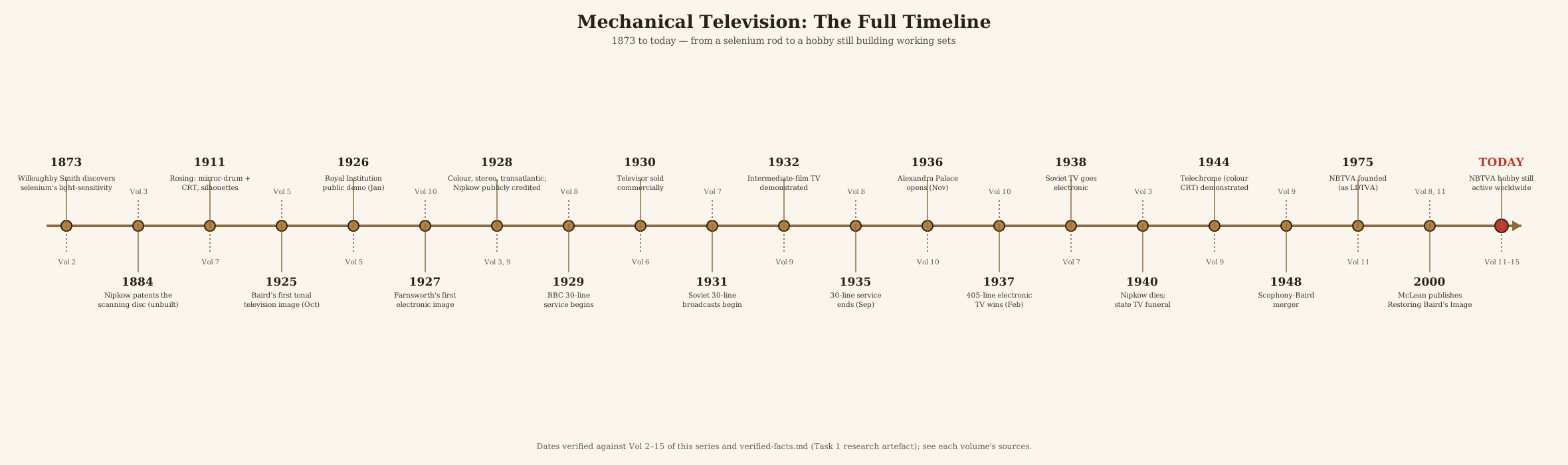
Table 2 — Timeline: 1873 to Today
| Year | Event | Volume |
|---|---|---|
| 1873 | Willoughby Smith discovers selenium’s light-sensitivity | Vol 2 |
| 1884 | Paul Nipkow patents the scanning disc (never built) | Vol 3 |
| 1911 | Boris Rosing demonstrates mirror-drum transmission to a CRT receiver | Vol 7 |
| 13 Jun 1925 | Jenkins transmits a silhouette image (Radiovision, US) | Vol 7 |
| 2 Oct 1925 | Baird transmits the first tonal (grey-scale) television image | Vol 5 |
| 26 Jan 1926 | Royal Institution demonstration — first public/press demo of true television | Vol 5 |
| 25 Dec 1926 | Takayanagi demonstrates a Nipkow-disc-to-CRT hybrid system (Japan) | Vol 7 |
| Sep 1927 | Farnsworth transmits the first fully electronic image | Vol 10 |
| Feb 1928 | First transatlantic television transmission | Vol 5 |
| Jul 1928 | Baird’s first colour television demonstration | Vol 9 |
| Aug 1928 | Baird’s stereoscopic television demonstration; Berlin Funkausstellung publicly credits Nipkow | Vol 3, Vol 9 |
| 1929 | BBC 30-line broadcast service begins; Fernseh AG formed (Germany) | Vol 7, Vol 8 |
| 1930 | The Televisor goes on public sale | Vol 6 |
| 1931 | Soviet 30-line broadcasts begin; Mihály demonstrates in Berlin | Vol 7 |
| 1932 | Intermediate-film television demonstrated (Fernseh AG, then Baird) | Vol 9 |
| Mar 1935 | Fernsehsender “Paul Nipkow” opens in Berlin — world’s first regular public TV station | Vol 3 |
| Sep 1935 | BBC 30-line service ends (11 September) | Vol 8 |
| Nov 1936 | Alexandra Palace service opens, alternating Baird and Marconi-EMI systems | Vol 10 |
| Feb 1937 | The Baird system is dropped; 405-line electronic television wins | Vol 10 |
| 1938 | Soviet television transitions to electronic standards | Vol 7 |
| Aug 1940 | Paul Nipkow dies; given a state funeral broadcast live on television | Vol 3 |
| Aug 1944 | Telechrome, Baird’s electronic colour CRT system, demonstrated | Vol 9 |
| 1948 | Scophony merges with John Logie Baird Ltd | Vol 9 |
| 1975 | The Narrow-Bandwidth Television Association founded (as the LDTVA) | Vol 11 |
| 1978 | Renamed the Narrow-Bandwidth Television Association (NBTVA) | Vol 11 |
| 1982–2000 | Donald McLean recovers the Phonovision discs; publishes Restoring Baird’s Image | Vol 8, Vol 11 |
| Today | The NBTVA remains active: quarterly Newsletter, annual Convention, live forum, Club Sales | Vol 11–15 |
16.3 Key Figures
Table 3 — Key Figures
| Figure | Role | Volume |
|---|---|---|
| Willoughby Smith | Discovered selenium’s light-sensitivity (1873), the basic sensing effect behind every early image-transmission scheme | Vol 2 |
| Paul Nipkow | Patented the scanning-disc principle (1884); never built a working set himself; publicly credited as television’s originator only in 1928 | Vol 3 |
| John Logie Baird | Built the first working television system (1925), gave the first public demonstration (1926), and sold the Televisor commercially from 1930 | Vol 5, Vol 6 |
| Charles Francis Jenkins | American rival; built the Radiovisor/Radiovision system, demonstrating silhouette images from June 1925 | Vol 7 |
| Dénes von Mihály | Hungarian/German rival; built the Telehor system, publicly demonstrated 1928 and 1931 | Vol 7 |
| Boris Rosing | Russian pioneer; combined a mechanical mirror-drum transmitter with an early CRT receiver (1911) | Vol 7 |
| Kenjiro Takayanagi | Japanese pioneer; demonstrated a Nipkow-disc-transmitter/CRT-receiver hybrid (1926), “the father of Japanese television” | Vol 7 |
| Max Dieckmann / Rudolf Hell | German engineers working on an electronic (not mechanical) CRT system in 1925 — the boundary case that must not be counted among the Nipkow-disc pioneers | Vol 7 |
| Philo Farnsworth | American inventor of the first fully electronic camera tube (image dissector), 1927 | Vol 10 |
| Vladimir Zworykin | RCA engineer; developed the iconoscope camera tube (patent filed 1923, working model 1933) | Vol 10 |
| Isaac Shoenberg | Led EMI’s television research group; directed the programme that produced the Emitron tube and the winning 405-line system | Vol 10 |
| Alan Blumlein | EMI engineer; contributed to the 405-line system’s scanning and signal-processing circuitry | Vol 10 |
| David Sarnoff | RCA president; backed Zworykin’s iconoscope development at scale | Vol 10 |
| Donald McLean | Forensically recovered Baird’s Phonovision discs (from 1982; publishable results by the 1990s); later built an NBTV digital standard converter (1988) | Vol 8, Vol 11 |
| Doug Pitt | NBTVA co-founder; proposed the founding project and organised the 1975 meeting that formed the club | Vol 11 |
| Stan Kujawinski | NBTVA co-founder; the club’s own documented source for why the modern standard settled on 32 lines rather than Baird’s 30 | Vol 11 |
| Chris Long | Australian schoolboy builder whose letter to Wireless World helped catalyse the informal circle that became the NBTVA | Vol 11 |
16.4 Museums & Collections
- Science Museum Group (London) — holds original Baird apparatus from 1925–1930, including the Model C “Noah’s Ark” Televisor (c.1929, one of only ~20 built) and a Mervyn Unisphere mirror-drum television. https://collection.sciencemuseumgroup.org.uk/ (Vol 6, Vol 9, Vol 14)
- National Science and Media Museum (Bradford, UK) — holds the surviving Telechrome tube and other Baird-related material. https://www.scienceandmediamuseum.org.uk/ (Vol 9, Vol 14)
- Early Television Museum (Hilliard, Ohio, US) — a working restored Baird Televisor (serial no. 717), documented mirror-drum and mirror-screw specimens, and extensive online historical documentation. https://www.earlytelevision.org/ (Vol 7, Vol 14, Vol 15)
- Museo Nazionale della Scienza e della Tecnologia Leonardo da Vinci (Milan, Italy) — holds a 1931 Fracarro aluminium Nipkow disc with documented square-section apertures. http://www.museoscienza.org/ (Vol 13)
- Powerhouse Museum (Sydney, Australia) — holds a documented genuine Televisor specimen, part of the small population of surviving units outside the UK. (Vol 14)
- The Narrow-Bandwidth Television Association (NBTVA) — not a museum in the institutional sense, but the living custodian of the scanning-disc tradition: an active international club with a quarterly Newsletter, an online forum, a Club Sales parts operation, and an annual Convention held in Loughborough, UK. http://www.nbtv.wyenet.co.uk/ (Vol 11)
Further Reading
- Donald F. McLean, Restoring Baird’s Image (IET, 2000) — the definitive account of the Phonovision recovery project (Vol 8).
- The NBTVA’s own site — standards, history, equipment, and beginner-build chapters, the primary source behind Vol 11–13 and Vol 15: http://www.nbtv.wyenet.co.uk/ (mirrored at nbtv.org)
- The NBTVA forum — an active community discussing builds, standards, and history: https://www.taswegian.com/NBTV/forum/
- The Early Television Museum’s site — detailed histories and restoration accounts of period hardware: https://www.earlytelevision.org/
- bairdtelevision.com — a detailed, dedicated biographical and technical archive on John Logie Baird’s life and work: https://www.bairdtelevision.com/
- The Science Museum Group Collection online catalogue — searchable, photographed, and catalogued original apparatus: https://collection.sciencemuseumgroup.org.uk/
- The DPMA’s (German Patent and Trade Mark Office) own account of the Nipkow patent, including a digitised copy of DE 30105: https://www.dpma.de/english/our_office/publications/milestones/inventionsthatmadehistory/nipkow-scheibe/index.html
- cool386.com’s detailed reconstruction of a 30-line Baird Televisor receiver circuit — a useful secondary engineering reference (Vol 6, Vol 11): https://www.cool386.com/televisor/televisor.html
- Bonhams’ “Instruments of Science and Technology” sale archive — the record of every confirmed genuine-Televisor auction result used in Vol 14: https://www.bonhams.com/
16.5 Anchor Index
A topic-to-volume map for readers who arrived here looking for one specific thing.
Table 4 — Anchor Index
| Topic | Volume(s) |
|---|---|
| Persistence of vision, selenium, earliest “telectroscope” proposals | Vol 2 |
| Nipkow’s 1884 patent and disc geometry origins | Vol 3 |
| Scanning theory, frame rate, flicker, bandwidth mathematics | Vol 4 |
| Baird’s biography and first demonstrations (1925–26) | Vol 5 |
| Televisor hardware: disc, motor, neon lamp, framing/phasing controls | Vol 6 |
| 30-line standard parameters (as implemented in the Televisor) | Vol 6, Vol 16 |
| Rivals: Jenkins, Mihály, Rosing, Takayanagi, Dieckmann/Hell | Vol 7 |
| Fernseh AG and Soviet mechanical television | Vol 7 |
| BBC 30-line broadcast era (1929–35) | Vol 8 |
| Phonovision and Donald McLean’s recovery work | Vol 8 |
| Colour, stereoscopic, and large-screen television (Scophony) | Vol 9 |
| Intermediate-film television | Vol 9 |
| Telechrome (electronic colour CRT) | Vol 9 |
| The Alexandra Palace trial and the 1937 decision | Vol 10 |
| EMI, Emitron, Shoenberg, Blumlein, Farnsworth, Zworykin | Vol 10 |
| NBTVA founding, history, and why 32 lines | Vol 11 |
| NBTV signal structure: sync, bandwidth, encode-to-display chain | Vol 12 |
| Disc geometry, optics, materials, motors, tolerances | Vol 13 |
| Acquiring a genuine or modern set: market prices, authenticity | Vol 14 |
| Restoration, building from scratch, safety | Vol 15 |
| Glossary, standards table, timeline, key figures, this index | Vol 16 |
| Building and driving the MindSets NBTV kit, the steampunk cabinet | Televisor Kit Build dive (companion site) |
16.6 Cross-References
- The full standards table above draws its numbers from the Baird 30-line hardware described in Vol 6 — Inside the Baird Televisor and the modern NBTV signal described in Vol 12 — The NBTV Signal Explained; neither volume should ever be found stating a different figure for the same parameter.
- The people listed in Key Figures are introduced in fuller biographical and technical detail in Vol 3 — Nipkow’s Disc (1884), Vol 5 — John Logie Baird & the First Television, Vol 7 — The Rivals, Vol 10 — Why Electronic TV Won, and Vol 11 — The Modern Revival: NBTV and the NBTVA.
- The museums and collections listed above are the same institutions cited throughout Vol 6, Vol 9, Vol 13, and Vol 14 — Acquiring a Mechanical Television.
- Every date on the timeline is drawn from, and should agree with, the corresponding body volume named beside it — this volume introduces no new dates of its own.
- The companion Televisor Kit Build dive on this site picks up where this series’ theory and history leave off: assembling the MindSets Online NBTV kit, feeding it a signal, and building its steampunk cabinet.
- For the complete narrative arc this reference volume compresses, start from Vol 1 — Introduction & Orientation.
Comments (0)