Mechanical TV Deep Dive · Volume 12
The NBTV Signal Explained
Everything the previous volume described — the founding of the NBTVA, the compasses-and-dividers reasoning behind 32 lines, the members building discs and cameras on kitchen tables — depends on one underlying fact that is easy to state and genuinely remarkable to think through: a moving picture, in the modern NBTV standard, is nothing more than a sound. Not a metaphorical sound, and not a sound carrying a picture the way a modem’s screech carries data — an actual, audio-frequency electrical waveform that will come out of a headphone jack as an audible tone if played, and that a sound card, a CD player, or a radio receiver can move around the world without ever needing to know it is a picture at all. This volume follows a single frame all the way through that waveform: how a two-dimensional image becomes a one-dimensional voltage that rises and falls thirty-two times over the course of one twelfth-and-a-half of a second; what that voltage looks like on an oscilloscope; how the receiver at the other end tells one line from the next and one frame from the next without any separate synchronising channel; why the whole thing fits inside ten kilohertz; and what that means in practice for anyone who wants to record a picture on a compact disc, send it out over the air, or — the reason this volume exists at all — feed it into a modern NBTV kit. Every parameter below has been re-confirmed directly against the NBTVA’s own published standard, fetched a second time for this volume; where anything differs from the historical Baird 30-line system, that difference is called out explicitly rather than assumed.
12.1 A Picture as a Sound
The central trick of any scanning television system, mechanical or electronic, is to convert a two-dimensional arrangement of light and dark into a single number that varies over time — a voltage, in other words, exactly like the voltage a microphone produces from air pressure. Nipkow’s spiral of apertures did this mechanically, as Vol 3 described: a hole moving in a fixed path across the image lets through only the light at one point at a time, so a single photocell watching through that hole produces a current that rises and falls as brighter and darker parts of the picture sweep past it. The modern NBTV standard does exactly the same thing, whether the “hole” is a physical aperture in a spinning disc, a pixel address stepped through by a microcontroller reading a stored image, or a webcam frame sampled point by point in software. The output, in every case, is the same kind of object: a single time-varying voltage, one value after another, that a receiver can turn back into a picture provided it scans its own display in exactly the same pattern, at exactly the same rate, and stays exactly in step.
What makes NBTV worth a volume of its own — as opposed to being just another entry in the “theory of scanning” chapter already covered in Vol 4 — is how deliberately, and how completely, the modern club standard keeps that voltage inside the frequency range of ordinary sound: roughly 2 hertz to 10 kilohertz, the same band a mid-range loudspeaker or a cheap microphone comfortably reproduces. That single design decision is what allows an NBTV picture to be recorded on an audio CD, carried down a telephone-quality voice channel, or played back through the line-out socket of an ordinary sound card into a waiting monitor — none of which would be remotely possible if the signal needed the megahertz-wide bandwidth that ordinary broadcast television requires. The rest of this volume is, in a real sense, the working-out of that one decision: what shape the waveform has to take, line by line and frame by frame, to say everything a 32-line picture needs to say without ever leaving the audio band.
12.2 One Frame, One Dimension: The Scan Raster
The NBTVA’s own published standard — Chapter 25 of the club’s technical handbook, “NBTV standards and recommendations,” fetched directly from the association’s site for this volume — specifies the geometry of the modern picture in exactly the same terms the Baird 30-line standard used a half-century earlier, changed only where the club deliberately chose to change it. A complete NBTV frame consists of 32 lines, each line a vertical strip of the picture, scanned from bottom to top. Having scanned line 1 bottom-to-top, the system does not return line 1 to the bottom and scan line 2 in the same place — instead the whole scanning position steps sideways, and the frame itself is scanned horizontally, from right to left, so that line 32 finishes at the far left edge of the picture. One complete frame — all 32 lines, right edge to left edge — takes one twelfth-and-a-half of a second: the club’s standard runs at 12.5 frames per second, exactly the Baird broadcast rate, giving 400 lines per second (32 × 12.5) end to end. The picture this produces is portrait, taller than it is wide, with an aspect ratio of 3:2 (height to width) — visibly narrower and taller than a modern television picture, and a little different again from Baird’s own 7:3. The standard even specifies which side of a Nipkow disc the picture should be viewed from (the right) and which way the disc should turn (anti-clockwise), because — as the standard’s own note on “right-hand optics” explains — a picture recorded from a camera on one side of a disc and viewed from the wrong side of a different disc suffers from an unpleasant curvature distortion that simple handedness conventions avoid.
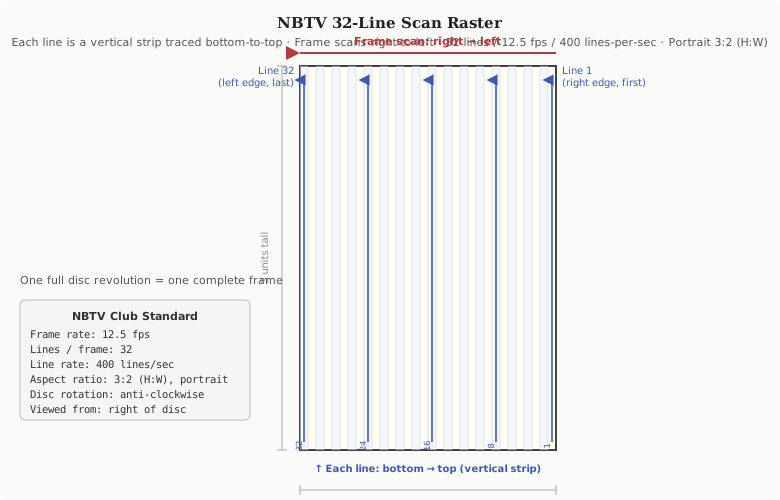
It is worth pausing on how close this is to the Baird 30-line standard, and exactly where it differs — because the closeness is deliberate. The NBTVA’s published standard lists the historical Baird figures on the very same page as the modern club standard, for comparison: 30 lines rather than 32; 375 lines per second rather than 400; the same vertical bottom-to-top line scan and horizontal right-to-left frame scan; but a taller, narrower 7:3 aspect ratio rather than 3:2. The standard adds one further, previously under-appreciated wrinkle to the historical figure: in an actual production Baird Televisor, the first three lines and the last three lines of each frame were deliberately made wider and spaced further apart than the twenty-four lines in between, which altered the effective aspect ratio of the picture the viewer actually saw to something closer to 2:1 — a refinement of the 7:3 broadcast figure that is easy to miss if one only reads the nominal standard. The standard’s page also documents a third historical scheme entirely, the German TeKaDe system, which kept 30 lines and 375 lines per second but scanned in landscape — lines horizontal, frames scanning vertically top to bottom — with a 3:4 aspect ratio. That a national broadcaster could choose the opposite scan orientation and still deliver a working television service is a useful reminder that “vertical lines, horizontal frame, portrait picture” was never a physical necessity of scanning-disc television — it was Baird’s choice, one the NBTVA’s founders chose to keep when they set the modern 32-line standard (for the reasons of disc-marking geometry described in full in Vol 11), rather than a law of nature the way the speed of light is.
12.3 The Waveform: Levels, Polarity, and the Volt Peak-to-Peak
Once a frame has been decomposed into 32 vertical strips, each strip must itself become a voltage that rises and falls as it sweeps past bright and dark parts of the scene. The NBTVA’s standard is precise about what that voltage should look like electrically, not just what pattern it should trace geometrically. The complete video signal — from full black to full white — spans one volt peak-to-peak, and its polarity is positive: white produces the most positive voltage, black the most negative, with every shade of grey falling in proportion between the two. This is the same polarity convention used throughout mainstream broadcast television, and it matters for anyone building or troubleshooting equipment, because a camera or amplifier stage with inverted polarity will produce a photographic-negative image — dark subjects rendered bright and bright subjects rendered dark — even though every other timing parameter is correct.
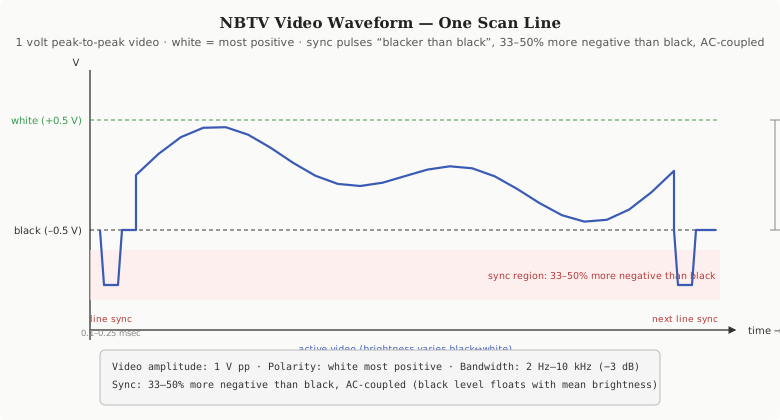
The signal’s bandwidth — the range of frequencies present in that rising-and-falling voltage — is specified as 2 Hz to 10 kHz, measured at −3 dB. That is a genuinely narrow band by television standards: broadcast video occupies megahertz, not kilohertz. It is, however, comfortably within what an ordinary audio system reproduces without difficulty, which is precisely the point of choosing it, and the subject of its own section below. For comparison, the same standards page states that the historical Baird 30-line signal has a theoretical bandwidth of approximately 13 kHz — a detail worth keeping in mind, because it means the modern 32-line standard’s narrower ~10 kHz figure is not, in fact, why the club chose 32 lines over 30; Vol 11 traces the real reason (disc-marking geometry, not bandwidth) to a specific, named account from co-founder Stan Kujawinski.
12.4 Synchronisation: Blacker Than Black
A voltage that swings between black and white tells a receiver what brightness to display, but it says nothing about when one line ends and the next begins, or when one frame ends and the next begins. That timing information has to travel down the same single wire as the picture itself — there is no second channel — and the NBTVA standard solves this with a sync pulse that is unmistakable precisely because it goes somewhere the picture itself is never allowed to go. Between each line of active video, the signal dips to a level 33% to 50% more negative than the blackest black the picture can show — a region the standard’s own documentation calls “blacker than black” or “ultra black.” No combination of scene brightness can ever produce a voltage that far below black, so a receiver watching for that specific excursion can distinguish a genuine sync pulse from even the darkest possible picture content with no ambiguity. Each of these line-sync pulses is brief: the standard specifies a width of 0.1 to 0.25 milliseconds. The signal is also specified as AC-coupled, meaning the black-level voltage itself is allowed to drift up and down slightly with the average brightness of the picture — a consequence of removing any steady (DC) component from the signal, which is often unavoidable when a signal has passed through a transformer, capacitor-coupled amplifier stage, or a radio channel. Well-designed receivers compensate for this drift with DC-restoration or clamping circuitry, which re-anchors the black level before the picture is displayed.
This blacker-than-black scheme is a genuine, and rarely mentioned, technical advance over how Baird’s own 30-line system handled synchronisation. The NBTVA’s standards documentation notes, in its own words, that Baird never used an ultra-black sync pulse at all — his system used an ordinary black bar between lines, at the same voltage level as the darkest picture content, rather than a level unambiguously beyond it. This caused a real, practical problem: because a genuinely black picture and a sync pulse were electrically indistinguishable, Baird’s receivers could lose synchronisation whenever a scene happened to go fully black, and — according to the same NBTVA documentation — black pictures were therefore never permitted on the BBC’s 30-line service at all, a production constraint imposed by a synchronisation limitation rather than by anything about the picture itself. The modern club standard’s blacker-than-black sync pulse removes that constraint entirely: because the sync pulse occupies a voltage range the picture can never legitimately reach, an NBTV picture is free to go fully black without any risk of a receiver losing its place.
12.5 The Missing Pulse: How Frame Sync Works
Line synchronisation — telling the receiver where one line ends and the next begins — is only half the problem. The receiver also needs to know when a complete frame has finished, so that it can return to the top of the picture (or, in scanning-disc terms, so that it knows the disc has completed a full revolution) rather than simply treating line 33 as if it were a continuation of the same frame. The NBTVA standard solves this with an elegantly minimal trick: it does not add a separate frame-sync signal at all. Instead, the one line-sync pulse that would normally fall between line 32 and line 1 is simply left out, and the video signal is held at the black level for that same interval instead of dipping to sync. A receiver that is counting line-sync pulses, and that suddenly does not find one where it expects one, has all the information it needs: a full revolution — a full frame — has just completed, and line-numbering should restart at line 1. No separate tone, no additional channel, no extra pulse shape is needed; the absence of an expected pulse is itself the message.
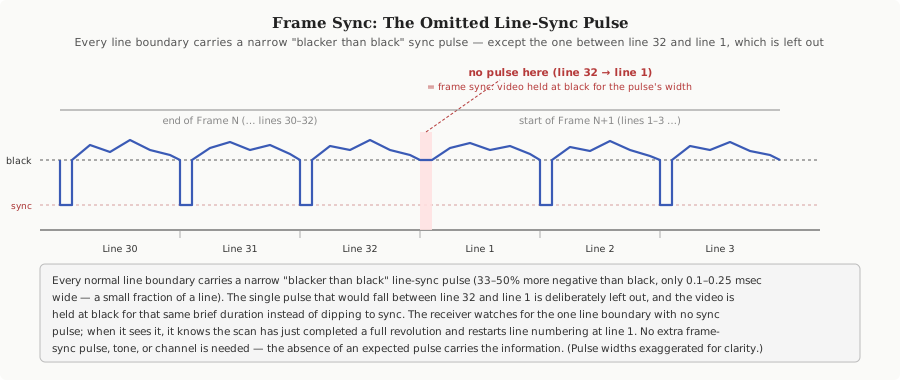
This is not merely a description on a specification page; it is realised in actual club-built hardware in a way that is worth describing, because it makes the abstract rule concrete. A documented NBTVA project for a combined camera-and-monitor unit — designed by club members Les Robotham and R. Pedro, with the sync-generating circuit itself designed by member Peter Smith — uses a single disc carrying a special one-and-a-half-turn scanning spiral of 48 holes, shared between its camera and monitor halves: the camera side masks off the innermost 16 holes and the monitor side the outermost 16, so that each sees the 32 apertures it needs to scan a 32-line picture. To this the disc adds a separate ring of 32 additional holes near the rim, sensed by their own dedicated photodiode-and-LED pair, purely to generate one sync pulse per line as the disc turns. Critically, one of those 32 sync holes is deliberately masked over, so that the sync pulse it would otherwise generate never appears. That single masked hole is the entire physical mechanism behind the standard’s “missing pulse between line 32 and line 1”: the omission is not calculated electronically at all in this design, it is simply built into the disc as a hole that was never drilled — or was drilled and then covered — at exactly the point in the disc’s rotation where the frame boundary falls. The same project’s video-processing chain, incidentally, is a tidy real-world illustration of several of this volume’s abstractions at once: a DC-restorer clamps the negative excursion of the raw camera signal to a fixed reference (fixing the black-level drift AC-coupling introduces), an adjustable gain stage sets the video swing to the standard’s specified 1 volt peak-to-peak, an optional non-linear stage applies gamma correction, and only then are the sync pulses from the masked-hole ring mixed back in to produce the finished, standards-compliant composite signal ready to feed a monitor.
12.6 Why Ten Kilohertz Fits an Audio Channel
Returning to the bandwidth figure from earlier — 2 Hz to 10 kHz — it is worth being explicit about why that particular ceiling matters so much in practice, because it is the single fact that makes everything else in this section possible. Ten kilohertz sits comfortably within the range of frequencies that ordinary consumer audio equipment is designed to reproduce faithfully: a 44.1 kHz digital audio sample rate (the standard rate used by an audio CD) can represent frequencies up to roughly 22 kHz without difficulty, more than double what an NBTV signal ever needs, and even a modest sound card’s line output or a telephone-quality voice channel will pass 10 kHz with only mild attenuation. The consequence is that an NBTV signal can be treated, for every practical purpose of storage and transport, as if it were a piece of recorded sound — because to any piece of ordinary audio equipment sitting between the encoder and the display, that is exactly what it is.
This is the direct, and only slightly more sophisticated, descendant of the same discovery Baird’s engineers made in the late 1920s when they cut the five surviving Phonovision discs — thirty-line television pictures recorded onto ordinary 78 rpm shellac gramophone records, described fully in Vol 8, and only recovered into viewable images more than sixty years later by Donald McLean. The NBTVA’s own recommendations for recording and distributing modern NBTV material make the same principle explicit and formal: the association recommends CD-R, CD-RW, or DVD-Audio as the best medium for NBTV material, using an ordinary 44.1 kHz stereo digital audio stream with 16 bits per sample — exactly the audio-CD standard — with the picture information recorded on the left channel and synchronising or accompanying sound on the right, at a recording level of roughly −10 dB with peaks reaching −2 dB. The reasoning the club gives is straightforward: direct digital recording at those settings preserves the waveform with almost no distortion, and playback speed on digital media is crystal-stable, which matters enormously for a signal whose entire picture geometry depends on a receiver’s scanning rate staying locked to the rate the signal was recorded at.
The same recommendation comes with an equally firm warning, and it is worth stating plainly because it is exactly the kind of mistake an newcomer moving digital files around a modern computer might make without thinking twice: lossy compressed audio formats — MP3, WMA, and similar bit-rate-reduced schemes — are explicitly unsuitable for NBTV material. Those formats work by discarding whatever a model of human hearing predicts a listener will not consciously notice missing; that model has nothing to do with what makes an NBTV picture legible, and the compression artefacts it introduces, while they may indeed be inaudible as sound, show up as visible noise and distortion in the reconstructed picture. An MP3 of an NBTV signal may sound completely unremarkable and still be useless as a television source. For members who prefer to send pictures over the air rather than by disc or file, the same standards documentation sets out concrete radio-transmission schemes as well — amplitude modulation in either polarity, frequency modulation, and vestigial-sideband transmission, each with its own specified modulation depth or deviation and occupied bandwidth — coordinated in practice through the NBTVA’s weekly on-air schedule on the 80-metre amateur band described in Vol 11.
12.7 From Camera to Glow: The Complete Signal Chain
Pulling every stage described above into a single picture: an NBTV signal begins at a source — a live camera sweeping a scene in the standard’s 32-line raster, an electronic pattern generator producing a test card or synthetic image, or modern conversion software (video2nbtv and similar tools, treated in full in the companion Kit Build dive) turning an ordinary video clip into the same kind of raster. That source feeds an encoder stage, whether built from discrete components as in the club project described above or realised entirely in software, whose job is to produce the finished composite waveform: video held to the standard’s 1-volt peak-to-peak swing with white the more positive polarity, DC-restored to keep the black level stable, and mixed with blacker-than-black line-sync pulses that omit the single pulse between line 32 and line 1. The result is the audio-bandwidth signal itself — 2 Hz to 10 kHz, indistinguishable in principle from any other audio waveform to anything that isn’t specifically looking for its sync pulses.
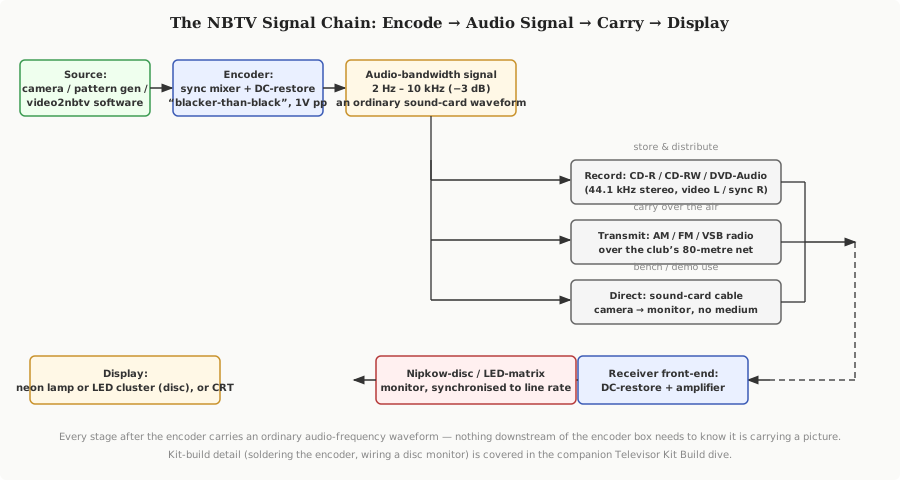
From that point, the signal can travel by any of the three routes already described — recorded to disc, transmitted by radio, or carried directly down a cable from a sound card’s output — without the encoder or the display needing to care which route was used, because all three routes are, electrically, just ways of moving an audio-frequency voltage from one place to another. At the far end, a receiver front-end performs the mirror-image job of the encoder: it re-establishes a stable black level (DC-restoration again, undoing whatever drift the transport introduced) and amplifies the signal back up to a usable level. That recovered composite signal finally drives the display — a Nipkow-disc monitor with a neon lamp or an LED cluster behind it, exactly as the NBTVA’s beginner-build chapter described in Vol 11, or, in more modern club experiments, a CRT with its deflection speeds adjusted to the 32-line raster, or a solid-state LED-matrix panel of the kind the Televisor Kit Build dive on this site documents in detail. Every stage in this chain after the encoder is, in the most literal sense, an audio system; the picture is only ever a picture again at the two ends.
12.8 Practical Signal Sources Today
Building or buying an NBTV monitor answers only half the question of “how do I see a picture on it” — the other half is where the signal itself comes from, and the modern hobby has settled on a handful of well-worn answers that are worth introducing here, briefly, since the companion Televisor Kit Build dive covers the hands-on side of using them in full. The NBTVA’s own Club Sales operation, described in Vol 11, supplies pre-recorded test CDs specifically so that a newly finished monitor can be checked for focus, framing, and synchronisation before its owner attempts to build a camera or generator of their own — precisely the beginner’s path the club’s own construction literature recommends. Beyond ready-made test material, the club’s technical handbook documents purpose-built signal-generation hardware members can build themselves: a sawtooth test generator for basic timing checks, a colour-bar generator for a fixed reference pattern, and an EPROM-based pattern generator whose documentation specifies, down to the individual byte and bit, exactly how a still or moving 32-line frame should be packed into digital storage — including which byte represents the bottom-right corner of the picture, how sync bits are flagged within each line’s data, and how the frame-sync convention described earlier in this volume (a deliberately zeroed sync position on line 1) is represented in stored form. That level of byte-precise specification is a useful reminder that everything described qualitatively in this volume — the raster order, the polarity, the missing pulse — has a fully worked-out, unambiguous digital representation in the club’s own literature, not just an analogue waveform description.
On the software side, modern hobbyists increasingly generate or convert NBTV material on an ordinary PC rather than with dedicated hardware: the club’s own literature documents using a PC for NBTV display and recording, and independent tools such as video2nbtv exist specifically to convert conventional video files into an NBTV-compatible audio-bandwidth signal for playback through a sound card. This research pass did not independently re-verify the current canonical home or maintenance status of that software (the copy referenced in this project’s own scoping notes is a third-party mirror, not necessarily the author’s own site) — that verification, along with hands-on installation and use, is deliberately left to the companion Televisor Kit Build dive, which speaks to exactly this signal and needs to get every detail of driving a real kit right. What this volume can say with confidence is the target format any such tool has to hit: a 32-line, 12.5 fps, 3:2-portrait raster; 1-volt peak-to-peak video with white the more positive polarity; blacker-than-black sync pulses 33–50% below black with the line-32-to-line-1 pulse omitted; and the whole signal held within roughly 2 Hz to 10 kHz so that it survives an ordinary sound card, CD, or radio channel intact.
12.9 Bridge to the Kit
Every parameter in this volume exists for a very practical reason: it is exactly what a piece of modern NBTV-compatible equipment expects to receive, and exactly what it will produce. The companion Televisor Kit Build dive on this site documents the MindSets Online “Televisor” NBTV kit end to end — unboxing, assembly, first light, and the steampunk cabinet build around it — but the moment that kit is asked to display anything at all, it is this signal, described here in full, that it is listening for: 32 lines, bottom-to-top, right-to-left, 1 volt peak-to-peak, blacker-than-black sync, the missing pulse between line 32 and line 1, all of it living inside 10 kilohertz of audio bandwidth. Readers who want the theory before the soldering iron now have it; readers who arrived here from the kit build looking for why a particular waveform looks the way it does on their oscilloscope should find every feature of it accounted for above.
12.10 Cross-References
- The general theory of scanning, bandwidth, and synchronisation that underlies every mechanical television system — including the Baird 30-line signal this standard echoes and revises — is set out in Vol 4 — Theory of Operation.
- The Baird Televisor’s own hardware, including the receiver electronics whose synchronisation limitations the modern blacker-than-black scheme specifically improves on, is dissected in Vol 6 — Inside the Baird Televisor.
- The founding of the NBTVA, the people behind it, and the full account of why the club settled on 32 lines rather than Baird’s 30 (a matter of disc-marking geometry, not bandwidth or signal theory) are covered in Vol 11 — The Modern Revival: NBTV and the NBTVA.
- Baird’s Phonovision discs — the historical predecessor of recording a television signal on ordinary audio media — and Donald McLean’s recovery of them are described in Vol 8 — The 30-Line Broadcast Era (1929–35).
- The Baird 30-line and modern NBTV 32-line standards are tabulated side by side, parameter for parameter, in Vol 16 — Reference and Cheatsheet.
- The companion Televisor Kit Build dive on this site covers assembling a modern NBTV monitor, generating and feeding it a signal in practice (including the
video2nbtvandnbtv-design-toolssoftware this volume introduces but does not verify in depth), and building its steampunk cabinet.
Comments (0)