Mechanical TV Deep Dive · Volume 13
Optics, Discs & Mechanics in Depth
Every volume so far has treated the Nipkow disc as a settled fact: a spinning wheel with holes in it, standing in for the whole apparatus of scanning. That shorthand has been useful, but it hides an enormous amount of engineering. The disc is not a passive accessory sitting between a lamp and a viewer — it is the entire optical and mechanical system of a mechanical television, doing simultaneously the job that a modern camera’s shutter, lens, sensor raster, and display raster all do separately. Get the disc’s geometry wrong and no signal, however well encoded, will resolve into a picture; get its balance wrong and the picture shakes; get its synchronisation wrong and the picture tears itself apart on the screen. This volume is the engineering deep-dive the series has been building toward: how a spiral of holes actually decomposes a two-dimensional scene into a one-dimensional signal, why the size of each hole is a trade rather than a free choice, what a disc is made of and how it is built true, why some discs carry lenses and most do not, how the light source has changed from a glowing plate of neon gas to a cluster of LEDs, how the disc is made to turn at all, and how — this is usually the hardest part in practice — it is kept turning in exact lock-step with the incoming picture. Two bodies of evidence sit behind everything below, and they are kept deliberately distinct throughout: the original Baird-era engineering, documented only approximately by enthusiast reconstruction and museum specimens (Vol 6, §11 of this project’s research record) because no complete Baird Television Ltd factory specification survives; and modern NBTV hobbyist practice, documented in exhaustive, numbered detail by the NBTVA’s own technical handbook, fetched directly for this volume. Where a figure is historical and approximate, it stays hedged. Where it is a modern club figure, it is quoted with its chapter and page.
13.1 Decomposing a Picture: The Spiral’s Geometry
Nipkow’s 1884 patent, as Vol 2 and Vol 3 established, specified the principle of a rotating disc perforated with a one-turn inward spiral of holes and said nothing at all about how large the disc should be, how large the holes should be, or how far apart successive holes should sit. Every one of those numbers was left to the engineers who rebuilt the idea in the 1920s and to the hobbyists who have refined it since — which means the geometry of a real scanning disc is not part of television history so much as it is a piece of applied geometry that anyone building a disc today still has to work out for themselves, guided by the same handful of relationships whether the year is 1930 or 2026.
The starting point is the picture the disc has to scan: a fixed rectangular window, held at one edge of the disc, through which the scene (or, at the receiving end, the light source) is visible. A one-turn spiral carrying N equally spaced holes places hole 1 at the largest radius the window covers and hole N at the smallest, with every intermediate hole stepping inward by the same amount as the disc completes one full revolution. Two numbers describe that step precisely. The radial pitch — the difference in radius between one hole and the next — is set by the height of the picture window divided by the number of lines, N: fit N lines into a window of a given height, and the holes must be spaced that height divided by N apart, radially, or they will not each trace a distinct horizontal strip of the window as they pass through it. The angular pitch — the difference in angle between one hole and the next — is set simply by dividing a full turn among the N holes: 360° ÷ N. For the modern NBTVA’s 32-line club standard this angular step is 11.25°; for Baird’s original 30-line standard it is 12°. A club co-founder, Stan Kujawinski, is on record that 32 lines were chosen over 30 “for practical reasons to do with accurately marking out the angles for scanning discs using compasses and dividers”; the more specific explanation that circulates — that 32, being a power of two, lets a disc-builder step off those 11.25° divisions by repeatedly bisecting the circle with compass and dividers alone, without a protractor, where 30 holes at 12° apart do not fall out so conveniently — was worked out by other club members replying to Kujawinski’s account rather than stated by him (Vol 11 gives the full account of this club history).
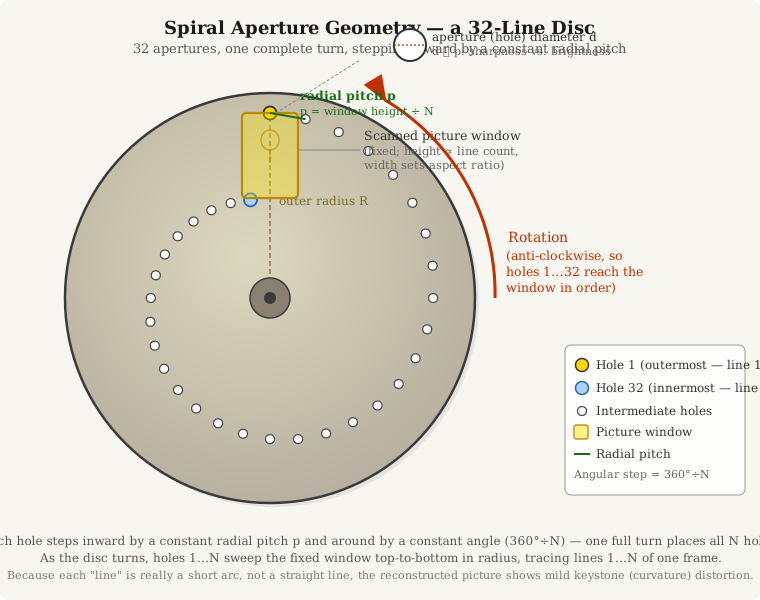
Two further, closely related consequences follow directly from this geometry, and both are genuine, documented features of real scanning-disc pictures rather than theoretical curiosities. First, because each hole traces an arc of a circle rather than a straight horizontal line as the disc rotates, the picture a Nipkow disc scans or displays is never quite rectangular — it is a shallow sector of a circle, a curvature the NBTVA’s own equipment chapter labels “keystone distortion.” That chapter notes a specifically historical reason the distortion was so visible to 1930s viewers: the BBC’s own transmitter scanned with a mirror drum, which produces a squared-off rectangular raster, while home receivers reconstructed the picture on curved-scanning Nipkow discs — a transmitter-versus-receiver technology mismatch that left the received image visibly bowed. A distinct but related refinement appears on the modern club’s standards page: when two disc systems are paired — a disc camera feeding a disc monitor — the residual curvature largely cancels between them only if both share the same handedness of optics; mismatched handedness makes it “very unpleasant,” in the club’s own words, which is why the NBTVA recommends a standard “right-handed optics” convention for both camera and monitor discs (documented alongside the standard’s rotation-direction and viewing-side specifications, set out in Vol 12). Second, the frame itself is not scanned as a simple rectangle sitting symmetrically on the disc — it sits at one fixed radial band, off to one side, which is why disc diameter and picture size are coupled: a bigger picture, at a fixed number of lines, needs either a bigger disc (to keep the radial pitch, and therefore the resolvable detail, the same) or a coarser radial pitch on the same-sized disc (trading detail for picture size). The NBTVA’s own lens-selection chapter quotes a concrete, real example of this coupling: the frame scanned on the club’s standard 32-line, 12-inch (≈305 mm) disc measures approximately 28 mm by 20 mm — a small window on a disc nearly a foot across, because most of that disc’s radius is unused structural material, and only a narrow band near the rim actually carries the spiral.
13.2 Aperture Size: Trading Resolution for Brightness
Radial pitch answers the question of where the holes go; it does not answer the separate question of how large each hole should be, and that second question turns out to be a genuine, unavoidable trade rather than a simple “as small as possible” default. A hole’s diameter cannot sensibly exceed the radial pitch between it and its neighbour: make the aperture larger than the pitch and adjacent holes begin to admit light from more than one nominal scan line at once, so that lines blur into each other and vertical resolution is lost regardless of how finely the disc’s geometry was cut. The natural instinct, then, is to make the aperture as small as the drilling process allows — but a smaller aperture also passes proportionally less light from whatever is on the other side of it, whether that is scene light falling on a camera’s photocell or lamp light escaping toward a viewer’s eye. A disc built with apertures much smaller than the radial pitch will, in principle, resolve slightly sharper detail line to line, but it will do so at the cost of a dimmer picture and a weaker, noisier signal from the photocell behind it — exactly the same resolution-versus-light trade that governs the f-number of an ordinary camera lens, just expressed through a hole’s diameter instead of an iris. In practice, most working Nipkow discs choose an aperture close to, but not exceeding, the radial pitch, accepting a small amount of unavoidable overlap between adjacent lines as the price of a usable amount of light.
Aperture shape, not just size, is also part of this trade, and it turns up in a genuinely documented period example. A production Nipkow disc manufactured by the Italian firm Fracarro in 1931 — an aluminium disc with a one-turn spiral of holes near its outer rim, sold commercially for reception of either the London (British 30-line) or Berlin (German) television services depending on which version of the disc a customer bought — survives today in the collection of Milan’s Museo Nazionale della Scienza e della Tecnologia Leonardo da Vinci. The museum’s own catalogue record for the object states that “the exact position of the holes and their square cross-section were the principal factors responsible for the sharpness of the image in viewing” — a genuine period acknowledgment that aperture shape, not only aperture area, affected picture quality. Square apertures tile a scanned raster with no gaps between adjacent lines for a given pitch, in a way that round holes of the same diameter cannot quite match — and square holes were not unique to Fracarro: the genuine Plessey-built Baird Televisor disc is itself catalogued with square holes (Bonhams’ description of the fully provenanced No. 192 unit; Vol 6, §11a, and Vol 14), which corrects a common assumption that the Nipkow disc used round holes. Whether period engineers reasoned about the shape trade in explicit terms is not always recorded, but the documented use of square-section apertures across more than one 1930s system is a genuine piece of period engineering worth noting rather than flattening into a single “the Nipkow disc had round holes” generalisation.
13.3 Choosing and Building the Disc: Material, Diameter, Balance
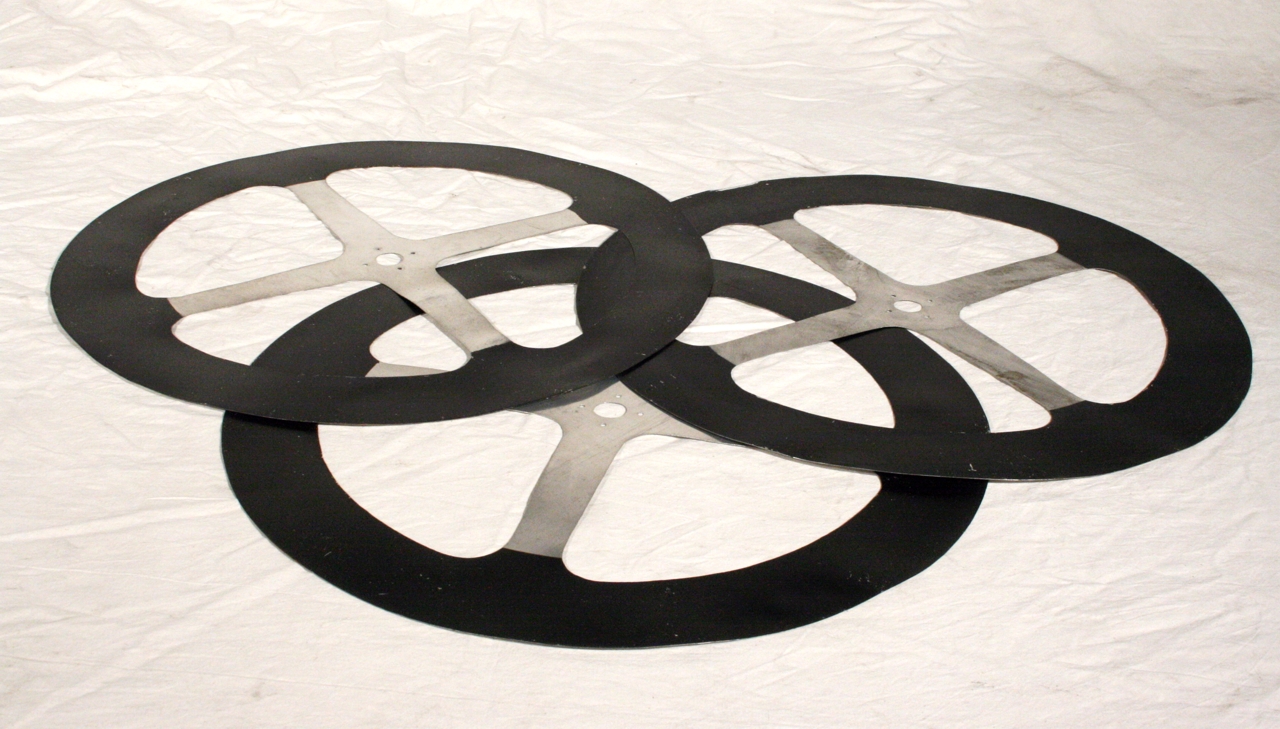
A disc’s material and diameter are chosen together, and the modern hobby’s own two standard sizes make the trade concrete rather than abstract. The NBTVA’s beginner path starts with a pre-drilled 12-inch (≈305 mm) plastic disc, sold ready-made through the club’s own shop specifically because — in the club’s own words — the disc “is the most important part of the televisor; this will determine the picture quality,” and its pre-cut discs are machined on numerically controlled equipment “to the highest accuracy” rather than left to a hobbyist’s hand drill. Once a builder has a working small televisor and wants a larger picture, the club’s documented next step is a 490 mm metal disc, which demands a correspondingly more capable motor (a Smith Industries unit, reference FHM1207/04, is the club’s own tested example, driving the 490 mm disc directly from a 15 V, 3 A supply) and a heavier LED-driver current to keep the larger scanned area adequately bright. The historical Baird production disc sat in between these two modern reference points in scale — approximately 30–45 cm in diameter by the best available reconstruction (Vol 6, §11a; still UNCONFIRMED against any surviving Baird factory drawing) — which is a useful reminder that the modern club’s 305 mm and 490 mm discs were not picked at random but bracket the range that period engineers and modern hobbyists have both, independently, found workable for a hand-buildable receiver.
Whatever the diameter, a spinning disc at several hundred revolutions per minute has to be flat and properly balanced, or its own motion becomes a source of picture error rather than a neutral carrier of it. The NBTVA’s documentation is candid that real hobbyist-built discs are not perfectly true: the club’s own reference automatic speed-control circuit deliberately sets its opto-sensor’s working gap at 8 mm specifically, in the designer’s own words, “to give enough clearance for a wobbly disc yet sensitive enough to cope with the small holes in the 12-inch club disc” — an explicit, quantified engineering allowance for real-world disc wobble, not an assumption that a hobbyist’s disc will spin true. This is precisely why the club recommends buying a numerically-machined disc rather than hand-drilling one for a first build: accurate radial and angular hole placement, disc flatness, and rotational balance are inseparable from picture quality, and a disc that wobbles, that is not flat, or whose holes drift from their calculated positions will show its errors directly as a degraded picture rather than as a purely mechanical inconvenience.
13.4 Flat Apertures versus Lens-Discs
Every hole in a Nipkow disc does two jobs depending on which side of the apparatus it sits: at a camera, it lets a thin sample of scene light through to a photocell; at a monitor, it lets a thin sample of the light source’s output escape toward the viewer. In both cases, a plain, flat, bare hole passes only the light that happens to already be travelling in its direction — most of the light emitted by a lamp, or reflected by a scene, misses the tiny aperture entirely and is wasted. The alternative the modern hobby documents explicitly is the lens-disc: a disc built with a small lens seated in each scanning hole rather than a bare opening. The NBTVA’s own equipment chapter confirms this directly — “one variation of this system was to fit lenses in the scanning holes” — describing it as a genuine, if less common, construction technique alongside the plain flat-hole disc that both Baird’s production Televisor and most modern club builds actually use (Vol 6, §11a).
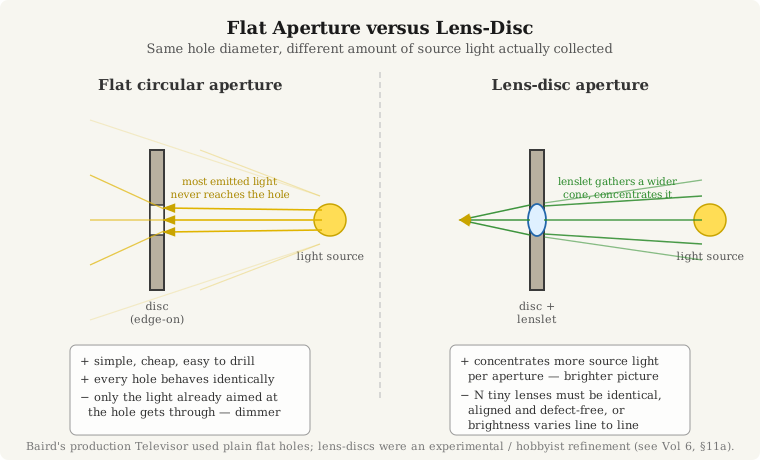
The appeal of a lens-disc is straightforward: concentrating more of a lamp’s (or a scene’s) light through each aperture means a brighter picture, or a usable picture from a weaker light source, for the same aperture diameter — which matters because aperture diameter is already constrained by the resolution trade described above and cannot simply be enlarged to let in more light without blurring lines together. The cost is manufacturing difficulty of a different order than drilling a flat hole: every one of N tiny lenses around the disc has to be essentially identical in focal length and free of its own defects, and all of them have to be seated at the correct position and angle, or the picture will show a visible brightness variation from line to line as the disc turns past lenslets of slightly differing quality — a much less forgiving requirement than a flat hole, whose only real requirement is being the correct size and in the correct place. This is almost certainly why the flat aperture, not the lens-disc, has remained the default in both the historical Baird Televisor and the great majority of modern club builds documented by the NBTVA: it is the simpler, more repeatable choice, and the alternative gains brightness only by trading away that simplicity.
13.5 The Light Source: Neon Plate to LED Cluster
The historical Baird Televisor displayed its picture on a flat-plate neon glow lamp, sized to roughly match the shape of the scanned window itself — approximately 25–35 mm wide by 55–75 mm tall by the best available reconstruction (Vol 6, §11b; still UNCONFIRMED against a surviving factory specification, and kept hedged here as elsewhere). A neon lamp of this kind is, physically, a single continuous glowing surface: applying a varying current across it produces a correspondingly varying glow more or less uniformly across its whole face, so that whichever aperture happens to be in front of it at a given instant sees the correct instantaneous brightness with essentially no additional optical work required. That property — a genuinely flat, spatially uniform emitter, matched in shape to the window it illuminates — is exactly what a disc monitor wants behind its spiral of apertures, and it is one of the real reasons the neon lamp remained the standard mechanical-television light source for as long as it did, even though its total light output was modest and its distinctive orange-red colour became one of the defining sensory characteristics of watching 1930s television at all.
The modern hobby has almost entirely replaced the neon lamp with clusters of high-brightness LEDs, and the NBTVA’s own construction literature documents the change in real, practical detail. LED output is measured in millicandelas at a standard 20 mA forward current, combined with the beam’s opening angle to give the total light actually delivered; AlInGaP “ultra-bright” orange LEDs are the club’s specifically favoured choice because their emitted colour most closely matches the historic neon glow (each drops roughly 2 volts forward, so three in series consume 6 volts, leaving comfortable headroom on a 12-volt driver rail), while modern GaN white LEDs give a different, distinctly modern-toned display and — because each drops around 4 volts, allowing fewer to be stacked in series before exceeding a 12-volt rail — are more often wired in parallel banks instead of series chains. Some of the highest-output LEDs the club documents carry manufacturer warnings that their undiffused output is bright enough to injure eyes at close range.
The one genuine complication LEDs introduce that the neon lamp did not have is exactly the point/flat-source problem the spec of this dive anticipated: an LED cluster is a small number of discrete, roughly point-like emitters, not a single continuous glowing plate. Left undiffused, a viewer would see the individual LEDs’ positions and hot-spots through the spinning disc rather than a smooth, evenly lit field. The NBTVA’s own beginner-build chapter addresses this directly, specifying “a diffuser between the LEDs and the viewing area close to the spinning disc” to spread the cluster’s output into something closer to the neon lamp’s original flat, even glow, and cautioning that “careful positioning of the LEDs and the diffuser is important to ensure the illumination is constant over the display area” — treating uniform illumination as a real, solved-but-not-automatic engineering requirement rather than an assumption. LED driver circuits documented by the club also deliberately introduce a small non-linearity (via extra resistor/diode networks in the drive path) to imitate the roughly quadratic brightness response of a cathode-ray tube for members who monitor NBTV signals on CRT-based equipment — a genuinely different problem from the neon-versus-LED comparison, but one the club’s own gamma-correction chapter treats as directly adjacent to it: a plain disc televisor with either a neon lamp or an undriven LED cluster is very close to gamma = 1 (light output roughly proportional to drive current), which is not automatically the right response curve for video that was gamma-corrected upstream for a CRT-based monitor.
13.6 Turning the Disc: Motor Choice
Whatever light source sits behind it, the disc itself has to be driven at a precise, steady rotational speed, and the two eras of mechanical television solved that requirement in almost opposite ways. Baird’s original engineering, as Vol 6 describes in detail, exploited a genuinely elegant shortcut: because the BBC’s 30-line broadcast ran at exactly 12.5 frames per second — one-quarter of the 50 Hz UK mains frequency — a simple synchronous or induction motor, wired directly to the household AC supply, would naturally settle at very close to the correct 750 rpm disc speed without any active speed-control electronics at all, because every such motor and every BBC studio disc were ultimately paced by the same national power grid. This bought Baird’s engineers automatic, essentially free speed lock across the entire receiving population, at the cost of tying every Televisor’s disc speed rigidly to whatever the local mains frequency happened to be, and to physically being near a wall outlet.
Modern NBTV practice, by contrast, generally abandons the mains-synchronous motor in favour of an ordinary DC motor under active electronic control — the NBTVA’s documented reference build uses a small salvaged cassette-deck DC motor for the 12-inch club disc, and a more powerful geared or direct-drive DC motor (the club’s own tested Smith Industries FHM1207/04 unit, among others) for the larger 490 mm disc — because a DC motor is cheap, widely salvageable, works from a simple regulated low-voltage supply rather than requiring mains wiring near a spinning disc, and, critically, its speed can be actively servoed to match whatever signal is actually arriving rather than assuming the signal and the receiver share the same mains grid. Both direct drive (the motor shaft coupled straight to the disc, generally the more mechanically straightforward option if the motor’s own bearings can support the disc’s weight) and belt drive (usable at higher disc diameters or where direct coupling is impractical, provided belt slippage is avoided with well-matched pulleys and a suitably grippy belt) are documented, working options in the club’s own construction literature, with the choice largely determined by the specific motor and disc size in hand rather than one method being categorically superior.
13.7 Holding Lock: Synchronization Engineering
Choosing a motor that can, in principle, spin a disc at the right average speed solves only half of the synchronisation problem — arguably the easier half. Vol 4 established the requirement in the abstract: a receiver’s disc must match a transmitter’s disc (or a signal’s own embedded timing) not merely in average rotational rate but in exact rotational position from one instant to the next, or the picture displayed will not correspond to the picture sent. Historical Baird engineering split this requirement into two distinct, separately named controls, as Vol 6 documents in detail: speed lock, provided essentially for free by the shared mains grid described above, and a separate, manually operated phasing (framing) control — typically a small knob acting through a differential gear or a friction clutch in the disc drive — that let the viewer nudge the disc’s rotational position relative to the motor shaft, without changing its speed, until a “split” or “torn” picture snapped into a single, correctly assembled frame. Getting a Baird-era Televisor watchable at all required this same manual sequence at the start of every session: tune the set, let the mains-locked motor settle to speed, then work the phasing knob until the picture assembled itself correctly, understanding that drift over a viewing session might require the same adjustment again.
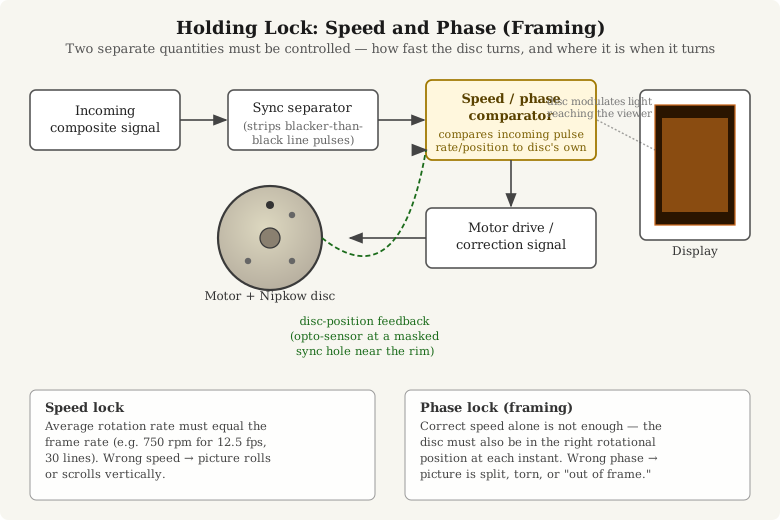
Modern NBTV practice folds both requirements into a single automatic feedback loop, documented in real, buildable circuit form by the NBTVA’s own beginners’ chapter. A reference “automatic speed control circuit” compares the disc’s actual rotational rate and position — sensed optically from a dedicated ring of 32 sync holes near the disc’s rim, one of which is deliberately masked so its missing pulse marks the frame boundary, exactly the physical mechanism Vol 12 describes for generating the standard’s “missing line-sync pulse between line 32 and line 1” — against the frame-timing reference recovered from the incoming video signal by a sync separator stage, and uses any difference to correct the DC motor’s drive automatically. Because this comparison runs continuously and electronically rather than depending on a shared mains grid, it delivers both speed lock and phase lock (framing) together, without a manual phasing knob, at the cost of needing that dedicated sync-hole ring, an opto-sensor, and a working feedback circuit that a mains-synchronous Baird receiver never required. Whichever mechanism is used — a nation’s shared 50 Hz grid plus a manual knob, or a modern opto-electronic feedback loop — the underlying engineering requirement is identical: an aperture at the receiving end has to be in the same place, at the same time, as the corresponding aperture was at the transmitting end, or no amount of correct picture content will display correctly.
13.8 Building a Good Disc: Tolerances and Failure Modes
Pulling the geometry, materials, and drive requirements above together, a well-built disc has to satisfy several tolerances simultaneously, and a real disc’s failure to meet any one of them shows up as a specific, recognisable picture fault rather than a generic “bad picture.” A disc whose holes are not accurately placed at the calculated radial and angular pitch produces a picture with lines that are unevenly spaced or subtly warped, regardless of how well the motor and sync circuitry perform — which is exactly why the NBTVA sells factory-cut, numerically-machined discs rather than expecting hand-drilling to hold the required precision, and why the club’s own documentation treats disc accuracy as the single factor that “will determine picture quality” ahead of every other component in the build. A disc that is not flat, or not properly balanced on its hub, wobbles as it spins; the club’s own reference sync circuit is deliberately designed with an 8 mm sensor gap specifically to tolerate a documented, real amount of this wobble rather than assuming a perfectly true disc, but a disc that wobbles significantly more than that allowance will still show a shaking, unstable image and can confuse an opto-sensor trying to read timing pulses reliably from its rim. An aperture size chosen too large for its radial pitch blurs adjacent lines together, softening vertical detail no amount of downstream signal quality can restore; an aperture chosen too small starves the photocell (at a camera) or the viewer’s eye (at a monitor) of light, trading a theoretical sharpness gain for a genuinely dimmer, noisier picture. A lens-disc with even a few inconsistent or misaligned lenslets shows as a visible flicker or brightness variation tied to disc rotation, appearing and disappearing with the same period as the disc’s spin — a distinctive symptom that generally points straight back to the disc rather than to the electronics. And on the synchronisation side, a picture that rolls or scrolls vertically points to a speed-lock failure — the disc’s average rate does not match the frame rate — while a picture that is split, torn, or otherwise assembled out of order points to a phase-lock (framing) failure — the disc’s rotational position, not its average speed, has drifted or was never correctly set in the first place. Distinguishing these failure modes from each other, rather than treating “the picture looks wrong” as a single undifferentiated problem, is the practical skill that separates a working disc televisor from one that merely spins.
None of this is a substitute for actually building one. This volume has set out why each of these tolerances exists and what breaks when they are not met; the companion Restoration & Building volume of this dive takes the reader from this theory to an actual bill of materials, a build sequence, and the hands-on calibration steps — including how the tolerances described here translate into practical checks with a real disc on a real bench.
13.9 Cross-References
- Paul Nipkow’s original scanning-disc principle, and why his 1884 patent specified no disc geometry at all, is covered in Vol 3 — Nipkow’s Disc (1884).
- The general theory of scanning, frame rate, and flicker that this volume’s geometry serves is set out in Vol 4 — Theory of Operation.
- The historical Baird Televisor’s own hardware — its disc, motor, neon lamp, and manual phasing control, with all of §11’s hedged, approximate physical specifications — is dissected in Vol 6 — Inside the Baird Televisor.
- The modern NBTV signal this volume’s synchronisation section assumes as its input — the blacker-than-black sync pulses, the missing line-32-to-line-1 pulse, and the masked sync hole that produces it physically — is explained in full in Vol 12 — The NBTV Signal Explained.
- The founding of the NBTVA and the club co-founder’s account of why 32 lines were chosen over Baird’s 30 is told in Vol 11 — The Modern Revival: NBTV and the NBTVA.
- Taking this volume’s engineering principles to an actual build — parts, sequence, calibration, and safety — is the subject of Vol 15 — Restoration & Building.
- The Baird 30-line and modern NBTV 32-line standards are tabulated side by side in Vol 16 — Reference and Cheatsheet.
Comments (0)